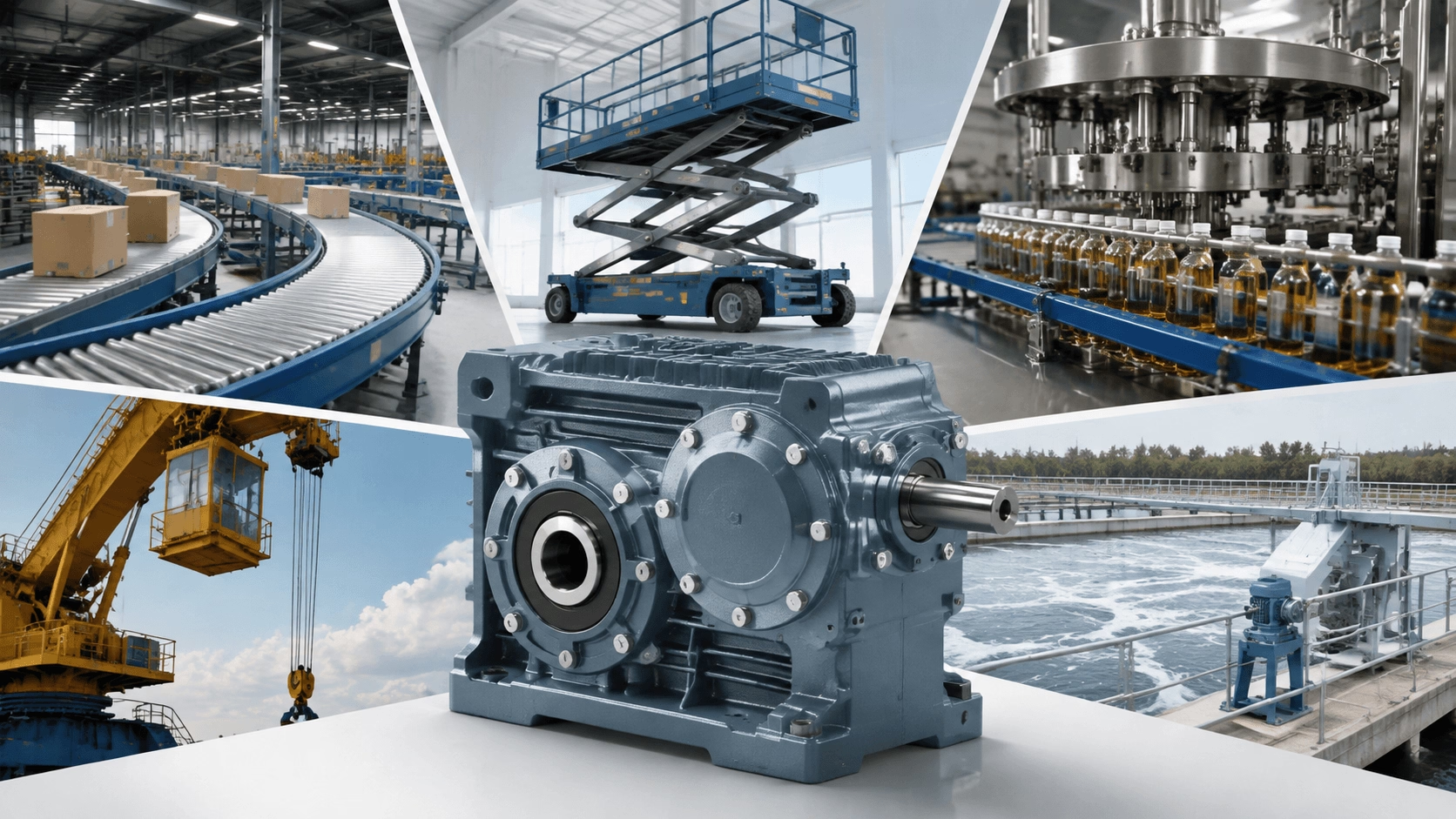
A comprehensive 2026 guide to worm gearbox applications, encompassing working principles, mechanical advantages, key industrial uses, selection criteria, and comparative analysis with alternative power transmission technologies.
1. Introduction
In the contemporary industrial landscape, where operational efficiency, mechanical reliability, spatial compactness, and safety remain paramount, worm gearboxes (also designated as worm gear reducers or worm drives) continue to serve as a foundational power transmission solution. These gearboxes feature a highly specialised kinematic design: a screw-like worm shaft that meshes with a conjugate worm wheel, delivering substantial reduction ratios—often exceeding 60:1 in a single stage—alongside right-angle power transmission.
The sliding contact interface between the worm and the wheel generates inherent self-locking properties (non-backdrivability) in numerous configurations, alongside high torque multiplication, acoustically quiet operation, and a remarkably compact footprint. While they typically exhibit lower mechanical efficiency (ranging from 50% to 90%, contingent upon the ratio, load, and tribological conditions) compared to helical or planetary alternatives, their distinct mechanical strengths render them indispensable across diverse industrial sectors.
System integrators, Original Equipment Manufacturers (OEMs), and plant engineers frequently specify worm gearboxes when applications demand high torque at low rotational speeds, strict spatial constraints, shock load tolerance, or the critical safety requirement to prevent reverse motion under load.
2. Kinematic Principles of Worm Gearboxes
A standard worm gearbox comprises an input worm (a threaded shaft analogous to a power screw) driven by a prime mover, which engages with a larger, perpendicular worm wheel. As the worm rotates, its helical threads exert force against the teeth of the wheel, driving it at a significantly reduced angular velocity while proportionally multiplying torque.
This sliding-contact architecture enables several critical mechanical features:
- High Single-Stage Reduction: Capable of achieving substantial speed reduction ratios, commonly ranging from 5:1 to >100:1, within a single, compact housing.
- Right-Angle Configuration: Facilitates perpendicular shaft layouts, optimising the spatial envelope of the driven machinery.
- Self-Locking Behaviour: The high friction angle inherent in the sliding contact prevents the output wheel from backdriving the input worm, ensuring secure load holding without the necessity for auxiliary braking systems.
Modern iterations incorporate hardened alloy steel worms, precision-machined bronze wheels, advanced synthetic lubricants, and versatile output configurations such as hollow shafts. While mechanical efficiency improves at lower reduction ratios with optimal lubrication, it inherently decreases at high ratios due to elevated sliding friction and thermal dissipation requirements.
3. Mechanical Advantages and Operational Limitations
3.1 Key Advantages
- Compact Footprint & High Torque Density: Delivers substantial torque multiplication within a minimal spatial envelope.
- Acoustic & Kinematic Smoothness: The continuous, sliding engagement yields exceptionally quiet and vibration-free operation.
- Inherent Safety (Self-Locking): Crucial for vertical lifting applications, preventing catastrophic load dropping during power loss.
- Cost-Effectiveness: Highly economical for applications requiring moderate to high reduction ratios.
- Shock Load Resilience: The robust tooth profile and housing design effectively absorb sudden torsional shocks.
3.2 Limitations and Engineering Nuances
- Thermal & Efficiency Constraints: Lower mechanical efficiency translates to higher heat generation, necessitating careful thermal management in continuous, high-duty-cycle applications.
- Lubrication Dependency: Susceptible to accelerated wear if lubrication regimes are compromised or if incorrect fluid viscosities are utilised.
- Backlash Tolerances: Exhibits higher inherent backlash compared to precision planetary or cycloidal alternatives, limiting use in ultra-high-precision servo positioning.
These operational trade-offs position worm gearboxes as the optimal solution for low-to-moderate speed, high-torque applications where ultimate energy efficiency is secondary to compactness, cost, and holding safety.
4. Primary Applications in Modern Industry
4.1 Material Handling and Conveyor Systems
Worm gearboxes extensively power belt, roller, and chain conveyors across manufacturing, logistics, mining, and food processing. The self-locking feature prevents load rollback on inclined planes, while the quiet operation is highly suited for indoor distribution facilities.
4.2 Lifts, Hoists, Elevators, and Cranes
The non-backdrivable kinematics ensure safe, static load holding even in the event of a primary motor failure. They are heavily utilised in scissor lifts, winches, gate operators, and light-to-medium crane hoists.
4.3 Food Processing, Beverage, and Packaging Machinery
Compact, acoustically quiet, and hygienic designs (featuring stainless steel housings and food-grade synthetic lubricants) make them ideal for mixers, volumetric fillers, wrapping machines, and auger feeders.
4.4 Automation, Robotics, and Precision Equipment
Miniature and instrument-grade worm gearboxes are integrated into robotic articulation joints, CNC indexing tables, 3D printing mechanisms, and medical devices where moderate precision and extreme spatial compactness are required.
4.5 Heavy Industry: Mixers, Crushers, Pumps, and Augers
The ability to deliver massive torque at very low output speeds makes worm drives ideal for processing viscous materials and handling severe crushing loads in chemical, pharmaceutical, agricultural, and mining equipment.
4.6 Additional Notable Applications
- Automated perimeter gates, security doors, and traffic barriers.
- Automotive steering and actuation systems.
- Escalator drives and rolling mill adjustments.
- Heavy-duty valve actuators and solar tracking arrays.
5. Comparative Analysis with Alternative Reducers
| Gear Technology | Comparative Analysis vs. Worm Gearboxes |
|---|---|
| Helical / Helical-Bevel | Helical units offer superior mechanical efficiency and higher speed capabilities but are physically larger and more expensive for high reduction ratios. Worm drives prevail in compactness and self-locking safety. |
| Planetary Reducers | Planetary gearboxes provide ultra-high precision, low backlash, and high efficiency. Worm drives offer a vastly more cost-effective solution for applications requiring static torque holding and moderate precision. |
| Cycloidal Drives | Cycloidal reducers excel in extreme shock resistance and zero-backlash precision. Worm gearboxes remain the simpler, more economical choice for standard, high-ratio torque reduction. |
6. Engineering Selection Considerations
To ensure optimal performance and longevity, system integrators must evaluate the following parameters:
- Torque, Speed, and Service Factors: Calculate peak output torque and apply appropriate service factors (often 1.5 to >2.5) to account for shock loads and start-stop frequencies.
- Thermal Limits: Verify that the continuous thermal capacity of the gearbox exceeds the application's heat generation profile to prevent lubricant breakdown.
- Mounting and Integration: Specify exact mounting orientations (e.g., B3, B5, B14) to ensure proper oil bath coverage and seal integrity.
- Lubrication Regimes: Select between lifetime synthetic grease (for sealed, low-maintenance units) or oil-bath lubrication (for high-thermal, heavy-duty applications).
- Environmental Factors: Specify appropriate IP ratings, corrosion-resistant coatings, and hygienic finishes for washdown or extreme temperature environments.
Note: Manufacturers provide sophisticated selection software, thermal dissipation curves, and 3D CAD models to streamline integration. Over-sizing is a common and recommended practice in shock-prone or high-thermal applications.
7. Edge Cases, Nuances, and Industry 4.0 Integration
Specialised edge cases—such as extreme cryogenic temperatures, vacuum/cleanroom environments, or ultra-high cyclic reversal rates—require bespoke material selections and specialised sealing technologies.
Looking toward the future, modern worm units utilising advanced tribological coatings and ultra-low friction synthetic lubricants are progressively narrowing the traditional efficiency gap. Furthermore, within the context of Industry 4.0, worm gearboxes are increasingly integrated with smart servo systems and IoT-enabled condition monitoring sensors (tracking vibration and temperature). Concurrent trends in miniaturisation are expanding their utility in next-generation robotics and automated smart warehousing.
8. Conclusion: A Timeless Yet Evolving Solution
Worm gearboxes remain a versatile, highly reliable cornerstone of modern industrial power transmission. Their unique ability to deliver high torque multiplication, spatial compactness, acoustically quiet performance, and inherent mechanical safety ensures they underpin countless critical processes across global sectors.
By meticulously matching application demands with precise gearbox capabilities, and by collaborating with experienced manufacturing partners for bespoke features, engineering projects achieve robust performance and exceptional long-term value. As industrial automation continues to intensify, worm gearboxes will persistently evolve alongside complementary digital and material technologies.
9. Engineered Power Transmission Solutions with Titecho
Techo Electrical & Mechanical (Taizhou) Co., Ltd. (Brand: Titecho) specialises in the design and manufacture of high-performance worm gearboxes and comprehensive power transmission assemblies. Our product portfolio features precision-machined components, advanced sealing technologies, and highly customisable mounting configurations tailored for material handling, automation, and heavy industrial applications.
We provide extensive engineering support, including thermal modelling, 3D CAD integration, and bespoke modifications to meet the exact spatial and torque requirements of your project.
Explore technical data sheets, performance curves, and application engineering support at www.cntecho.com.
© Techo Electrical & Mechanical (Titecho) – Precision Power Transmission for Advanced Industry