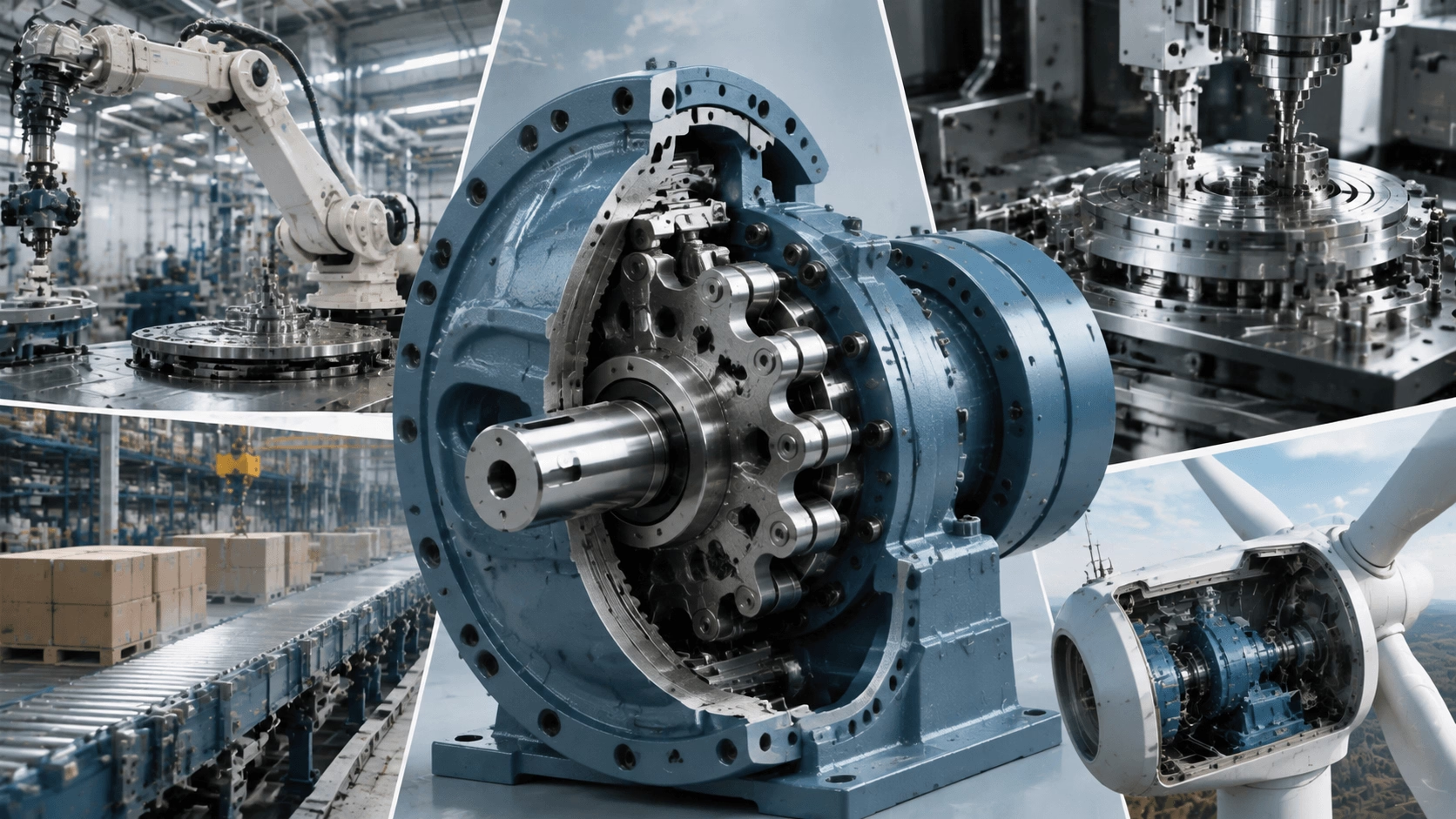
A comprehensive 2026 technical guide for system integrators on specifying cycloidal reducers, encompassing torque calculations, backlash tolerances, load profiling, efficiency metrics, application suitability, and mechanical integration factors.
1. Introduction
In the complex domain of industrial automation, robotics, machine tools, and heavy-duty material handling, system integrators serve as the critical bridge between off-the-shelf components and fully optimised, reliable production systems. A pivotal decision within this engineering process is the selection of the appropriate speed reducer. For applications demanding high torque density, exceptional shock load resistance, near-zero backlash, and long-term operational durability, cycloidal reducers (also designated as cycloidal gearboxes or cyclo drives) frequently emerge as the optimal technical choice.
Unlike traditional planetary or worm gear reducers, cycloidal reducers operate on a unique kinematic principle involving an eccentric cam driving a cycloidal disc that meshes with a stationary ring of pins. This architecture distributes mechanical loads across multiple contact points simultaneously, delivering exceptionally smooth operation, high torsional stiffness, and remarkable resilience under demanding operational conditions. System integrators highly value these mechanisms for precision positioning, repetitive high-cycle tasks, and environments subjected to sudden impacts or highly variable loads.
This guide delineates the professional selection methodology for cycloidal reducers, covering their working principles, key mechanical advantages, critical selection criteria, comparative analysis against alternative technologies, real-world applications, and practical considerations for successful system integration.
2. Understanding Cycloidal Reducers: Core Principles and Design
A standard cycloidal reducer comprises an input shaft equipped with an eccentric bearing, one or more cycloidal discs featuring specific lobe profiles, output pins or rollers, and a fixed housing ring with stationary pins. As the eccentric input rotates, the cycloidal disc rolls inside the stationary pin ring without slipping, generating a high-reduction output motion with minimal backlash.
Key Mechanical Characteristics
- High Reduction Ratios: Capable of achieving substantial reduction ratios in a single stage (commonly 10:1 to 87:1 or higher); multi-stage configurations can reach ratios in the thousands.
- Rolling Contact Kinematics: The predominance of rolling contact over sliding friction contributes to high mechanical efficiency (typically 90–97% for single-stage units) and significantly reduces component wear.
- Multiple Tooth Engagement: Typically, 30–50% of the cycloidal lobes are in simultaneous contact with the housing pins, enabling superior torque transmission capacity and exceptional shock absorption.
This mechanical architecture results in a compact axial footprint, high torsional and tilting stiffness, and the ability to manage substantial overhung loads. Modern variants frequently incorporate hardened alloy steel components, precision-ground profiles, and options for hollow shafts or integrated motor mounting interfaces to facilitate seamless system integration.
3. Why Cycloidal Reducers Excel in Industrial Projects
| Advantage Category | Technical Description |
|---|---|
| Superior Shock Load Capacity | Distributed contact points absorb sudden kinetic impacts far more effectively than conventional planetary gear teeth. |
| Near-Zero Backlash | Essential for CNC machining, robotic articulation, and precision automation requiring exact positional repeatability. |
| High Torque Density & Rigidity | Delivers exceptional power transmission within a compact envelope, maintaining high torsional stiffness under load. |
| Extended Service Life | Rolling friction mechanics drastically reduce wear rates, minimising long-term maintenance requirements. |
| Smooth, Low-Vibration Operation | Ideal for sensitive instrumentation, optical equipment, or high-speed dynamic systems. |
While efficiency typically remains high across a broad load spectrum, it can exhibit slight variations depending on specific torque and speed parameters. Compared to harmonic (strain wave) drives, cycloidal reducers generally provide superior shock resistance and structural durability in heavy-duty industrial settings.
4. Core Selection Criteria: A Systematic Approach
System integrators must employ a rigorous, multi-step methodology to specify the correct cycloidal reducer.
4.1 Define Load Profile and Duty Cycle
Evaluate the application for constant versus variable loading, peak torque requirements, shock factors, and total operating hours. Calculate an appropriate Service Factor (ranging from 1.5 to >3.0 for heavy shock applications). Environments with severe impact loading demand correspondingly higher service factors.
4.2 Calculate Required Torque and Reduction Ratio
The fundamental sizing equation is:
Output Torque = (Motor Torque × Reduction Ratio × Efficiency) × Service Factor
Integrators must verify the calculated output torque against the manufacturer’s published torque-speed curves, thermal dissipation limits, and specific duty cycle ratings to prevent mechanical or thermal failure.
4.3 Precision and Backlash Requirements
For ultra-precise motion control applications, prioritise specifications for low lost motion (arcminutes). Consider the thermal expansion effects on internal clearances and how operational temperature fluctuations might influence positional accuracy.
4.4 Mounting, Integration, and Spatial Constraints
Evaluate the mechanical interface requirements, including output shaft configurations (solid, hollow, flange), motor compatibility (adapter kits, direct integration), and overall envelope dimensions to ensure fitment within the machine design.
4.5 Environmental and Operational Factors
- Thermal Management & Lubrication: Select appropriate grease or oil lubrication based on ambient temperature and operational speed.
- Ingress Protection (IP Rating): Specify adequate sealing (e.g., IP65 or IP67) for washdown, dusty, or outdoor environments.
- Radial and Axial Load Capacity: Verify that the output bearings can withstand the maximum anticipated overhung and thrust loads.
4.6 Lifecycle Cost and Supplier Support
Evaluate the Total Cost of Ownership (TCO), factoring in engineering support availability, 3D CAD model accessibility, comprehensive performance data, and long-term spare parts availability.
5. Comparative Analysis with Alternative Technologies
| Technology | Comparison with Cycloidal Reducers |
|---|---|
| Planetary Reducers | Cycloidal offers superior shock load resistance, higher torque density in compact sizes, and better precision retention over time. |
| Harmonic (Strain Wave) Drives | Cycloidal provides significantly higher torque capacity, better structural rigidity, and enhanced durability in heavy-duty or high-shock environments. |
| Worm / Helical Gears | Cycloidal delivers substantially higher mechanical efficiency, reduced thermal generation, and a more compact, high-performance footprint. |
6. Real-World Applications in Industrial Projects
- Industrial Robotics: Base (J1) and arm (J2/J3) joints requiring high torque and shock absorption.
- CNC Machine Tools: Rotary tables and tool changers demanding zero backlash and high rigidity.
- Automated Conveyors & Packaging: High-cycle indexing and precise material placement.
- Material Handling & Cranes: Hoist drives and heavy-load positioning subject to severe shock loads.
- Food Processing, Printing, & Medical Equipment: Applications requiring smooth, clean, and highly repeatable motion.
Case Example: A robotic palletising cell utilises cycloidal reducers at the base axes to absorb the kinetic impacts of heavy payload deceleration, maintaining sub-millimetre positional accuracy over millions of operational cycles.
7. Practical Implications and Edge Cases
System integrators must navigate specific engineering trade-offs and edge cases:
- High Input Speeds: Exceeding nominal input speeds necessitates rigorous thermal management and potential derating to prevent lubricant degradation.
- Vacuum / Cleanroom Environments: Require specialised outgassing-compliant lubricants and advanced sealing technologies.
- Frequent Reversals: High-cycle reversing applications demand careful verification of fatigue life and backlash stability.
- Prototyping: Testing physical prototypes under simulated worst-case load conditions is highly recommended before finalising fleet-wide procurement.
8. Conclusion: Partnering for Optimal Integration
Selecting a cycloidal reducer is both a complex technical exercise and a strategic procurement decision. By meticulously evaluating load profiles, torque requirements, precision tolerances, mechanical integration factors, and environmental conditions, system integrators can fully leverage the inherent strengths of cycloidal technology to deliver robust, high-performance automated systems.
Collaborating with experienced manufacturers ensures access to deep engineering support, bespoke customisation, and guaranteed long-term reliability. Cycloidal reducers remain an indispensable technological asset for constructing resilient, high-precision industrial machinery.
9. Engineered Solutions for Professional Integration
Techo Electrical & Mechanical (Taizhou) Co., Ltd. (Brand: Titecho) specialises in high-precision power transmission components, including premium cycloidal reducers engineered for demanding system integration. Our product portfolio features advanced metallurgy, precision-ground cycloidal profiles, and robust sealing options tailored for robotics, automation, and heavy industrial applications.
We offer flexible mounting configurations, integrated motor adaptations, and comprehensive technical documentation to accelerate your design process.
Explore technical data sheets, 3D CAD models, and application engineering support at www.cntecho.com.
© Techo Electrical & Mechanical (Titecho) – Precision Power Transmission for Advanced Automation