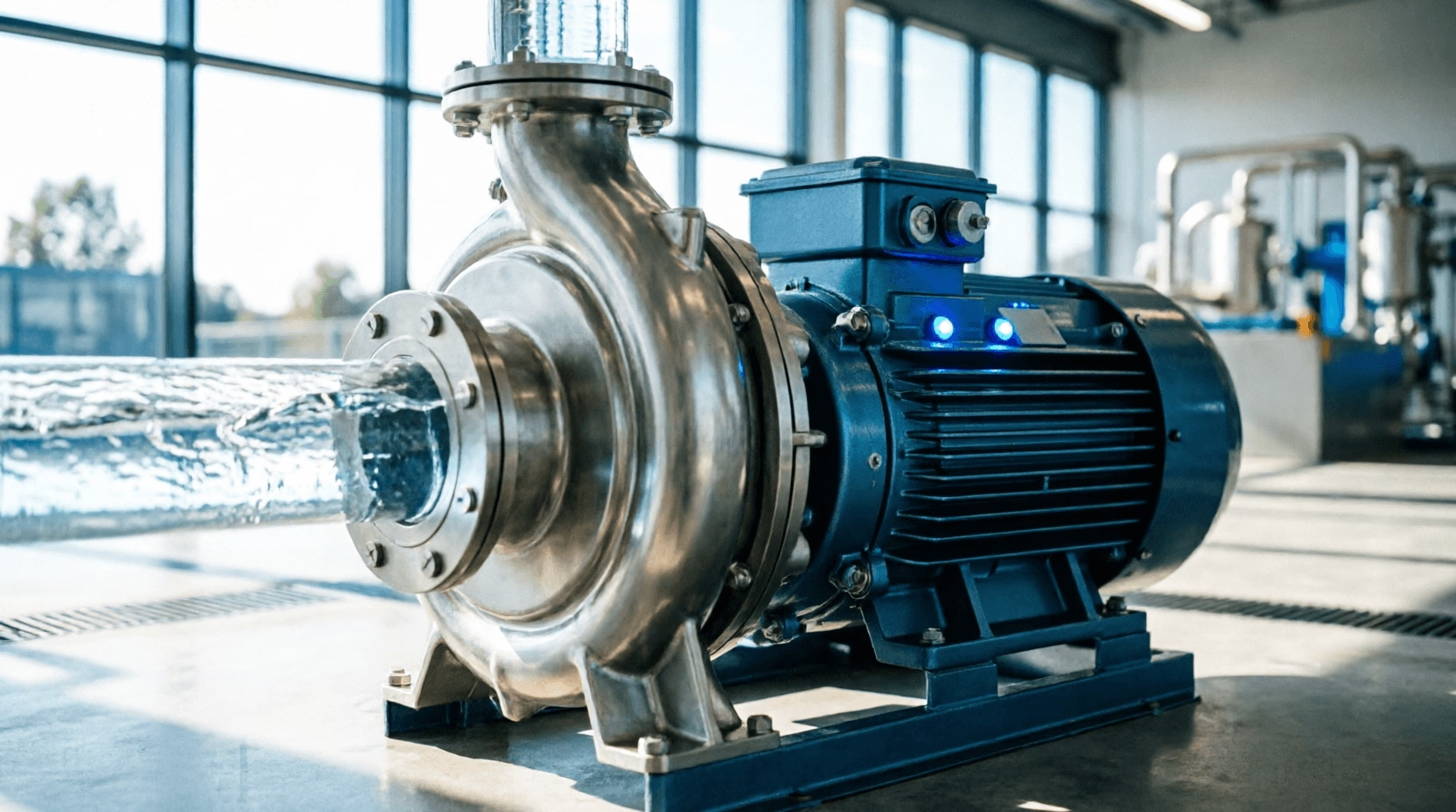
A Comprehensive 2026 Guide to Water Pumps: Engineering Fundamentals, Selection Criteria, and Sustainability Innovations for Agriculture, Industry, and Wastewater Management
Water pumps constitute the circulatory system of modern civilization, serving as indispensable assets across residential, agricultural, industrial, and municipal infrastructure. From the ancient Archimedean screw to contemporary magnetically driven smart pumps, fluid handling technology has undergone a profound evolution. As of 2026, the global water pump market valuation exceeds USD 74 billion, expanding at a Compound Annual Growth Rate (CAGR) of 4.4%. This growth is propelled by accelerating urbanization, the imperative for precision agriculture, stringent wastewater treatment regulations, and the global transition toward energy-efficient hydraulic systems.
This guide provides an in-depth technical analysis of pump classifications, operational physics, critical selection parameters such as Net Positive Suction Head (NPSH), and the emerging efficiency trends defining the 2026 landscape.
1. Fundamental Working Principles and Hydraulic Physics
At their core, pumps are turbomachines that convert mechanical energy—typically derived from alternating current (AC) motors or internal combustion engines—into hydraulic energy. This conversion occurs through two primary physical mechanisms: kinetic transfer and positive displacement.
Centrifugal Pumps (Kinetic Energy Transfer)
Centrifugal pumps operate on the principle of centrifugal force. An impeller rotates within a casing, imparting velocity to the fluid. As the fluid exits the impeller vane tips, it enters a volute or diffuser where kinetic energy is converted into static pressure head according to Bernoulli’s principle.
- Operational Characteristic: Flow rate varies inversely with system head.
- Best Application: High-flow, low-to-medium head scenarios including irrigation, HVAC circulation, and general water transfer.
- Performance Curve: Exhibits a continuous head-capacity curve; power consumption typically rises with flow.
Positive Displacement (PD) Pumps
Unlike centrifugal designs, PD pumps trap a fixed volume of fluid and mechanically force it into the discharge pipe. Common variants include diaphragm, gear, lobe, and piston configurations.
- Operational Characteristic: Flow remains nearly constant regardless of discharge pressure (neglecting slip).
- Best Application: High-pressure, high-viscosity fluids, metering/dosing, and shear-sensitive media.
- Safety Note: PD pumps require relief valves on the discharge side to prevent catastrophic over-pressurization if blocked.
NPSH and Cavitation: The Critical Design Constraint
A paramount consideration in pump engineering is Net Positive Suction Head (NPSH). Cavitation occurs when local static pressure drops below the fluid's vapor pressure, causing vapor bubbles to form and subsequently collapse violently upon reaching higher-pressure zones.
- NPSHa > NPSHr: The available NPSH (NPSHa) must exceed the required NPSH (NPSHr) specified by the manufacturer, ideally with a safety margin of 0.5 to 1.0 meters or more depending on the application.
- Consequences of Failure: Insufficient margin leads to pitting of impeller vanes, bearing failure, excessive vibration, noise, and loss of hydraulic performance.
- Mitigation Strategies: Increasing suction tank level, reducing suction line friction losses, lowering fluid temperature, or selecting low-NPSH impellers.
2. Key Pump Types and Technical Selection Factors
Selecting the appropriate pump architecture requires matching hydraulic requirements with mechanical capabilities and environmental constraints.
Centrifugal Pumps
Dominating the market due to simplicity and cost-effectiveness, these are categorized as follows:
- Single-Stage: One impeller; suitable for low-head duties.
- Multistage: Multiple impellers in series; generates high head for boiler feed, reverse osmosis, and deep-well applications.
- End-Suction vs. Split-Case: End-suction offers compact footprint; horizontal split-case facilitates maintenance without disturbing piping alignment.
Submersible Pumps
These units integrate a hermetically sealed motor directly coupled to the pump stage, operating fully submerged.
- Advantages: Self-priming, eliminated cavitation risk (due to flooded suction), silent operation, and space efficiency.
- Applications: Deep aquifer extraction, sewage lifting stations, mine dewatering, and fountain/aeration systems.
Positive Displacement Pumps
- Peristaltic/Hose Pumps: Fluid contacts only the elastomeric tube; ideal for abrasive slurries and sterile pharmaceutical processing.
- Diaphragm Pumps: Leak-free design capable of running dry; standard for chemical metering and hazardous fluid transfer.
- Progressive Cavity Pumps: Gentle pumping action for polymers, sludge, and food products.
Material Science and Edge Cases
Fluid compatibility dictates metallurgy and elastomer selection:
- Corrosive Media: Requires 316L stainless steel, duplex alloys, or fluoropolymer linings.
- Abrasive Slurries: Demands hardened cast iron, ceramic coatings, or replaceable wear plates.
- High Temperature: Necessitates thermal expansion compensation and specialized mechanical seals or magnetic drive couplings.
Efficiency and Variable Speed Control
Pump efficiency (eta) represents the ratio of hydraulic power output to shaft power input. While premium hydraulic designs achieve efficiencies exceeding 85%, system-level optimization is paramount.
- Variable Speed Drives (VSD/VFD): Matching motor speed to real-time demand via affinity laws reduces energy consumption exponentially. Reducing speed by 20% can decrease power draw by approximately 50% (Power proportional to Speed cubed).
- Motor Standards: Transitioning from IE2 to IE4/IE5 ultra-premium efficiency motors yields significant lifecycle savings.
3. Sector-Specific Applications and Operational Requirements
Agriculture and Precision Irrigation
Modern agriculture demands reliability and water conservation. High-volume centrifugal pumps supply drip and sprinkler networks, while VSD integration allows pressure stabilization despite fluctuating zone demands. Solar-powered pumping solutions are increasingly prevalent in off-grid cultivation, reducing operational expenditure and carbon footprint.
Industrial Manufacturing and Power Generation
Industrial facilities utilize complex pumping networks for:
- Cooling Towers: Large axial or mixed-flow pumps for heat rejection.
- Boiler Feedwater: High-pressure multistage centrifugal pumps with strict NPSH margins.
- Process Transfer: Chemically compatible PD pumps for reagents and solvents.
Reliability is non-negotiable; redundant configurations and predictive maintenance sensors are standard specifications.
Municipal Water and Wastewater Treatment
Municipal infrastructure faces dual challenges of aging assets and regulatory compliance. Submersible and dry-pit sewage pumps handle raw influent containing solids and rags. Advanced aeration blowers and sludge recirculation pumps are critical for biological nutrient removal processes. Smart monitoring enables utilities to optimize energy intensity per cubic meter treated.
High-Pressure Cleaning and Surface Preparation
Specialized triplex plunger pumps, frequently paired with robust Titecho AC motors, deliver pressures ranging from 1500 to over 5000 PSI. These systems are essential for:
- Industrial surface preparation and coating removal.
- Vehicle fleet washing and sanitation.
- Food processing equipment cleaning (CIP systems).
- Hydro-demolition and concrete scarification.
Critical Warning: Poor pump selection results in 20–40% excess energy consumption, accelerated wear, and unplanned downtime. Emerging smart pumps with integrated IoT sensors enable condition-based monitoring, transforming reactive maintenance into proactive asset management.
4. 2026 Innovations and Sustainability Trajectories
The pump industry in 2026 is defined by the convergence of digitalization, decarbonization, and resource recovery.
- Regulatory Compliance: Global adoption of IE4 and IE5 motor standards mandates higher baseline efficiencies. Extended Product Approach (EPA) regulations evaluate entire pumping systems rather than individual components.
- Digital Twins and AI: Machine learning algorithms analyze vibration, temperature, and power signatures to predict failures weeks in advance and auto-optimize setpoints for minimum specific energy consumption.
- Solar-Hybrid Systems: Integrated photovoltaic pumping solutions with battery buffering reduce grid dependency and operational costs in remote installations.
- Desalination and Water Reuse: Growing scarcity drives demand for corrosion-resistant, high-recovery reverse osmosis pumps and energy recovery devices (ERDs) that reclaim hydraulic energy from brine streams.
- Circular Economy: Manufacturers are designing for disassembly, utilizing recycled materials, and offering remanufacturing services to extend asset lifecycles and reduce embodied carbon.
5. TECHO / TITECHO: Integrated Pump and Motor Solutions
Techo Electrical & Mechanical (Taizhou) Co., Ltd., operating under the trade name Titecho, delivers engineered fluid handling solutions characterized by vertical integration and performance validation. Unlike assemblers, Titecho manufactures both the hydraulic end and the driving motor, ensuring optimal impedance matching and system reliability.
Core Competencies
- Integrated High-Efficiency Systems: Purpose-built motor-pump combinations optimized for irrigation, industrial process, and municipal duties, minimizing transmission losses and maximizing wire-to-water efficiency.
- Proven Durability: Designs validated through extensive field testing in diverse climatic and operational conditions, emphasizing low acoustic emission, extended bearing life, and reduced total cost of ownership.
- High-Pressure Excellence: Specialized triplex pumps paired with Titecho AC motors for demanding cleaning and industrial applications, delivering consistent pressure and flow stability.
- Global OEM Partnership: Comprehensive support for original equipment manufacturers including customization, private labeling, regional certification assistance, and tailored performance specifications.
For detailed product catalogs, technical datasheets, and partnership inquiries, please visit www.cntecho.com.
6. Summary: Balancing Performance, Reliability, and Environmental Stewardship
Water pumps represent a mature yet rapidly evolving engineering discipline where performance, reliability, and sustainability must be balanced simultaneously. The optimal solution in 2026 transcends simple component specification; it encompasses system-level thinking, intelligent control integration, and lifecycle cost analysis.
By mastering fundamental principles such as NPSH and affinity laws, understanding the distinct characteristics of centrifugal versus positive displacement architectures, and embracing emerging technologies like VSDs and IoT-enabled monitoring, engineers and operators can achieve dramatic reductions in energy consumption and maintenance expenditure. In an era of water scarcity and energy transition, informed pump selection is not merely a technical decision—it is a strategic imperative for resilient and responsible infrastructure.