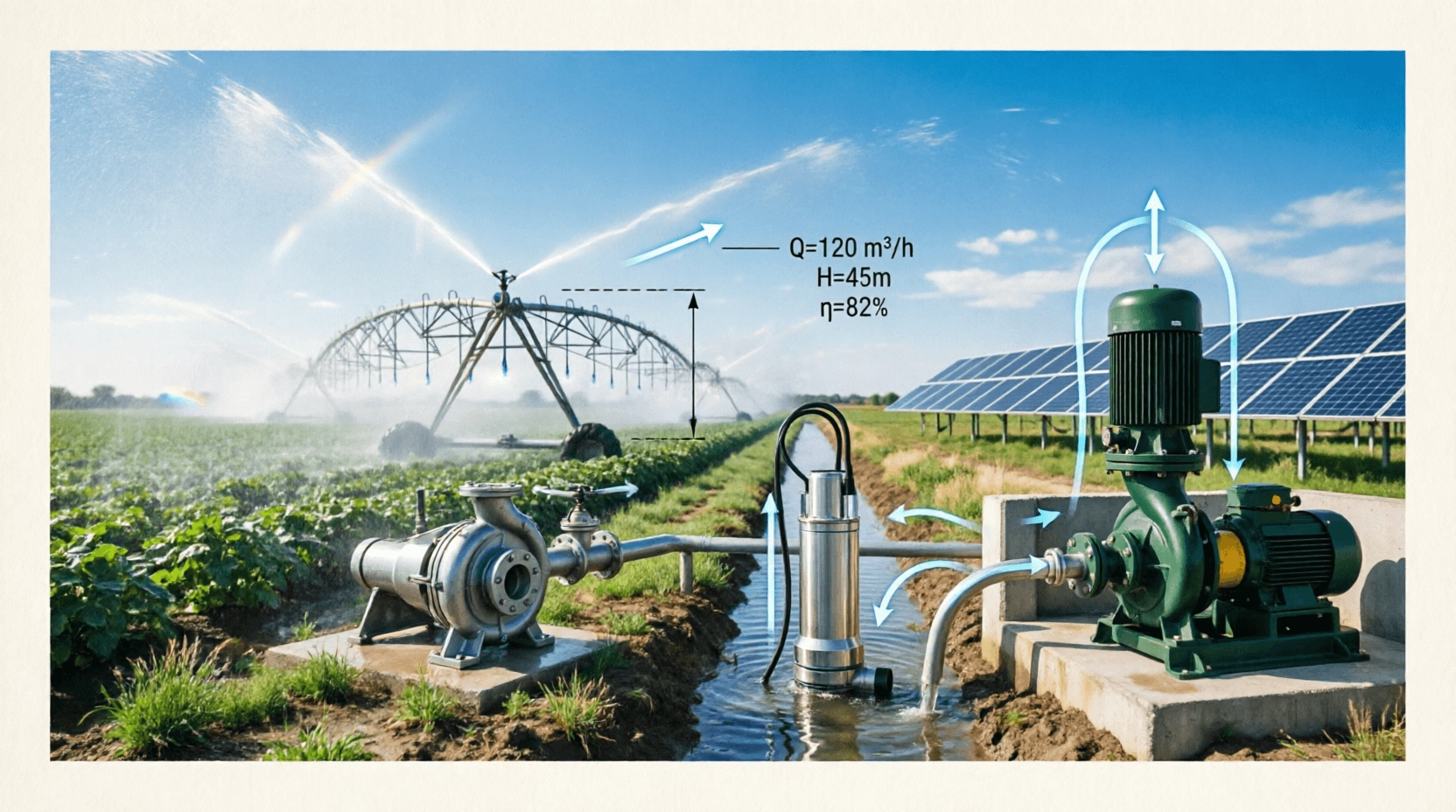
A comprehensive exploration of Variable Frequency Drive (VFD) advantages for pumps, fans, and conveyors—covering energy reduction, soft starting, advanced diagnostics, and enhanced process control. Technical insights from Techo Electrical & Mechanical.
1. Why VFDs Matter in Modern Industry
Variable Frequency Drives (VFDs) represent a cornerstone technology for contemporary motor control systems. By dynamically modulating motor speed and torque to match real-time process demand, VFDs deliver three critical outcomes: significant energy consumption reduction, improved process stability, and extended equipment service life.
2. The Physics of Energy Savings
Affinity Laws and Centrifugal Loads
For centrifugal loads such as pumps and fans, power consumption is governed by the affinity laws, where power scales approximately with the cube of speed:
P₂ / P₁ ≈ (N₂ / N₁)³
This relationship means that reducing motor speed by just 20% can decrease energy consumption by nearly 50%. VFDs enable precise speed modulation, eliminating the inherent inefficiencies of mechanical throttling valves, dampers, and frequent on/off cycling.
3. Operational Advantages Beyond Energy
| Benefit Category | Description |
|---|---|
| Soft Start & Stop | Eliminates high inrush current; reduces mechanical stress on couplings, belts, and driven equipment during acceleration and deceleration. |
| Precise Process Control | Maintains flow, pressure, temperature, or speed within tighter tolerances through closed-loop feedback. |
| Reduced Mechanical Wear | Smooth, controlled acceleration profiles lower shock loads, extending bearing and seal life. |
| Advanced Diagnostics | Provides fault logging, thermal protection, motor overload monitoring, and predictive maintenance alerts. |
4. Applications That Benefit Most
- Pumps and Fans: Deliver the largest absolute energy savings in variable-flow and variable-pressure systems.
- Conveyors & Material Handling: Speed synchronisation improves throughput consistency and reduces product damage from abrupt starts/stops.
- Compressors & Chillers: Optimise capacity modulation to match load, significantly reducing cycling losses and improving part-load efficiency.
- HVAC Systems: Enhance occupant comfort through stable temperature and humidity control while reducing overall building energy expenditure.
5. Integration and Compatibility Considerations
Successful VFD deployment requires careful attention to electrical and mechanical integration:
- Harmonic Mitigation: Install line reactors, passive filters, or active front-end drives where harmonic distortion exceeds utility or IEEE 519 limits.
- Cooling & Ventilation: Mount drives in adequately ventilated enclosures; derate capacity if ambient temperatures exceed manufacturer specifications.
- EMC Compliance: Ensure proper grounding, use shielded motor cables, and maintain separation between power and signal conductors to prevent electromagnetic interference.
- Motor Compatibility: Verify motor insulation class is suitable for PWM voltage waveforms; install insulated bearings or shaft grounding rings to prevent bearing damage from induced currents.
6. Advanced Control Strategies
Maximise VFD value through sophisticated control architectures:
- Implement PID control loops for closed-loop regulation of process variables.
- Configure flow/pressure cascade controls for multi-variable optimisation.
- Utilise setpoint scheduling to adapt drive behaviour across different operating modes.
- For multi-pump systems, deploy master-slave control or pump staging logic to maintain optimal efficiency across the entire load range.
7. Building the Economic Case
A robust ROI analysis should incorporate:
- Measured duty cycles and projected speed reductions to quantify energy savings.
- Reduced maintenance costs attributable to soft starting and decreased mechanical wear.
- Extended equipment lifespan deferring capital replacement expenditures.
- Available utility rebates and tax incentives for VFD installations.
Most well-engineered VFD retrofit projects achieve payback within 1–3 years, with many high-duty-cycle applications recovering investment in under 18 months.
8. Unlock Energy Savings with Techo
Techo Electrical & Mechanical provides end-to-end VFD solutions including:
- Application-specific drive selection and sizing
- System integration and control programming
- Commissioning and performance validation
- Harmonic mitigation design and implementation
- Post-installation training and support
Contact us at www.cntecho.com to evaluate a VFD retrofit for your application or schedule a complimentary energy assessment.
© Techo Electrical & Mechanical – Intelligent Motor Control for Sustainable Industry