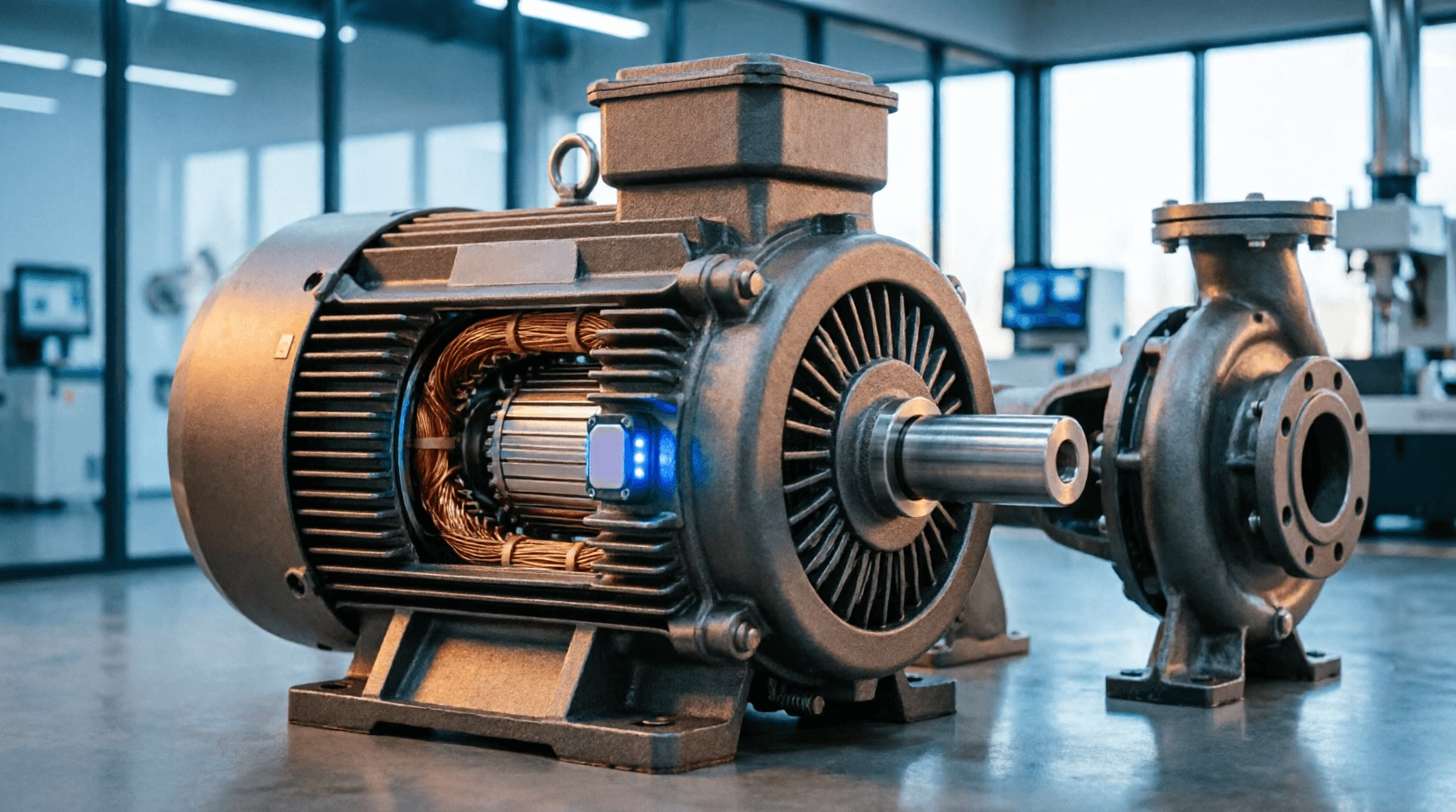
A Comprehensive 2026 Guide to Asynchronous Motor Technology: Electromagnetic Fundamentals, IE Efficiency Classes, VFD Integration, and Industrial Applications for Pumps, High-Pressure Washers, and HVAC Systems
Three-phase AC induction motors, technically designated as asynchronous motors, serve as the foundational prime movers of global industrial infrastructure. Since their independent invention by Nikola Tesla and Galileo Ferraris in the late 19th century, these machines have achieved ubiquity through an elegant combination of electromagnetic simplicity and mechanical robustness. Unlike synchronous or DC machines, induction motors transfer energy from stator to rotor entirely through electromagnetic induction, eliminating brushes, commutators, and direct electrical contact.
In 2026, three-phase induction motors remain the dominant technology across manufacturing, agriculture, water management, and building services. Driven by stringent energy regulations, digitalization, and electrification mandates, the sector is undergoing a significant transformation toward super-premium efficiency and intelligent integration. This guide details the operational physics, classification standards, application-specific selection criteria, and emerging trends defining the modern induction motor landscape.
1. Electromagnetic Operating Principles and Performance Characteristics
The operation of an AC induction motor is governed by Faraday’s Law of Electromagnetic Induction and Lorentz Force principles. Understanding these fundamentals is essential for proper specification and troubleshooting.
Rotating Magnetic Field and Synchronous Speed
When balanced three-phase alternating current flows through spatially displaced stator windings, it generates a rotating magnetic field (RMF). The speed of this field, known as synchronous speed, is strictly determined by supply frequency and motor pole configuration:
Ns = 120 × f / P
Where:
- Ns = Synchronous speed in revolutions per minute (RPM)
- f = Supply frequency in Hertz (Hz)
- P = Number of magnetic poles
For example, a 4-pole motor operating on a 60 Hz supply has a synchronous speed of 1800 RPM; on 50 Hz, it is 1500 RPM.
Slip and Torque Production
The rotor cannot rotate at synchronous speed; if it did, no relative motion would exist between the RMF and rotor conductors, inducing zero electromotive force (EMF) and producing zero torque. The necessary speed differential is termed slip:
s = (Ns - Nr) / Ns
Where Nr is actual rotor speed. Under rated load, slip typically ranges from 2% to 5% for standard designs. This slip induces rotor currents, which interact with the stator flux to produce electromagnetic torque proportional to the product of flux density, rotor current, and power factor.
Three-Phase Superiority Over Single-Phase
While single-phase induction motors require auxiliary starting mechanisms (capacitor-start, split-phase), three-phase motors are inherently self-starting due to the naturally rotating field. Key advantages include:
- Smoother Torque: Constant instantaneous power delivery eliminates pulsating torque inherent in single-phase designs.
- Higher Efficiency: Premium three-phase models achieve efficiencies exceeding 95%, significantly outperforming equivalent single-phase units.
- Superior Power Density: Greater output per unit volume and weight.
- Balanced Loading: Symmetrical phase currents reduce neutral conductor requirements and harmonic distortion.
NEMA Design Classifications
Torque-speed characteristics are standardized under NEMA MG-1:
- Design B: General-purpose; normal starting torque, low starting current; suitable for pumps, fans, and conveyors.
- Design A: Higher starting torque and breakdown torque than Design B; optimized for high-inertia fan and pump starts.
- Design C: High starting torque with moderate starting current; intended for compressors, crushers, and loaded conveyors.
- Design D: Very high starting torque with high slip; used for punch presses, hoists, and oil-well pumping where peak loads are severe.
Variable Frequency Drive (VFD) Compatibility Considerations
VFDs enable precise speed control and energy savings but introduce electrical stresses requiring mitigation:
- Voltage Reflection: Fast-switching IGBTs create dv/dt transients that can degrade insulation; inverter-duty motors feature enhanced dielectric systems.
- Bearing Currents: Common-mode voltages induce shaft currents causing fluting and premature failure; insulated bearings or shaft grounding rings are recommended.
- Cooling at Low Speed: Self-cooled motors may overheat below base speed; independent forced ventilation or derating is required for continuous low-frequency operation.
2. Motor Types, Efficiency Standards, and Selection Criteria
Squirrel-Cage Rotor Motors
Representing over 90% of industrial installations, squirrel-cage motors feature rotor bars short-circuited by end rings, forming a structure resembling a hamster wheel.
- Advantages: Extreme ruggedness, minimal maintenance, low cost, high reliability.
- Applications: Continuous-duty pumps, compressors, conveyors, fans, and general machinery.
- Variants: Standard aluminum rotors for cost optimization; copper rotors for premium efficiency applications.
Wound-Rotor (Slip-Ring) Motors
These motors feature insulated rotor windings connected to external circuits via slip rings and brushes.
- Functionality: External resistance insertion enables adjustable starting torque and limited speed control.
- Applications: Cranes, hoists, large ball mills, and high-inertia starts where soft starting is critical.
- Limitations: Higher maintenance (brush wear), lower efficiency, greater complexity. Largely superseded by VFD-controlled squirrel-cage motors except in specialized heavy-duty scenarios.
International Efficiency (IE) Classification System
The IEC 60034-30-1 standard defines global efficiency benchmarks. Regulatory frameworks in the EU, US, China, and other jurisdictions increasingly mandate minimum levels:
| Class | Designation | Description | 2026 Status |
|---|---|---|---|
| IE1 | Standard Efficiency | Baseline legacy design | Phased out in most markets |
| IE2 | High Efficiency | Former regulatory minimum | Being retired for new installations |
| IE3 | Premium Efficiency | Current mainstream standard | Minimum requirement in many regions |
| IE4 | Super-Premium Efficiency | Advanced materials/design | Increasingly mandated; 20–40% loss reduction vs. IE2 |
| IE5 | Ultra-Premium Efficiency | Emerging frontier; often EC/synRM hybrid | Voluntary adoption; future regulatory target |
Economic Impact: Upgrading a continuously operated 10 kW motor from IE1 to IE4 can yield electricity savings exceeding USD 3,000–5,000 over a 15–20 year lifespan, with payback periods frequently under two years. Total Cost of Ownership (TCO) analysis consistently favors premium-efficiency selections despite higher initial capital expenditure.
Critical Selection Parameters
Beyond efficiency class, proper specification requires evaluation of:
- Enclosure Protection (IP Rating): IP55 minimum for dusty/wet environments; IP65/IP66 for washdown or outdoor exposure; TEFC (Totally Enclosed Fan Cooled) as industrial baseline.
- Insulation Class: Class F (155°C) or Class H (180°C) for elevated ambient temperatures or VFD service; temperature rise margin directly correlates with winding longevity.
- Duty Cycle: S1 (continuous) vs. S2–S8 intermittent/variable duties; thermal capacity must match operational profile.
- Starting Requirements: High-inertia loads may necessitate Design C/D motors, reduced-voltage starters, or VFD soft-start capability.
- Ambient Conditions: Altitude derating above 1000m; special lubrication for extreme cold; tropicalized protection for high-humidity marine/coastal sites.
3. Industrial Applications and Sector-Specific Requirements
Water Pumps and Fluid Handling
Induction motors are the universal drive for centrifugal, axial, and positive displacement pumps across all sectors:
- Irrigation: Large-horsepower vertical turbine and horizontal split-case pumps demand high-efficiency motors with reliable starting under variable water table conditions.
- Wastewater Treatment: Submersible and dry-installed sewage pumps require IP68 sealing, moisture-resistant insulation, and compatibility with level-based VFD control strategies.
- Industrial Process: Boiler feed, cooling tower circulation, and chemical transfer pumps benefit from precision speed matching via VFDs, reducing throttling losses and extending seal life.
High-Pressure Cleaning Systems
Triplex plunger pumps in pressure washers impose unique demands:
- Pressure Range: 100–500 bar (1500–7500 PSI) for automotive, food processing, construction, and industrial degreasing.
- Motor Requirements: High starting torque (Design C preferred), robust bearings for radial loads, IP55+ enclosure for wet environments, and thermal protection against stall conditions.
- Titecho Optimization: Purpose-matched motor-pump assemblies ensure impedance alignment, minimizing overheating and maximizing wire-to-water efficiency.
HVAC and Building Services
Heating, ventilation, and air conditioning represent approximately 40% of commercial building energy consumption:
- Fan and Pump Drives: VFD-integrated IE4 motors deliver 30–50% energy savings versus fixed-speed dampened systems.
- Compressors: Scroll, screw, and centrifugal chillers utilize high-efficiency induction motors with optimized part-load performance profiles.
- Noise Sensitivity: Low-vibration designs and acoustic enclosures are specified for occupied spaces.
Specialized Environment Edge Cases
- Hazardous Areas: ATEX/IECEx-certified explosion-proof motors for petrochemical, mining, and grain handling facilities.
- Extreme Temperatures: Arctic-grade lubricants and heaters for sub-zero mining; enhanced cooling and Class H insulation for desert desalination plants.
- Marine and Offshore: Salt-fog resistant coatings, stainless steel hardware, and classification society approvals (ABS, DNV, Lloyd’s).
4. 2026 Technology Trends and Market Trajectories
The global electric motor market is projected to exceed USD 163 billion by 2034, with three-phase induction motors maintaining leadership through continuous innovation rather than displacement.
Regulatory Acceleration Toward IE4/IE5
Updated DOE, EU Ecodesign, and Chinese GB standards are systematically retiring IE1 and IE2 classifications. Retrofit programs and incentive schemes are accelerating replacement cycles, making super-premium efficiency the new economic and regulatory baseline.
Smart Motor Integration and Predictive Maintenance
Embedded IoT sensors monitoring vibration, temperature, current signature, and insulation resistance enable condition-based asset management:
- Downtime Reduction: Predictive alerts reduce unplanned failures by 30–50%.
- Energy Optimization: Real-time load profiling identifies inefficiencies and right-sizing opportunities.
- Digital Twin Integration: Motor telemetry feeds system-level simulation models for holistic optimization.
Advanced Materials and Manufacturing
- Copper Rotor Technology: Die-cast copper rotors reduce I²R losses by 15–20% versus aluminum, enabling IE4/IE5 performance within standard frame sizes.
- Optimized Winding Topologies: Hairpin windings, fractional-slot concentrated windings, and automated insertion improve slot fill factors and reduce copper losses.
- High-Grade Electrical Steel: Thinner laminations with improved permeability reduce core hysteresis and eddy current losses.
Electrification and System-Level Thinking
Motor selection is shifting from component-centric to system-centric paradigms. Extended Product Approach (EPA) methodologies evaluate combined motor-drive-pump efficiency rather than isolated nameplate ratings. Electrification of previously diesel-driven mobile equipment creates new demand for compact, high-torque-density induction motors with integrated power electronics.
5. TECHO / TITECHO: Engineered 3-Phase Motors for Demanding Applications
Techo Electrical & Mechanical (Taizhou) Co., Ltd., operating under the Titecho brand, specializes in vertically integrated three-phase AC induction motor solutions purpose-engineered for fluid handling and high-pressure cleaning applications. Our manufacturing approach ensures optimal electromagnetic and mechanical synergy between motor and driven equipment.
Technical Differentiators
- Regulatory Compliance: Full IE3 and IE4 compliant product lines meeting current and anticipated global efficiency mandates, delivering measurable lifecycle cost reductions.
- Application-Specific Optimization: Motor-pump impedance matching for irrigation, wastewater, industrial washing, and building services, maximizing system-level wire-to-water efficiency.
- Robust Construction: Enhanced bearing systems, VFD-compatible insulation, and precision balancing ensure low vibration, extended service intervals, and reliable operation in harsh environments.
- Global OEM Partnership: Comprehensive support including custom specifications, private labeling, regional certification assistance (CE, UL, CCC, etc.), and tailored performance validation.
For complete technical documentation, performance curves, and partnership inquiries, please visit www.cntecho.com.
6. Summary: Mature Technology with Evolving Strategic Value
Three-phase AC induction motors exemplify engineering maturity coupled with continuous relevance. Their dominance persists not through stagnation but through disciplined evolution—integrating advanced materials, digital intelligence, and regulatory responsiveness while preserving the fundamental attributes of simplicity, durability, and cost-effectiveness that have defined the technology for over a century.
In 2026, informed procurement transcends basic nameplate specification. It requires understanding electromagnetic principles, navigating evolving efficiency standards, evaluating system-level interactions, and anticipating operational environments. Organizations that master these dimensions secure competitive advantages through reduced energy expenditure, minimized downtime, regulatory compliance, and enhanced sustainability credentials. In an increasingly electrified and resource-constrained world, the induction motor remains not merely a component, but a strategic enabler of resilient and responsible industrial operations.