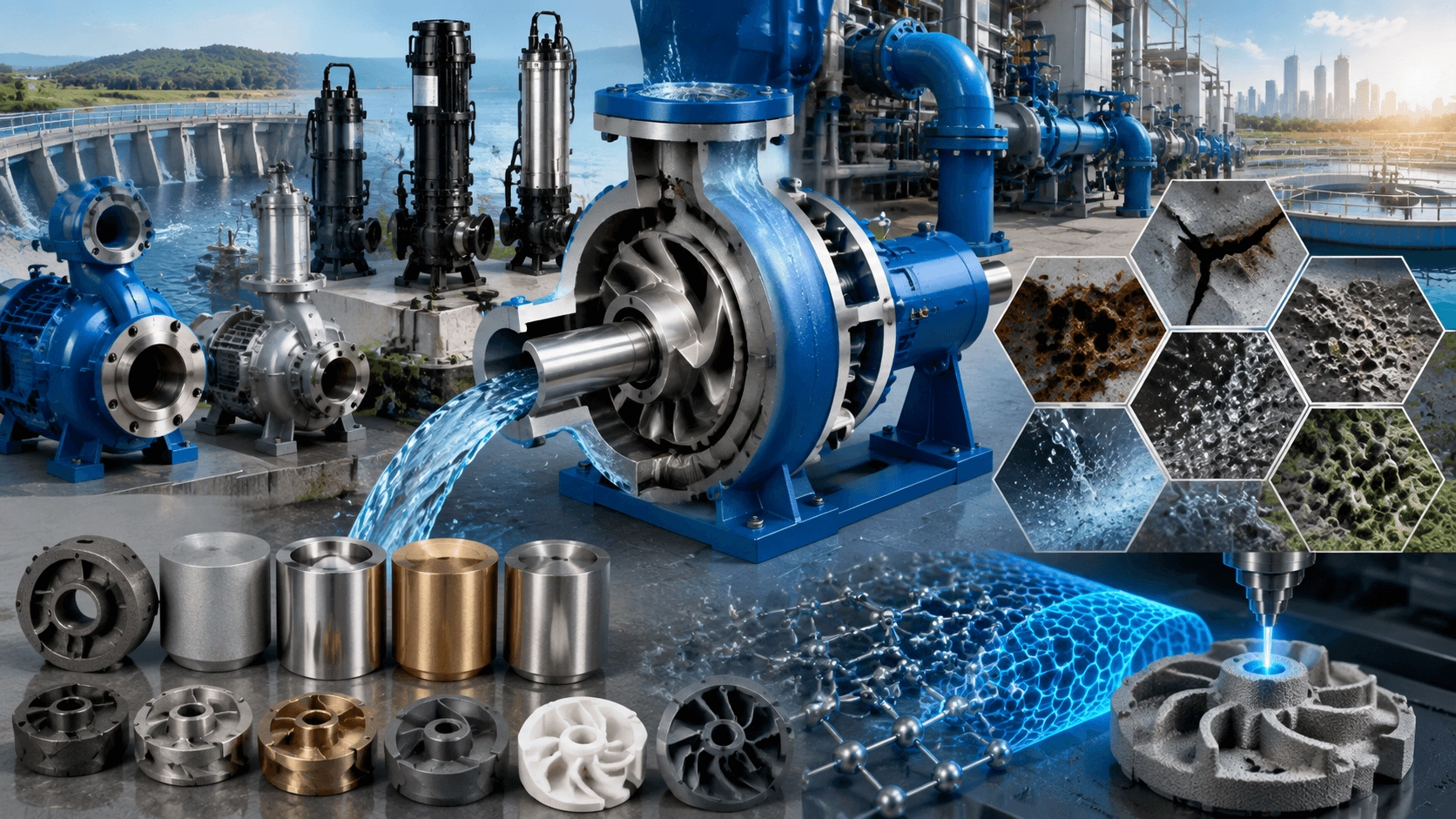
Water Pump Materials Guide 2026: Best Alloys, Corrosion Resistance & Selection
2026 Water Pump Materials Science Guide: A comprehensive engineering analysis of pump metallurgy—from cast iron and stainless steels to super-duplex, ceramics, titanium, and 2026 innovations like graphene coatings and additive manufacturing. Covers failure modes (corrosion/erosion/cavitation), quantitative selection criteria, international standards, and energy-efficient material choices for sustainable infrastructure.
Introduction: The Invisible Foundation of Fluid Movement
Water pumps are among the most critical machines in human society, silently powering irrigation, municipal water supply, industrial processes, wastewater treatment, mining operations, and desalination plants. These devices move vast volumes of fluid every second, yet their performance, longevity, and environmental footprint depend overwhelmingly on the materials from which they are constructed.
Improper material selection is a primary driver of premature failure through corrosion, erosion, or cavitation. This leads to increased energy consumption, exorbitant maintenance costs, and unplanned downtime. According to recent engineering analyses, pumping systems account for approximately 10–25% of global industrial electricity use, with poorly optimized or material-limited pumps wasting up to 30–40% of that energy due to hydraulic inefficiencies caused by surface degradation and internal leakage.
Understanding pump materials science is therefore essential—not only for engineers and operators but for anyone interested in sustainable infrastructure, resource efficiency, and technological progress. This guide offers a comprehensive, non-commercial exploration of the field, tracing its history, explaining core material families, detailing selection criteria, examining failure mechanisms, reviewing international standards, and highlighting frontier developments as of 2026.
Historical Evolution of Water Pump Materials
The quest for better pump materials began with the earliest attempts to lift water. Around 4000–2500 BC, Mesopotamian and Egyptian engineers relied on organic materials—wood, leather, and clay—for shadufs and basic bucket systems. These suffered from rapid biodegradation and limited mechanical strength.
Material Evolution Timeline
| Era | Key Development | Material Significance |
|---|---|---|
| 200 BC | Hellenistic Period | Archimedes screw pump (bronze/wood); Ctesibius force pump (bronze cylinders, leather valves). |
| 1475–1687 | Renaissance to Early Modern | Martini's centrifugal sketches; Papin's 1687 pump utilizing cast iron & brass components. |
| 1849 | First All-Metal Pump | Goulds' grey cast iron unit—marked the shift to durable ferrous alloys for industrial scale. |
| 1912–1939 | Specialized Alloys | Duriron (high-silicon cast iron) for acid service; Alloy 20 (Ni-Cr-Mo) commercialized. |
| 1970s–1990s | Advanced Stainless & Ceramics | Duplex/super-duplex (2205, 2507); high-chromium white irons; ceramic composites emerge. |
| 2026 | Computational Materials | Titanium, Hastelloy, and silicon carbide deployed at scale via advanced manufacturing and AI-driven design. |
The 20th century witnessed explosive progress. Austenitic stainless steels, especially 316L, proliferated after World War II. Duplex and super-duplex grades arrived in the 1970s–1980s, offering superior strength and corrosion resistance. Today, computational modeling and advanced manufacturing allow materials once considered exotic to be deployed cost-effectively.
Common Material Failure Mechanisms in Water Pumps
Material performance is best understood through the failures it must resist. Engineers categorize these into four primary modes:
🔴 Corrosion
- Pitting: Localized attack in chloride-rich environments, creating deep pits that penetrate walls.
- Crevice Corrosion: Occurs under seals, gaskets, or deposits where oxygen depletion creates an aggressive local environment.
- Galvanic Corrosion: Accelerated attack when dissimilar metals are in electrical contact within an electrolyte.
- Stress Corrosion Cracking (SCC): Catastrophic brittle failure caused by the combined effect of tensile stress and a corrosive environment (common in austenitic stainless steels with chlorides).
🟠 Erosion
High-velocity fluids containing abrasive particles (sand, silt) mechanically remove protective oxide layers and base metal. Slurry pumps in mining applications often lose 1–5 mm of wall thickness per year in severe service conditions.
🔵 Cavitation
When local pressure drops below the vapor pressure of the liquid, vapor bubbles form and then collapse violently as they move to higher-pressure regions (typically at the impeller inlet). This creates micro-jets that erode hardened steels at rates up to 0.5 mm/year, causing characteristic "sponge-like" damage.
🟣 Fatigue & Microbiologically Influenced Corrosion (MIC)
- Fatigue: Cyclic loading causes crack initiation at welds or stress concentrators.
- MIC: Sulfate-reducing bacteria produce hydrogen sulfide, accelerating pitting and under-deposit corrosion in stagnant or low-flow zones.
💡 Mitigation Strategy: Proper alloy selection based on fluid chemistry, surface treatments (hardening/coatings), and hydraulic design optimization to minimize turbulence and low-pressure zones.
Major Material Categories and Performance Comparison
Pump materials are grouped into metals, non-metals, and composites. Selection balances corrosion resistance, mechanical strength, wear performance, cost, and machinability.
1. Cast Irons and Ductile Irons
- Grey Cast Iron (2.5–4% C, 1–3% Si): Offers excellent castability and vibration damping. Ideal for clean-water, low-pressure applications.
- Ductile Iron: Nodularized with magnesium for higher toughness and impact resistance.
- Limitations: Poor corrosion resistance above pH 6–8; susceptible to graphitic corrosion in soft waters.
2. Bronzes and Copper Alloys
- Aluminum Bronze (9–14% Al) & Nickel-Aluminum Bronze: Excel in seawater due to stable protective oxide films and superior cavitation resistance.
- Typical Hardness: 150–200 HB.
- Applications: Impellers, wear rings, and bushings in marine and brackish water services.
3. Stainless Steels
Stainless steels are defined by their Chromium content (>10.5%) and specific alloying elements.
| Grade | Composition | Key Characteristics | PREN Value* |
|---|---|---|---|
| Austenitic 316L | 16–18% Cr, 10–14% Ni, 2–3% Mo | Good general corrosion resistance; susceptible to pitting in high chlorides. | ~24–26 |
| Duplex 2205 | 22% Cr, 5% Ni, 3% Mo, 0.14–0.20% N | 2× yield strength of 316L; superior SCC resistance. | ~34–36 |
| Super-Duplex 2507 | 25% Cr, 7% Ni, 4% Mo, 0.24–0.32% N | Exceptional in seawater; high strength and wear resistance. | >40 |
*PREN (Pitting Resistance Equivalent Number) = %Cr + 3.3 × (%Mo + 0.5 × %W) + 16 × %N. A PREN >40 is generally required for reliable seawater service.
4. High-Alloy and Nickel-Base Materials
- High-Chromium White Iron (25–30% Cr): Hardness >600 HB. Used for mining slurry and Flue Gas Desulfurization (FGD) applications due to extreme abrasion resistance.
- Hastelloy C-276 (Ni-Mo-Cr): Resists pH extremes and oxidizing acids up to 450°C.
- Titanium (Grade 2/5): Density of 4.5 g/cm³. Outstanding seawater and chloride resistance; immune to SCC.
5. Non-Metallic and Composite Materials
- Engineering Plastics: Polypropylene (PP), PVDF, and PTFE offer full chemical resistance up to 120–150°C. Lightweight and ideal for aggressive chemical dosing.
- Silicon Carbide (SiC) Composites: Vickers hardness >2,500. Erosion rate is 1/10th that of duplex stainless steel. Operates across pH 0–14.
- Fiber-Reinforced Composites: Superior strength-to-weight ratio, increasingly used for portable and chemical pumps (2025–2026 trend).
6. Surface Engineering
Thermal spray (HVOF), ceramic coatings, rubber linings, and epoxy composites extend base-material life by 30–100% while improving hydraulic efficiency through smoother surface finishes that reduce friction losses.
Material Selection Principles and Quantitative Evaluation
Engineers follow a systematic, data-driven process to select the optimal material:
- Characterize the Fluid: Determine pH, temperature, chloride/sulfate concentration, solids loading (size, hardness, concentration), velocity, and dissolved gases (O₂, CO₂, H₂S).
- Calculate PREN and Consult Iso-Corrosion Diagrams: Use standardized charts to predict corrosion rates for specific alloys in the given chemical environment.
- Perform Wear Modeling: Utilize ASTM G65 (abrasion) or G76 (erosion) data to estimate material loss rates over the design life.
- FEA and CFD Analysis: Use Finite Element Analysis and Computational Fluid Dynamics to predict stress, deflection (<0.05 mm typical for shafts), and Net Positive Suction Head (NPSH) margins to avoid cavitation.
- Life Cycle Cost (LCC) Analysis: Calculate total cost: Capital + Energy (often 70–80% of total) + Maintenance + Downtime. Higher-alloy options frequently deliver lower 5–10 year LCC despite 20–50% higher initial cost.
- Compliance Check: Ensure materials meet NSF/ANSI 61 (drinking water), EHEDG (food/pharma), galvanic compatibility requirements, and thermal expansion matching with other components.
Testing Standards and Certification
Reliable material selection depends on rigorous testing and adherence to international standards:
- API 610 / ISO 13709: Standard for process pumps, providing detailed material tables for refinery and heavy industrial service.
- ASTM G48 / G150: Standard test methods for pitting and crevice corrosion resistance of stainless steels.
- NACE MR0175 / ISO 15156: Requirements for materials resistant to sulfide stress cracking in sour service (H₂S environments).
- Hydraulic Institute (HI) Standards: Define performance, efficiency, and testing protocols for various pump types.
- ISO 9906: Acceptance testing protocols for rotational dynamic pumps.
Certification bodies verify material traceability, mechanical properties, and corrosion performance through mill certificates and independent laboratory validation.
Emerging Trends and Future Directions (2025–2030 Horizon)
Material science in pumping is advancing rapidly, driven by digitalization and sustainability goals:
🖨️ Additive Manufacturing (3D Printing)
Complex impeller geometries that were previously impossible to cast can now be printed, reducing hydraulic losses by 5–15%. Polymer-derived ceramics and graphene-reinforced composites are now printable at industrial scale.
⚛️ Graphene & 2D Materials
Graphene coatings and composites improve wear resistance, thermal conductivity, and anti-fouling properties. Research in 2024–2025 demonstrated 40–60% lower erosion rates compared to traditional hard-faced alloys.
🔬 High-Entropy Alloys (HEAs)
Multi-principal-element alloys offer tunable hardness, exceptional corrosion resistance, and high-temperature stability, making them ideal for extreme slurry and geothermal applications.
🧬 Smart & Self-Healing Materials
Embedded sensors monitor real-time corrosion and vibration. Microcapsule-based coatings autonomously release healing agents to repair micro-cracks before they propagate.
🌱 Sustainable Materials
Bio-based polymers, 85–95% recyclable super-duplex alloys, and low-carbon manufacturing processes align with circular-economy goals and strict environmental regulations.
🤖 AI-Driven Discovery
Machine learning platforms accelerate materials screening, predicting alloy performance and corrosion rates in specific fluids before physical testing begins, drastically reducing R&D time.
Conclusion: The Invisible Foundation of Fluid Movement
Water pump materials science exemplifies how centuries of empirical discovery, alloy development, and computational modeling converge to solve practical challenges. From ancient bronze impellers to today's super-duplex, ceramic-composite, and graphene-enhanced components, every advance has expanded humanity's ability to manage water resources sustainably.
As global water demand rises and energy efficiency becomes non-negotiable, a deeper appreciation of these materials empowers better design, operation, and innovation. Whether in a municipal treatment plant, a remote agricultural field, or an offshore platform, the right material ensures reliable flow, minimal environmental impact, and long-term economic value. By continuing to explore and refine pump materials, engineers and scientists keep the lifeblood of civilization—water—moving efficiently into the future.