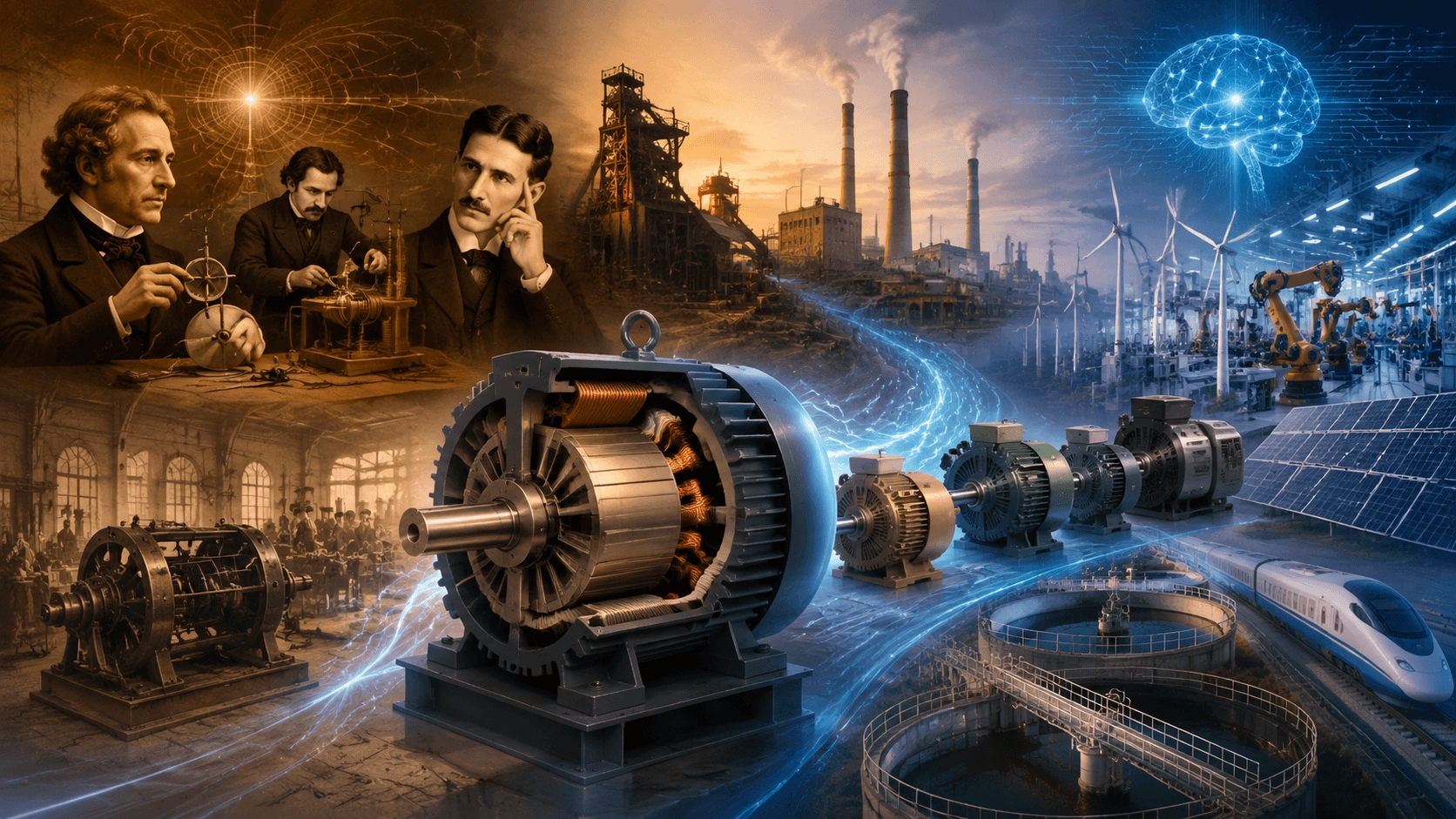
TECHO 2026 Industrial Heritage Overview: Tracing the arc of alternating current technology from the theoretical breakthroughs of Ørsted and Tesla to the three-phase industrial revolution, the VFD era, IE5 ultra-efficiency mandates, and the rise of AI-driven smart motors that now power 45% of global electricity consumption.
Introduction: The Uncelebrated Backbone of Modern Civilization
Alternating Current (AC) motors stand as the silent, uncelebrated backbone of modern global civilization. Powering nearly 45% of the world's total electricity consumption and over 70% of all industrial electrical load, these robust electromechanical machines underpin every critical sector of contemporary life. From municipal water treatment plants and commercial HVAC systems to automated factory assembly lines, renewable energy infrastructure, electric transportation, and precision robotics, the AC motor is the primary interface between electrical generation and mechanical work.
What began as a series of abstract theoretical breakthroughs in electromagnetism has evolved over 140 years into the most ubiquitous, efficient, and versatile energy conversion technology ever created. This comprehensive overview chronicles how the AC motor transformed from a laboratory curiosity into the driving force of the industrial age, and how each successive wave of innovation has redefined the limits of human engineering capability.
1820s–1880s: The Theoretical Foundations
From Electromagnetism to the Rotating Magnetic Field
The story of the AC motor does not begin with a single invention, but with a cascade of revolutionary scientific discoveries that unlocked the fundamental relationship between electricity and magnetism.
- 1820 | Ørsted’s Discovery: Danish physicist Hans Christian Ørsted observed that an electric current could deflect a compass needle, providing the first empirical proof that electricity and magnetism were inextricably linked. Within months, André-Marie Ampère formalized the mathematical laws of electromagnetic force.
- 1824 | Arago’s Rotations: French physicist François Arago documented that a rotating copper disk could induce magnetism in a nearby compass needle. This phenomenon, later named "Arago's Rotations," was the first recorded demonstration of a rotating magnetic field—the core operating principle of every AC motor built since.
- 1831 | Faraday’s Law: Michael Faraday published his groundbreaking theory of electromagnetic induction, proving that a changing magnetic field could induce an electric current in a conductor (and vice versa). This established the definitive scientific framework for converting electrical energy into mechanical motion.
⚠️ The DC Challenge and the Commutator Bottleneck
For the next five decades, engineering progress was dominated by Direct Current (DC) systems championed by Thomas Edison. While functional, early DC motors suffered from crippling inherent limitations. They relied on mechanical commutators and carbon brushes to reverse current in the rotor windings—a design that caused constant wear, frequent breakdowns, high maintenance costs, and severe safety risks in flammable environments. Most critically, DC power could not be transmitted over long distances without massive energy loss, confining electrification to dense urban areas with nearby power plants. The race to build a practical, commutator-free motor that could leverage the long-distance transmission advantages of AC power became the defining engineering challenge of the late 19th century.
1880s–1890s: The Birth of the Practical AC Motor
The Two-Phase Breakthrough and the Three-Phase Revolution
The turning point arrived in the mid-1880s when two visionary engineers, working continents apart, independently solved the puzzle of the AC induction motor.
The Pioneers of Induction
| Innovator | Location | Key Contribution | Year |
|---|---|---|---|
| Galileo Ferraris | Turin, Italy | Built first working two-phase AC induction motor using currents offset by 90° | 1885 |
| Nikola Tesla | United States | Filed U.S. patent; delivered landmark AIEE paper on complete AC motor systems | 1887-1888 |
In 1885, Galileo Ferraris demonstrated a working two-phase induction motor in his Turin laboratory. Simultaneously, Nikola Tesla had been developing his own two-phase design for nearly a decade. Tesla’s 1888 patent and subsequent paper to the American Institute of Electrical Engineers (AIEE) solved the core flaws of early prototypes, delivering consistent rotating torque and eliminating fragile commutators. His work caught the attention of George Westinghouse, who licensed Tesla's patents and ignited the famous "War of the Currents" against Edison's DC empire.
🏆 1889: The Three-Phase Revolution
While two-phase designs proved feasibility, the true revolution came from Russian-German engineer Mikhail Dolivo-Dobrovolsky at AEG in Berlin. In 1889, he invented the world’s first three-phase squirrel-cage induction motor.
By utilizing three currents offset by 120 degrees, Dolivo-Dobrovolsky’s design created a constant, uniform rotating magnetic field. This delivered smoother torque output, higher energy efficiency, simpler construction, and far lower manufacturing costs. Crucially, three-phase power required fewer transmission wires, cutting long-distance infrastructure costs by up to 50%.
The Frankfurt Proof (1891): Commercial viability was proven beyond dispute at the International Electrotechnical Exhibition in Frankfurt. Dolivo-Dobrovolsky’s team transmitted electricity 175 km from a hydroelectric plant in Lauffen am Neckar to the exhibition hall, powering three-phase motors with an overall system efficiency of 75%. This demonstration ended the War of the Currents and ushered in the era of global electrification.
1900–1999: Mass Industrialization and Iterative Refinement
The 20th Century: From Standardization to Precision Control
The 20th century saw the AC motor evolve from a groundbreaking novelty into the universal workhorse of global industry, shaped by wartime demand, material science breakthroughs, and the rise of power electronics.
1900–1945: Standardization and Wartime Expansion
The founding of the International Electrotechnical Commission (IEC) in 1906 established global standards for dimensions, voltage ratings, and performance parameters, enabling mass production and interchangeability. Wartime demand during both World Wars accelerated innovation dramatically:
- Laminated cold-rolled silicon steel cores replaced solid iron, drastically reducing eddy current losses.
- Synthetic insulation materials replaced natural rubber, increasing thermal tolerance and service life.
- Power Density Evolution: By 1945, a 100 HP AC motor occupied the same physical footprint as a 7.5 HP model from 1897—a 13x increase in power density.
1945–1980: Post-War Boom and the Dawn of Power Electronics
AC motors became ubiquitous in post-war civilian and industrial life. However, their greatest limitation remained: fixed speed determined by pole count and supply frequency. The 1950s and 60s brought the invention of the silicon-controlled rectifier (SCR/thyristor), enabling the first practical Variable Frequency Drives (VFDs). Though bulky and expensive, they proved variable speed control was technically feasible. Large-scale synchronous motors also emerged as grid stabilizers, correcting power factor and enabling modern power transmission networks.
1980s–1999: The VFD Revolution and Precision Control
The commercialization of the Insulated-Gate Bipolar Transistor (IGBT) in the 1980s was the most transformative shift of the late 20th century. IGBTs enabled compact, affordable, and highly efficient VFDs scalable from residential pumps to multi-megawatt industrial machinery.
- Stepless Speed Control: Precise torque regulation became achievable across the entire speed range.
- 50% Energy Reduction: Variable-load applications (fans, pumps, compressors) saw massive energy savings as motors no longer ran at full speed regardless of demand.
- Field-Oriented Control (FOC): Vector control allowed AC motors to match the dynamic response and precision of DC motors, even at zero speed.
By the end of the 1990s, AC motors had all but replaced DC motors in nearly every industrial application, evolving from fixed-speed workhorses into precision-controlled solutions for automation, robotics, and CNC machinery.
2000–Present: Efficiency, Digitalization, and Sustainability
The 21st Century: Smart Motors and the Net-Zero Transition
In the 21st century, AC motor development has been defined by two global imperatives: urgent carbon reduction and the integration of digital intelligence.
Global Energy Efficiency Mandates
Recognizing that motors consume nearly half of global electricity, governments worldwide implemented Minimum Energy Performance Standards (MEPS). The IEC 60034-30-1 standard established a universal classification system:
| IE Class | Designation | Status / Impact |
|---|---|---|
| IE1 | Standard Efficiency | Legacy baseline |
| IE2 | High Efficiency | Transitional standard |
| IE3 | Premium Efficiency | Mandatory minimum in 60+ countries |
| IE4 | Super Premium | Increasingly mandated for high-consumption sectors |
| IE5 | Ultra-Premium | 40% loss reduction vs. IE3; cutting-edge topology |
This regulatory push has driven new motor topologies into mainstream use. Permanent Magnet Synchronous Motors (PMSM), Synchronous Reluctance Motors (SynRM), and PM-Assisted SynRMs deliver higher efficiency and power density than traditional induction motors, maintaining peak performance even at partial loads.
Digitalization and Smart AC Motors
The Industrial Internet of Things (IIoT) has transformed the AC motor from a passive component into a connected intelligent asset. Modern smart motors integrate embedded sensors monitoring temperature, vibration, current, humidity, and bearing condition in real time.
💡 Predictive Maintenance Impact
AI and machine learning algorithms analyze smart motor data to identify potential faults months before failure. Facilities utilizing connected motor systems report up to a 70% reduction in unplanned industrial outages, shifting maintenance from reactive or scheduled models to truly predictive strategies.
Expansion into Sustainable Sectors
In the era of decarbonization, AC motors have expanded beyond traditional industry to become cornerstones of the net-zero transition:
- Wind Energy: High-efficiency motors power pitch and yaw systems.
- Solar Infrastructure: Driving water pumping and cooling solutions.
- Energy Storage: Managing battery thermal management and conversion systems.
- Electric Mobility: High-power-density traction motors serve as the standard for EVs, commercial shipping, and rail transit.
The Future: Next-Generation AC Motor Innovation
After 140 years, the evolution of the AC motor is far from over. Emerging technologies promise to further reduce losses and boost power density to unprecedented levels:
- Advanced Materials: Soft Magnetic Composites (SMC), amorphous alloy cores, and high-temperature superconducting materials are pushing beyond the theoretical limits of silicon steel.
- Integrated Systems: Motors, drives, sensors, and gearboxes are being combined into compact, all-in-one packages that eliminate cabling, reduce installation costs, and optimize system-level efficiency.
- AI-Driven Self-Optimization: Future motor systems will autonomously adapt to changing load conditions and operating environments in real time, maximizing efficiency and reliability without human intervention.
Conclusion: 140 Years of Innovation, The Story Continues
From Arago’s rotating magnetic field and Tesla’s pioneering patents to Dolivo-Dobrovolsky’s three-phase revolution, the VFD era, and today’s smart ultra-high-efficiency systems, the history of the AC motor is a testament to human ingenuity. It is a continuous drive to turn theoretical science into practical technology that powers human progress.
For over a century, the AC motor has shaped the modern world. As the global community faces the existential challenges of climate change and sustainable development, this remarkable machine—refined through 140 years of relentless innovation—will remain the indispensable driving force of civilization for decades to come.
Technical Summary: Key Milestones & Metrics
- Global Impact: Powers 45% of world electricity consumption; 70% of industrial electrical load.
- Efficiency Frontier: IE5 Ultra-Premium motors achieve 40% loss reduction vs. IE3; mandatory MEPS in 60+ countries.
- Technological Arc: Arago (1824) → Tesla/Ferraris (1880s) → Three-Phase (1889) → IGBT/VFD (1980s) → IIoT/AI (2020s).
- Future Focus: Soft magnetic composites, integrated motor-drive systems, and autonomous AI optimization.
© 2026 TECHO Industrial Engineering Solutions. All rights reserved. This document is provided for educational and technical reference purposes.