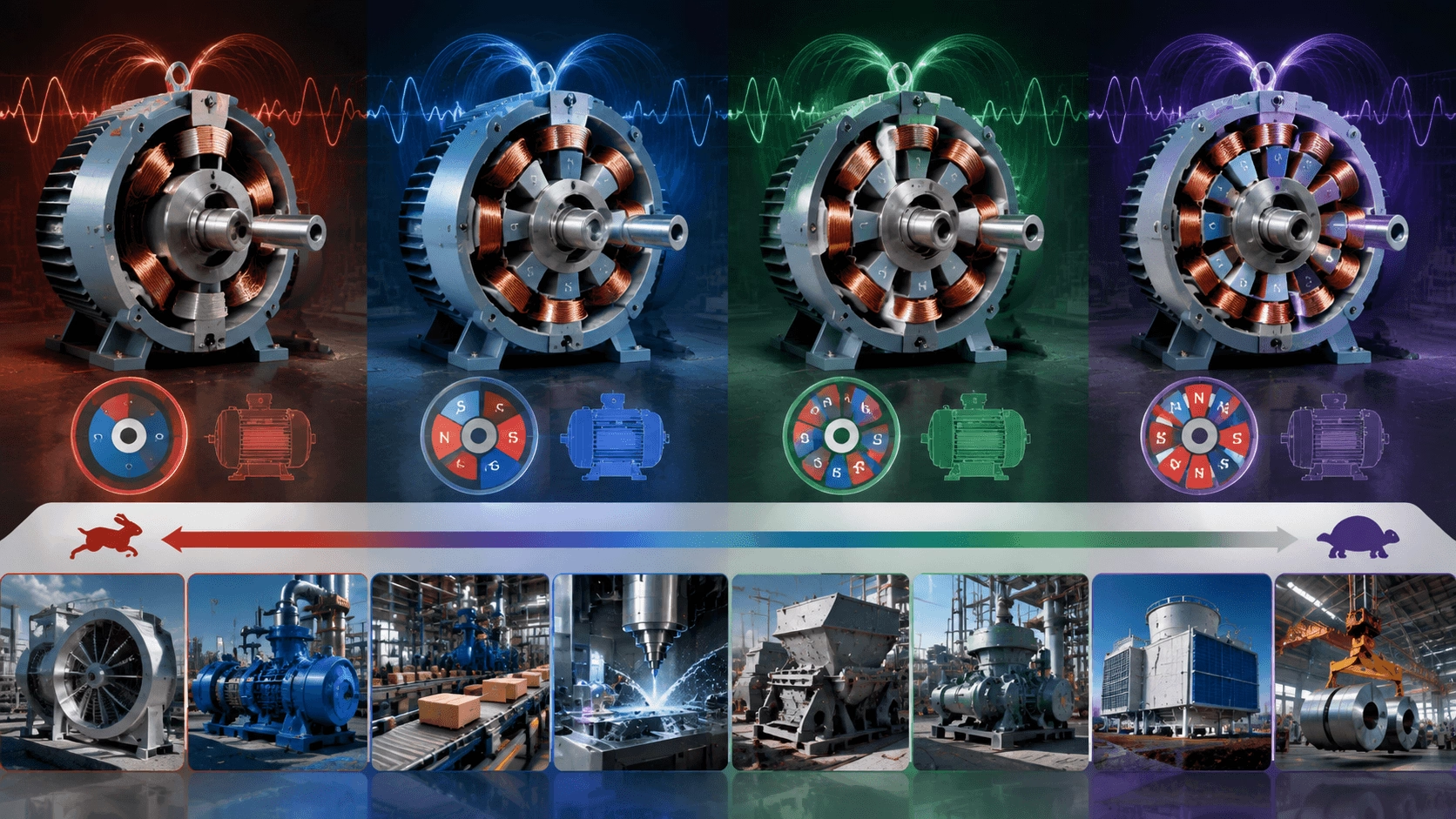
2026 Industrial Motor Selection Guide: A comprehensive technical analysis of stator pole counts, synchronous speed dynamics, torque-speed trade-offs, IE5 efficiency implications, and application-specific selection criteria for HVAC, manufacturing, EVs, and renewable energy systems. Compiled with TITECHO engineering expertise.
Introduction: Why Motor Pole Count Matters in the 2026 Industrial Landscape
In an era defined by skyrocketing energy costs—with global industrial electricity prices rising 15–20% between 2025 and 2026—and strict regulatory frameworks such as the EU Ecodesign Directive, US DOE mandates, and China’s GB standards enforcing IE3/IE4/IE5 efficiency tiers, understanding motor pole count is no longer optional; it is a critical engineering imperative.
With Variable Frequency Drives (VFDs) now deployed in approximately 70% of new industrial motor applications, the traditional "fixed-speed" mindset has evolved. However, the fundamental design parameter of pole count remains the primary determinant of a motor’s base speed, torque density, acoustic profile, physical footprint, and total cost of ownership (TCO).
For industrial buyers, OEM designers, and facility managers, selecting the wrong pole configuration can result in:
- 10–30% higher energy bills due to inefficient operating points.
- 2–3x increased maintenance costs from premature bearing wear or gear failures.
- Premature motor failure, often occurring within 2–3 years instead of the standard 8–10 year design life.
Whether you are sourcing motors for high-speed centrifugal fans, heavy-duty conveyors, electric vehicle traction, or wind turbine pitch systems, this guide delivers engineering-grade insights to help you choose the optimal pole count for maximum performance, reliability, and cost savings.
Core Fundamentals: What Are Motor Poles?
Motor poles refer to the number of magnetic north-south pole pairs created in the motor’s stator (the stationary outer core) when energized. In AC induction and synchronous motors, three-phase currents flowing through stator windings generate a Rotating Magnetic Field (RMF). This RMF induces current in the rotor (or interacts with permanent magnets), causing it to rotate and produce mechanical power.
Key Electromagnetic Principles
- Poles Always Come in Pairs: Due to the laws of electromagnetism, magnetic poles cannot exist in isolation. Therefore, the total number of poles (P) is always an even integer: 2, 4, 6, 8, etc.
- Speed vs. Pole Count Relationship: There is an inverse relationship between pole count and speed. Fewer poles mean the magnetic field completes a mechanical revolution faster. More poles mean the field rotates slower but with greater magnetic "leverage."
- The Torque-Speed Trade-off: For a given power rating (P_{out}), torque (T) is inversely proportional to speed (N):
T \propto \frac{1}{N}
Therefore, doubling the number of poles roughly halves the speed but doubles the available torque.
💡 The "Internal Gearing" Analogy:
Think of pole count as the motor’s inherent gear ratio:
- 2-Pole: High-speed, low-torque (Like a racecar on a straightaway).
- 4-Pole: Balanced speed and torque (Like a standard sedan).
- 6/8-Pole: Low-speed, high-torque (Like a heavy-duty truck or bulldozer).
The Science: Synchronous Speed Formula
The theoretical speed of the rotating magnetic field is known as Synchronous Speed (N_s). It is governed by the supply frequency and the number of poles. This formula is the foundation of all AC motor design.
N_s = \frac{120 \times f}{P}
Parameter Definitions:
- N_s: Synchronous speed in Revolutions Per Minute (RPM).
- f: Supply frequency in Hertz (Hz). Standard global frequencies are 50 Hz (Europe, Asia, Africa, Australia) and 60 Hz (North America, parts of South America and Asia).
- P: Number of magnetic poles (2, 4, 6, 8...).
- 120: A constant derived from converting seconds to minutes (60) and accounting for the two poles per magnetic cycle (2).
Understanding Slip in Induction Motors
Induction motors (the most common industrial type) never reach synchronous speed. They operate at a slightly lower speed called Rotor Speed (N_r) due to Slip (s). Slip is necessary for induction to occur; if the rotor spun at the same speed as the magnetic field, no current would be induced, and torque would drop to zero.
s = \frac{N_s - N_r}{N_s} \times 100\%
- Typical Slip: 2–5% for standard industrial motors.
- Example: A 4-pole, 50 Hz motor has a synchronous speed of 1,500 RPM. With 4% slip, its actual full-load speed is ~1,440 RPM.
2, 4, 6, and 8-Pole Motors: Complete 2026 Comparison
The following table compares the four most common pole configurations based on 2026 IEC 60034 standards, typical IE5 ultra-high-efficiency manufacturer data, and real-world industrial performance metrics.
| Feature | 2-Pole | 4-Pole | 6-Pole | 8-Pole |
|---|---|---|---|---|
| Sync Speed (50 Hz) | 3,000 RPM | 1,500 RPM | 1,000 RPM | 750 RPM |
| Actual Speed (50 Hz) (~3-4% Slip) | ~2,880 RPM | ~1,440 RPM | ~960 RPM | ~720 RPM |
| Sync Speed (60 Hz) | 3,600 RPM | 1,800 RPM | 1,200 RPM | 900 RPM |
| Torque Density (at 5.5 kW) | Low (~17.5 Nm) | Medium (~35 Nm) | High (~52.5 Nm) | Very High (~70 Nm) |
| Physical Size & Cost | Smallest / Lowest Base Cost | Medium (+15–20% size/cost) | Large (+30–40% size/cost) | Largest (+50–60% size/cost) |
| Noise & Vibration | Higher (75–85 dB) | Moderate (65–75 dB) | Low (55–65 dB) | Very Low (45–55 dB) |
| Primary Applications | Fans, blowers, centrifugal pumps, grinders, small HVAC compressors. | Conveyors, general machinery, lathes, medium-duty mixers, standard industrial drives. | Heavy conveyors, slurry pumps, crushers, food processing mixers, mining equipment. | Cranes, elevators, extruders, steel/cement mills, direct-drive wind turbine pitch systems. |
Performance Breakdown by Pole Count
1. 2-Pole Motors: High-Speed, Low-Torque
- Characteristics: Blazing speeds up to 3,600 RPM (60 Hz). Modest starting torque (typically 100–120% of rated torque).
- Pros: Compact footprint, lightweight, lower material cost (less copper/iron), high power density. Excellent for VFD applications where wide speed ranges are needed.
- Cons: Higher bearing wear due to high RPM, increased audible noise, and higher windage losses. Not suitable for high-inertia loads.
- 2026 Insight: When paired with a VFD for centrifugal fans/pumps, 2-pole motors offer massive energy savings via the Affinity Laws (Power \propto Speed^3). Reducing speed by 20% cuts energy use by ~50%.
2. 4-Pole Motors: The Industrial "Workhorse"
- Characteristics: Balanced speed (1,500–1,800 RPM) and torque. The most versatile choice, covering ~60% of industrial applications.
- Pros: Low slip, reliable across 50–100% load range, lower maintenance than 2-pole motors, excellent compatibility with both fixed-speed and VFD operations.
- Cons: Not optimal for extreme high-speed or extreme high-torque requirements.
- 2026 Insight: An IE5 4-pole 5.5 kW motor driving a warehouse conveyor typically runs at ~1,440 RPM. Compared to older IE2 models, it saves ~0.3 kW continuously, paying for itself in under 18 months.
3. 6-Pole Motors: Torque-Focused for Heavy Loads
- Characteristics: Operates at 1,000–1,200 RPM. High starting torque (150–200% of rated torque).
- Pros: Lower RPM reduces mechanical stress on bearings and shafts. Quieter operation and longer service life (10–12 years). Higher efficiency under heavy constant loads due to reduced windage.
- Cons: Larger frame size (+30–40% vs. 2-pole), higher material cost, lower power density.
- Application Example: Food-processing mixers handling thick doughs. The 6-pole motor provides consistent torque without splashing or shear damage, even as viscosity changes.
4. 8-Pole Motors: Maximum Torque at Minimal Speed
- Characteristics: Slow speed (750–900 RPM) with massive torque output. Built for the toughest industrial loads.
- Pros: Minimal vibration (critical for precision equipment), longest bearing life under shock loads, lowest noise. Ideal for direct-drive applications, eliminating the need for gearboxes.
- Cons: Physically bulky, high copper usage, 30–40% higher initial cost than 2-pole equivalents.
- Modern Twist: Widely used in direct-drive wind turbine pitch control systems. By eliminating the gearbox, maintenance costs drop by 40–50%, and system reliability skyrockets.
How to Choose the Right Pole Count: A Step-by-Step Framework
Selecting the correct pole count is a systematic engineering process. Follow these steps to avoid costly mismatches.
Step 1: Calculate Required Speed and Torque
Use the fundamental torque equation:
T = \frac{9550 \times P}{N}
Where T = Torque (Nm), P = Power (kW), and N = Actual Speed (RPM).
Example: You have an 11 kW fan that needs to operate at ~2,800 RPM.
- Target Speed: ~2,800 RPM.
- Closest Sync Speed (50 Hz): 3,000 RPM (2-Pole).
- Actual Speed with Slip: ~2,880 RPM.
- Required Torque: T = (9550 \times 11) / 2880 \approx 36.4 Nm.
- Conclusion: A 2-Pole motor is the optimal native fit. A 4-pole motor would require a VFD to reach this speed, adding complexity and cost.
Step 2: Factor in Duty Cycle and Load Inertia
- 24/7 Continuous Duty: Prefer 4-pole or 6-pole motors for lower slip and better thermal stability.
- Frequent Start/Stop: High-inertia loads (e.g., large flywheels, crushers) require high starting torque. Choose 6-pole or 8-pole designs.
- High Shock Loads: 8-pole motors offer superior robustness against mechanical shock.
Step 3: Decide Between VFD and Fixed-Speed
- Fixed-Speed: Match the pole count directly to your required operating speed (e.g., if you need 1,450 RPM, choose a 4-pole motor).
- Variable-Speed (VFD): A 4-pole motor is often the "sweet spot" for VFDs, offering a wide speed range (e.g., 0–3,000+ RPM) while maintaining good torque characteristics at low speeds. For variable-torque loads (fans/pumps), a 2-pole motor with a VFD offers the highest efficiency potential.
Step 4: Evaluate Efficiency Payback (IE5 Standards)
IE5 ultra-high efficiency motors are now available for all pole counts.
- Calculation: An IE5 4-pole 15 kW motor running 24/7 can save 300–500/year in energy costs compared to an IE4 model (assuming $0.15/kWh).
- Decision: For continuous operation, the higher upfront cost of IE5 is justified within 1–2 years.
Step 5: Check Physical Constraints and Noise Regulations
- Space-Limited: Compact HVAC units or mobile equipment require 2-pole or 4-pole motors.
- Noise-Sensitive: Hospitals, offices, and food processing plants benefit from the quieter operation of 6-pole or 8-pole motors (45–65 dB vs. 75–85 dB).
Advanced Topics: Pole Count Nuances for 2026
1. Pole-Changing Motors (Dahlander Design)
For applications requiring two discrete speeds (e.g., high/low fan settings), Dahlander winding motors allow switching between pole counts (e.g., 4/8 poles or 2/4 poles) via terminal box reconfiguration. This eliminates the need for expensive VFDs in simple dual-speed applications.
2. PMSMs and Electric Vehicle (EV) Traction
Modern EV traction motors and high-performance servos utilize Permanent Magnet Synchronous Motors (PMSMs) with high pole counts (8–12+ poles).
- Why? High pole counts maximize torque density at low speeds, allowing for compact motor diameters.
- Example: The Tesla Model 3 uses a 12-pole PMSM, while BYD utilizes 8–10 pole designs. This delivers instant acceleration torque without sacrificing high-speed efficiency.
3. VFD Compatibility and Derating
VFDs control speed by adjusting frequency, not pole count. However, pole count dictates the Base Speed.
- Constant Torque Loads (Conveyors): When running a 4-pole motor above its base speed (1,500 RPM @ 50 Hz) via a VFD, the motor enters "field weakening" mode, and torque drops. Proper VFD sizing and motor derating are critical.
- Variable Torque Loads (Fans): 2-pole motors paired with VFDs offer the best energy savings profile due to the cubic relationship between speed and power.
Frequently Asked Questions (2026 Edition)
1. Can I change the pole count on an existing motor?
No. The pole count is determined by the physical arrangement of the stator windings. To change speeds significantly, you must either replace the motor or use a VFD (which changes frequency, effectively changing the synchronous speed). Pole-changing motors (Dahlander) are a specific exception built with dual windings.
2. Do more poles mean better efficiency?
Not necessarily. While higher-pole motors often have lower windage losses due to slower speeds, they require more copper and iron, which increases electrical losses. IE5 efficiency standards ensure that modern motors of any pole count are highly optimized. The "best" efficiency depends on matching the motor to the load profile.
3. Is a 2-pole motor "better" than an 8-pole motor?
Neither is universally better. A 2-pole motor is better for high-speed, low-torque applications (fans). An 8-pole motor is better for low-speed, high-torque applications (crushers). Using an 8-pole motor for a fan would be oversized and inefficient; using a 2-pole motor for a crusher would likely stall or fail mechanically.
4. Are higher-pole motors more expensive to maintain?
Generally, no. In fact, 6-pole and 8-pole motors often have lower maintenance costs because their lower operating speeds reduce bearing wear and mechanical stress. However, their initial purchase price is higher due to increased material usage.
5. What is the future of motor pole counts in 2026+?
The trend is toward application-specific optimization. With the rise of PMSMs and integrated motor-drives, we are seeing non-standard pole counts (e.g., 10, 12, 14 poles) become more common in EVs and robotics to maximize torque density. For standard industrial AC induction motors, 4-pole will remain the dominant "workhorse," but 2-pole VFD-driven systems will grow in HVAC due to energy regulations.
Get Custom Motor Pole Configuration Quotes
Need help selecting the right pole count for your specific industrial application? Our engineering team at TITECHO will analyze your speed/torque requirements, duty cycle, and budget to recommend the optimal motor design.
- ✅ Compliant with 2026 IE5 Ultra-High Efficiency Standards
- ✅ Tailored for HVAC, Manufacturing, EVs, and Renewables
- ✅ Backed by our 5-Year Warranty
Contact Us for a Free Engineering Consultation:
- 📞 Phone: +86 13305761511
- ✉️ Email: [email protected]
- 💬 WhatsApp: Nancy / Jahor
TITECHO – TECHO ELECTRICAL & MECHANICAL (TAIZHOU) CO., LTD
Taizhou City, Zhejiang, China | www.cntecho.com | ISO 9001 Certified | IE5 Ultra-High Efficiency Motors Manufacturer