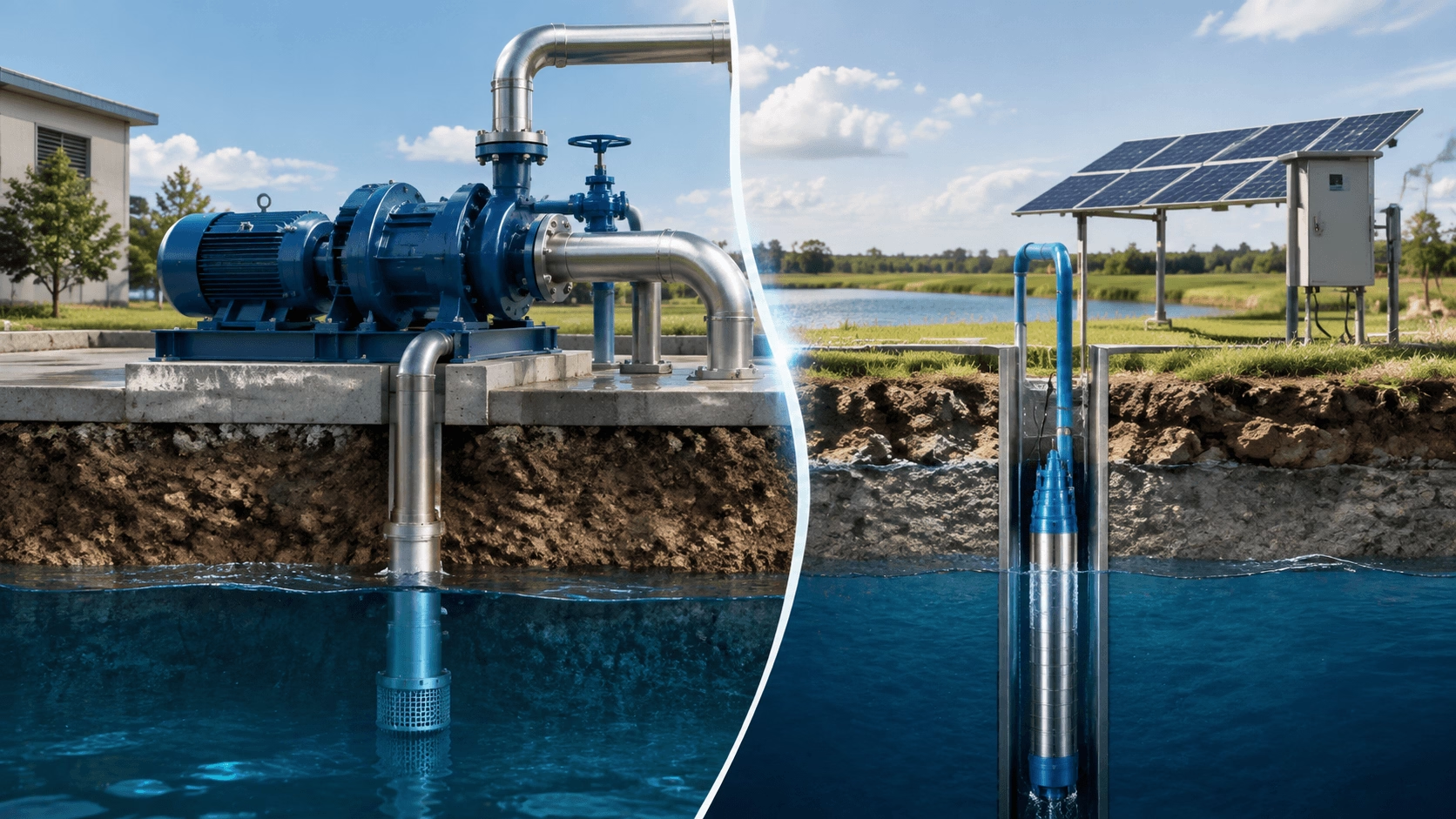
A comprehensive technical comparison of submersible and surface pumps, encompassing suction lift limits, NPSH analysis, installation factors, efficiency metrics, maintenance protocols, and water system applications. Expert engineering guidance from Techo Electrical & Mechanical (Titecho).
1. Introduction
Water pumping systems represent one of the largest applications of electric motors worldwide, accounting for approximately 20% of global electrical energy consumption. At the core of every water system lies a critical engineering decision: whether to install the pump below the water surface (submersible) or above the water level (surface).
This choice profoundly impacts initial capital expenditure, installation complexity, long-term energy efficiency, maintenance accessibility, system reliability, and total cost of ownership (TCO). This guide provides a rigorous technical comparison to assist engineers, system designers, and facility managers in selecting the optimal pump configuration for their specific water system requirements.
2. Fundamental Operating Principles
2.1 Submersible Pumps
A submersible pump comprises a centrifugal pump hydraulically coupled to a hermetically sealed electric motor, engineered to operate entirely submerged within the fluid being pumped. The complete assembly—including the motor, pump stages, intake screen, and discharge connection—is lowered directly into the source (well, sump, tank, or reservoir).
Key Characteristics:
- Pushing Mechanism: The pump pushes water to the surface rather than pulling it via suction.
- Thermal Management: The motor is cooled by the surrounding fluid, enabling exceptionally high power density.
- Simplification: No suction piping or priming mechanisms are required.
- Self-Priming: The pump is inherently self-priming as it remains permanently submerged.
2.2 Surface Pumps
Surface pumps are installed above the water level and draw fluid through a suction pipe. They encompass several distinct configurations:
| Surface Pump Type | Description | Typical Application |
|---|---|---|
| End-Suction Centrifugal | Horizontal shaft; single impeller | General water transfer; booster service |
| Split-Case Horizontal | Double-suction impeller; axially split casing | High-flow municipal systems; large-scale irrigation |
| Vertical Turbine | Multi-stage bowl assembly; submerged suction bell | Deep wells; raw water intake |
| Self-Priming | Built-in priming chamber; handles air/water mixtures | Sump dewatering; intermittent duty |
| Jet Pump | Ejector nozzle + diffuser; utilises recirculated water | Shallow wells; residential applications |
Surface pumps pull water through suction piping, creating a partial vacuum that allows atmospheric pressure to push the water up the suction line.
3. Head, Suction Lift, and NPSH: The Critical Differentiators
3.1 Atmospheric Pressure and Suction Lift Limits
The maximum theoretical suction lift for any surface pump is strictly limited by atmospheric pressure. At sea level with water at 20°C:
- Atmospheric pressure head: ~10.3 m (33.9 ft)
- Vapour pressure head: ~0.24 m (0.8 ft)
- Practical maximum suction lift: 6–7 m (20–23 ft) after accounting for Net Positive Suction Head (NPSH) requirements, friction losses, and safety margins.
Critical Implication: For water sources located deeper than approximately 7 metres below the pump centreline, a standard surface centrifugal pump is physically incapable of operating without transitioning to a vertical turbine configuration.
3.2 NPSH Comparison
| Parameter | Submersible Pump | Surface Centrifugal Pump |
|---|---|---|
| NPSH Available | High—positive static head at source depth | Limited by atmospheric pressure minus suction losses |
| NPSH Concern | Minimal for most installations | Critical; high cavitation risk with increased lift |
| Practical Depth Limit | Hundreds of metres (via multi-stage design) | ~7 m suction lift; unlimited with submerged turbine bowls |
4. Comparative Technical Analysis
4.1 Performance and Efficiency
| Aspect | Submersible Pumps | Surface Pumps |
|---|---|---|
| Hydraulic Efficiency | High (60–85% depending on size and staging) | High (70–90% for large split-case designs) |
| System Efficiency | Higher; eliminates suction line friction losses | Lower if suction conditions are suboptimal |
| Part-Load Efficiency | Excellent when paired with VFD control | Good; throttling creates significant energy waste |
| Head Capability | 500+ m achievable with multi-stage design | Limited single-stage head; turbine required for high head |
4.2 Installation and Infrastructure
| Factor | Submersible Pumps | Surface Pumps |
|---|---|---|
| Space Requirement | Minimal surface footprint | Requires dedicated pump house and concrete foundation |
| Installation Complexity | Requires hoisting equipment and wet electrical splices | Standard dry mechanical installation |
| Suction Piping | None required | Requires sealed, supported, air-tight piping |
| Priming System | Not required | Mandatory for non-self-priming models |
| Flood Risk | Inherently flood-proof operation | Motor and controls vulnerable to flooding |
4.3 Maintenance Accessibility
| Aspect | Submersible Pumps | Surface Pumps |
|---|---|---|
| Routine Inspection | Difficult; full extraction from well/sump needed | Fully visible and accessible |
| Bearing & Seal Service | Requires complete pump removal | In-place repair typically possible |
| Motor Repair | Requires specialised factory service | Standard local motor shop service |
| Mean Time To Repair (MTTR) | Longer (8–24 hours) | Shorter (2–8 hours) |
4.4 Reliability and Lifespan
| Factor | Submersible Pumps | Surface Pumps |
|---|---|---|
| Motor Cooling | Fluid-cooled; consistent temperature profile | Fan-cooled; dependent on ambient temperature |
| Environmental Exposure | Protected from weather, dust, and vandalism | Exposed; requires weatherproof enclosure |
| Seal Criticality | Seal failure causes catastrophic motor flooding | Seal failure typically causes only external leakage |
| Typical Service Life | 8–15 years | 15–25 years |
5. Application-Specific Selection Guidance
5.1 Deep Well Water Supply
| Parameter | Recommendation | Rationale |
|---|---|---|
| Depth to water > 7 m | Submersible | Surface pump suction lift is physically limited |
| Depth to water < 7 m | Either option | Submersible preferred for simplified installation |
| Small well casing | Submersible borehole pump | Compact diameter fits standard well casings |
5.2 Municipal Water Systems
| Application | Typical Choice | Rationale |
|---|---|---|
| Raw water intake | Vertical turbine / submersible | Effectively handles fluctuating water levels |
| Booster stations | Horizontal split-case | High efficiency and facile maintenance access |
| Wastewater lift stations | Wet-pit submersible | Flood-proof design; eliminates need for dedicated pump house |
5.3 Agricultural Irrigation
| System Type | Pump Choice | Considerations |
|---|---|---|
| Center-pivot irrigation | Submersible / vertical turbine | Excellent deep well adaptability |
| Flood irrigation | Surface axial-flow | Optimal for low head, high flow output |
| Drip irrigation | Multi-stage submersible | Provides stable, high-pressure delivery |
6. Economic Analysis: Total Cost of Ownership
6.1 Capital Cost Comparison
| Component | Submersible Pumps | Surface Pumps |
|---|---|---|
| Pump & Motor Assembly | Moderate to high | Lower; utilises standard components |
| Civil & Building Works | Minimal | High (pump house, foundation, HVAC) |
| Field Installation | Low for deep wells | High for full piping and enclosure construction |
6.2 Operating Cost Comparison
| Factor | Submersible Pumps | Surface Pumps |
|---|---|---|
| Energy Consumption | Lower; no suction line losses | Slightly higher with suboptimal suction conditions |
| Maintenance Labour | Less frequent, but higher cost per service event | Regular minor service, lower hourly cost |
| Spare Parts | Specialised, longer lead times | Universal, readily available off-the-shelf |
7. Key Selection Decision Matrix
| Criterion | Choose Submersible If... | Choose Surface If... |
|---|---|---|
| Water Depth | > 7 m, deep well, or low water table | Shallow source < 7 m above pump centreline |
| Site Space | Limited surface area; no pump house available | Adequate land for equipment housing and access |
| Downtime Tolerance | Planned periodic maintenance shutdowns acceptable | 24/7 operation with instant repair required |
| Flood Exposure | Flood-prone area or high groundwater level | Elevated, dry, and protected location |
8. Emerging Trends (2026)
Modern water pumping technology continues to evolve rapidly, driven by digitalisation and high-performance material upgrades, reshaping both submersible and surface pump design:
- Smart Submersible Systems: Integration of Variable Frequency Drives (VFDs), built-in temperature/vibration/current sensors, and wireless remote monitoring for cloud-based predictive maintenance.
- Advanced Corrosion Materials: Utilisation of duplex stainless steel, ceramic seals, and composite components to withstand harsh water and chemical environments.
- Global Efficiency Regulations: Strict adherence to IE3/IE4 high-efficiency motor mandates, eco-design compliance, and recyclable component design for sustainable, long-term operation.
9. Conclusion
The selection between submersible and surface pumps is not a matter of inherent technological superiority, but rather of matching the pump configuration to specific system constraints and operational priorities. Submersible pumps excel in deep installations, space-constrained sites, and flood-prone environments, offering installation simplicity and high energy efficiency at the expense of maintenance accessibility. Conversely, surface pumps dominate in shallow applications, high-flow municipal services, and scenarios where rapid repair and standard spare parts availability are paramount.
The engineering decision must be predicated on a systematic evaluation of water source depth and level variation, required flow and head, water quality, site constraints, maintenance capabilities, and lifecycle cost objectives. In many instances—particularly for deep wells—submersible technology represents the only physically viable option. For shallower applications, the choice becomes an optimisation problem balancing first cost, energy efficiency, maintenance philosophy, and risk tolerance.
Reference Standards:
To ensure long-term system reliability and regulatory compliance, consult NEMA MG-1, IEC 60034, API RP 11S4, Hydraulic Institute ANSI/HI, AWWA municipal water standards, and ASHRAE building service guidelines.
10. Engineered Water System Solutions with Titecho
Techo Electrical & Mechanical (Taizhou) Co., Ltd. (Brand: Titecho) specialises in the design and manufacture of high-efficiency electric motors and drive systems engineered for both submersible and surface water pumping applications. Our product portfolio features premium copper windings, advanced sealing technologies, IE3/IE4 efficiency classifications, and robust mechanical constructions tailored to the rigorous demands of municipal, agricultural, and industrial water systems.
We provide comprehensive engineering support, including NPSH analysis, system curve modelling, motor-pump matching, and VFD integration guidance to ensure optimal system performance and reliability.
Explore technical data sheets, performance curves, and application engineering support at www.cntecho.com.
© Techo Electrical & Mechanical (Titecho) – Precision Fluid Handling and Electromechanical Excellence