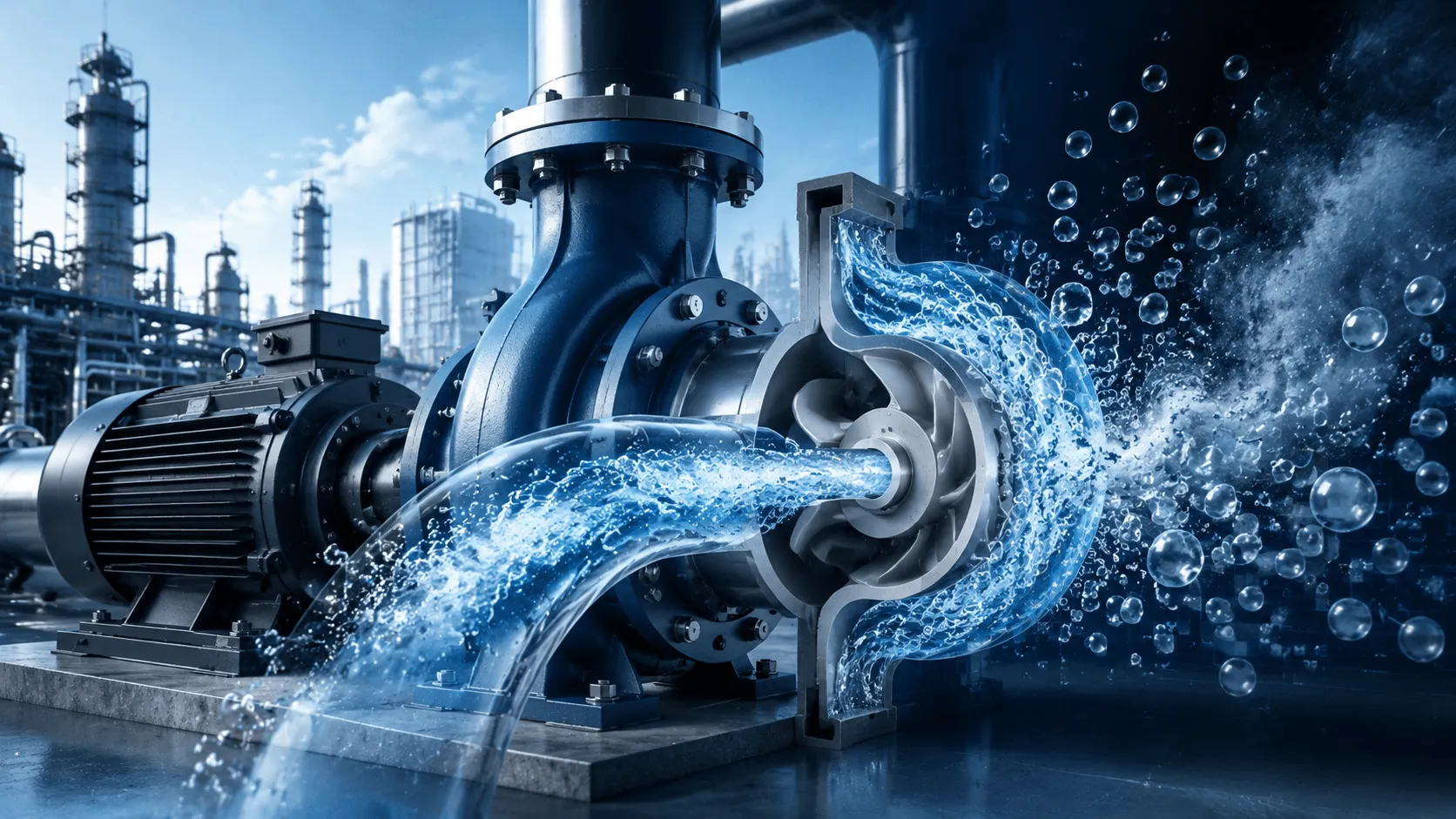
How to Prevent Pump Cavitation: NPSH Guide 2026
2026 NPSH guide: Prevent cavitation in industrial pumps. Learn NPSHa/NPSHr calculations, key factors (temperature, suction design, altitude), optimization steps & low-NPSHr solutions – TECHO expert advice, 30+ years manufacturer.
Mastering NPSH: The Definitive Technical Guide to Cavitation Prevention in Industrial Pump Systems
In chemical, power, water treatment, and mining industries, pump systems are the lifeline of production lines—their uninterrupted operation directly dictates productivity and operational costs. Yet cavitation, a hidden and destructive phenomenon, silently undermines pump performance, causing impeller erosion, seal failures, and unplanned downtime that costs industrial enterprises millions annually.
What Is Cavitation, and Why Does NPSH Matter?
To understand NPSH, we first need to grasp cavitation—its root cause, physical process, and industrial hazards. Cavitation occurs when the pressure of the liquid at the pump's suction inlet drops below the liquid's vapor pressure at the current operating temperature.
When this pressure threshold is breached, the liquid undergoes rapid vaporization, forming countless tiny vapor cavities (bubbles) in the fluid stream. These are not ordinary air pockets—they are pure vapor bubbles that carry destructive potential.
This implosion releases shock waves of up to 10,000 psi and high-velocity micro-jets, which repeatedly impact the impeller, volute, mechanical seal, and other key components. Over time, this cyclic impact causes metal pitting, surface erosion, and structural fatigue.
- Reduced pump efficiency and flow rate (up to 30% in severe cases), increasing energy consumption and failing to meet production demands
- Loud rattling or "gravel-grinding" noise, accompanied by abnormal vibration that affects the entire pipeline system
- Premature wear of mechanical seals and bearings, shortening pump service life by 50% or more and raising maintenance costs
- Sudden pump failure, triggering production line shutdowns—for refineries or chemical plants, downtime can cost 10,000–50,000 per hour
💡 Industrial Warning: Cavitation is most likely to occur in high-temperature, low-suction-pressure scenarios such as boiler feed pumps, high-rise water boosting systems, and gasoline transfer pumps. Early detection and intervention can reduce maintenance costs by 70%.
NPSH quantifies the critical "pressure margin" available at the pump suction to suppress liquid vaporization. Measured in meters (m) or feet (ft) of the pumped liquid, this unit directly correlates to system design.
For on-site operators, a simple analogy helps: NPSHa (available margin) is the actual fuel in your tank, while NPSHr (required margin) is the minimum fuel needed for the engine to run. Just as a car stalls with an empty tank, a pump suffers cavitation when NPSHa falls short of NPSHr.
The Two Critical Types of NPSH
NPSH is not a single fixed value but a pair of complementary parameters: NPSH Available (NPSHa) and NPSH Required (NPSHr). Their relationship is the golden rule of industrial pump operation: NPSHa must be greater than NPSHr, with an ideal safety buffer of 0.5–1.0 m (1.5–3.0 ft).
1. NPSH Available (NPSHa): The Pressure Margin You Have
NPSHa refers to the positive pressure margin (in meters/feet of liquid) at the pump's suction flange, calculated above the liquid's vapor pressure. Critically, NPSHa is determined by system design and operating conditions, not the pump itself.
NPSHa (m) = (Ps / ρg) + (vs² / 2g) - (Pv / ρg) - ΔPf
Where each term means:
- Ps = Absolute pressure at the suction tank surface (Pa)
- ρ = Liquid density (kg/m³)
- g = Gravitational acceleration (9.81 m/s²)
- vs = Liquid velocity at pump suction flange (m/s)
- Pv = Liquid vapor pressure at operating temperature (Pa)
- ΔPf = Total pressure loss in suction line (Pa)
📏 Quick Calculation Example: For a water pump system (20°C water) with open tank (Ps = 101,325 Pa), suction velocity 1.2 m/s, vapor pressure 2,339 Pa, and suction line pressure loss 0.6 m H₂O: NPSHa = (101325 / (998 × 9.81)) + (1.2² / (2 × 9.81)) - (2339 / (998 × 9.81)) - 0.6 ≈ 10.35 + 0.07 - 0.24 - 0.6 = 9.58 m.
Key factors that impact NPSHa in industrial applications:
- Atmospheric pressure matters: At 2,000 m altitude, atmospheric pressure drops to ~79,500 Pa, reducing NPSHa by ~2.2 m for water systems.
- Suction line design is make-or-break: A 10 m 2-inch pipe with fittings has pressure loss of ~1.2 m H₂O, while optimized design has only ~0.3 m H₂O.
- Temperature is a silent risk: 100°C water has 43x higher vapor pressure than 20°C water.
- Liquid density impacts static head: 40% brine (1,140 kg/m³) provides 17% lower static head than water.
2. NPSH Required (NPSHr): The Pressure Margin You Need
NPSHr is the minimum pressure margin required at the pump's suction flange to prevent cavitation. It is an inherent property of the pump, determined by its hydraulic design, impeller structure, and operating parameters.
- Impeller geometry: Hydrodynamically optimized impellers minimize local pressure drops (low NPSHr).
- Suction port size: Larger suction ports reduce liquid velocity at the impeller inlet.
- Operating speed (RPM): NPSHr increases with the square of the pump's RPM.
TECHO Customer Success Story: Petrochemical Plant Cavitation Resolution
A large petrochemical plant in Southeast Asia faced chronic cavitation issues with its boiler feed pumps. The system handled 95°C water, with an actual NPSHa of 1.2 m. The original generic pumps had an NPSHr of 1.6 m, leading to monthly impeller replacements and 8–12 hours of unplanned downtime per month (costing ~$40,000 per incident). After switching to TECHO CDLF 8-16 pumps (NPSHr = 1.0 m), cavitation was completely eliminated. Over 6 months, unplanned downtime dropped by 40%, and maintenance costs for pump components decreased by 65%.
Key Factors Influencing NPSH Performance
1. Fluid Properties
- Vapor pressure (Pv): Fluids with high vapor pressure (gasoline, ethanol, hot water) require higher NPSHa.
- Viscosity: High-viscosity fluids increase suction line friction loss (ΔPf), reducing NPSHa.
- Density: Denser fluids reduce the static head term in the NPSHa formula.
- Dissolved gases: Air or other gases dissolved in liquids come out of solution when pressure drops.
- Chemical composition: Corrosive fluids require pumps with corrosion-resistant materials.
⚠️ Critical Reminder: For high-temperature or corrosive fluids, always use vapor pressure values at the maximum operating temperature (not ambient temperature).
2. Suction Line Design (The #1 Cause of Low NPSHa)
- Minimize pressure losses: Avoid 90° bends, eliminate redundant valves, and select proper filters.
- Upsize suction lines: Use suction lines 1–2 sizes larger than the pump's suction flange.
- Avoid air traps: Route suction lines with a 1–2% downward slope toward the pump.
- Keep lines short: Aim for suction line length ≤5 meters.
- Use low-loss fittings: Full-port ball valves have 70% less pressure loss than gate valves.
3. Operating Conditions
- High discharge pressure: Excess backpressure forces the impeller to work harder, increasing NPSHr.
- Fluctuating flow rates: NPSHr increases with flow rate, so calculate for peak flow.
- Low tank liquid level: As the suction tank level drops, static pressure decreases.
- Fluid temperature variations: Sudden temperature spikes increase vapor pressure.
4. Pump Installation (Suction Lift vs. Suction Head)
- Suction lift (tank below pump): The pump "pulls" liquid upward, creating a pressure drop.
- Suction head (tank above pump): Gravity feeds liquid to the pump, increasing static pressure.
On-Site Installation Optimization Case: A food processing plant had cavitation issues with its syrup transfer pumps (suction lift of 2.8 m, NPSHa = 1.0 m, pump NPSHr = 1.1 m). Instead of replacing the pumps, the team relocated the pumps to be 0.6 m below the tank (creating a 0.6 m suction head), increasing NPSHa to 1.7 m. This simple installation adjustment eliminated cavitation at a fraction of the cost of new equipment.
Practical Steps to Optimize NPSH and Prevent Cavitation
1. Conduct Accurate NPSHa Calculations
- Gather comprehensive data: Local atmospheric pressure, maximum fluid operating temperature, fluid properties, suction line specifications, filter pressure drop, and maximum operating flow rate.
- Calculate each term in the NPSHa formula using friction loss charts or specialized software.
- Add a safety buffer: Ensure NPSHa ≥ NPSHr + 0.5–1.0 m for general industrial systems.
- Validate with on-site testing: Measure suction pressure with a precision gauge.
2. Select Pumps with Low NPSHr for Industrial Applications
TECHO's CDL/CDLF vertical multistage pumps are designed with anti-cavitation performance in mind:
- Hydrodynamically optimized impellers reducing NPSHr by up to 50%
- Stainless steel construction with polished internal surfaces
- Compact vertical design with short internal flow paths
- IE3/IE4 high-efficiency motors with stable RPM output
3. Optimize the Suction System
- Upsize the suction line to reduce friction loss by 50–60%
- Relocate the pump closer to the suction tank
- Add a booster pump to increase static pressure
- Install a suction stabilizer to dampen flow fluctuations
- Cool high-temperature fluids to reduce vapor pressure
4. Implement Proactive Monitoring and Maintenance
- Noise and vibration monitoring: Install sensors to detect cavitation signatures
- Real-time pressure/flow tracking: Monitor for sudden drops indicating cavitation
- Regular visual inspections: Check for pitting and erosion on impellers
- Filter maintenance: Clean or replace suction filters monthly
Why NPSH Is a Cornerstone of Reliable Industrial Pump Systems
Cavitation is not an inevitable consequence of pump operation—it is a preventable issue, and NPSH is the cornerstone of mitigation. In industrial settings, where downtime can cost thousands of dollars per hour, optimizing NPSH is not just a technical consideration but a financial imperative.
At TECHO, we engineer industrial pumps with NPSH performance at the core of their design. Our CDL/CDLF series pumps are built to thrive in harsh environments, with optimized impeller geometries, corrosion-resistant materials, and low-NPSHr designs.
✅ Final Industrial Best Practice: Integrate NPSH analysis into the initial system design phase, not just as a troubleshooting tool. Proactive NPSH optimization reduces capital costs, maintenance expenses, and downtime, delivering a 20–30% return on investment over the pump's lifecycle.
Get Expert NPSH Support for Your Industrial Pump Systems
Calculating NPSHa, selecting the right low-NPSHr pump, and optimizing your industrial system can be complex—especially for harsh or high-stakes applications. Our technical team specializes in NPSH analysis for industrial scenarios, offering free on-site or remote system audits.
We help you accurately calculate NPSHa, select a pump with ideal NPSHr, identify cost-effective upgrades, and troubleshoot existing cavitation issues.