Master pump selection with our complete guide to flow rate, total dynamic head, NPSH, efficiency & affinity laws. Learn to read pump curves & avoid cavitation. Get free expert advice from TITECHO engineers today!
Pump Parameters Guide
This comprehensive guide explains the six most critical pump parameters in clear, practical terms, drawing on decades of industrial and residential pump design, manufacturing, and application experience. It helps users select, operate, and maintain pumps effectively, avoiding common mistakes that lead to energy waste, equipment failure, or costly downtime. Whether you're specifying pumps for a factory, upgrading a domestic water system, or diagnosing an existing installation, this guide breaks down critical parameters in plain language—no engineering background needed.
1. Flow Rate (Q) — How Much Fluid Can the Pump Deliver?
Flow rate measures the volume of fluid the pump moves per unit of time. It's the foundational parameter that determines if the pump meets your system's demand.
- Too low → insufficient pressure or supply
- Too high → wasted energy and inefficiency
Common Units
- GPM (Gallons Per Minute) — residential & light commercial
- m³/h (Cubic Meters per Hour) — industrial & large-scale systems
- L/s (Liters per Second) — precision or small applications
Real-World Impact
A low-flow pump in a restaurant dishwashing line slows rinsing and service. An oversized residential well pump cycles excessively, shortening lifespan and inflating electricity bills—this is a top issue we see in residential service calls.
Pro Tip (From Pump Manufacturers): Calculate maximum simultaneous demand (e.g., 2 showers + kitchen faucet = X GPM), then select a pump with 10–15% extra capacity. This buffer accounts for future needs, peak loads, and minor system changes, without oversizing to the point of inefficiency. For industrial applications, request custom flow calibration from your manufacturer to match exact operational needs.
2. Head (Total Dynamic Head) — How High or Far Can the Pump Push Fluid?
Head quantifies the pump's ability to overcome gravity and system resistance. Expressed as height (not pressure), it remains consistent across different fluids— a key distinction often misunderstood by end-users.
Units & Conversion
- Feet (ft) or Meters (m)
- 1 ft water ≈ 0.433 PSI | 1 m water ≈ 9.81 kPa
Two Critical Types
- Static Head — vertical distance from source to highest delivery point (no flow)
- Total Dynamic Head (TDH) — static head + friction losses from pipes, valves, elbows, fittings
Critical Insight (Manufacturer Perspective): A pump rated for 50 ft head might seem adequate for a 40 ft lift, but long pipe runs and multiple bends can push dynamic head beyond capacity—resulting in zero flow. This is the most common sizing error we encounter. Reputable manufacturers will provide free TDH calculation services for industrial projects, accounting for all system components to ensure proper sizing. Always size using total dynamic head, not just static lift.
3. Power Consumption & Efficiency — What Will It Really Cost to Run?
Understand these two key power values to avoid long-term cost overruns:
- Shaft Power (input) — power delivered to the pump shaft (kW or HP; 1 HP ≈ 0.746 kW)
- Hydraulic Power (WHP) (output) — useful energy transferred to the fluid
Formula: WHP = (GPM × Head ft × Specific Gravity) / 3960
Efficiency = (WHP ÷ Shaft Power) × 100%
Typical range: 50–85% (losses due to friction, heat, mechanical wear). Even small efficiency gaps add up significantly over time.
Why It Matters
A 10–15% efficiency gain can save thousands annually. Example: A 50 HP pump at 75% efficiency uses ~27,000 extra kWh/year compared to 90% efficiency (at $0.15/kWh, 24/7 operation). For industrial facilities with dozens of pumps, this translates to six-figure savings.
Pro Tip (From Pump Manufacturers): Prioritize ENERGY STAR certified pumps or IE3/IE4 high-efficiency motors. These motors not only cut energy costs but also have longer service lives due to better thermal management. Most manufacturers offer a payback period analysis to show how quickly efficiency gains offset higher upfront costs, typically 1–2 years for continuous operation.
4. NPSH (Net Positive Suction Head) — Preventing Catastrophic Cavitation
Cavitation occurs when suction pressure falls below the fluid's vapor pressure, forming vapor bubbles that collapse violently—damaging impellers, causing noise, vibration, and eventual failure. It's one of the leading causes of premature pump replacement, often misdiagnosed as normal wear.
Key Values
- NPSHr — Required NPSH (manufacturer-specified minimum from pump curve; non-negotiable for reliable operation)
- NPSHa — Available NPSH (system calculation: atmospheric pressure – vapor pressure – suction losses)
Safety Rule (Industry Standard): NPSHa ≥ NPSHr + 10–20% margin (minimum 1–2 ft / 0.3–0.6 m safety buffer). Manufacturers optimize impeller and suction port designs to minimize NPSHr, but system design must still provide adequate NPSHa. Look for pumps with low NPSHr ratings (3–5 m for most industrial models) for harsh suction conditions.
Common Fixes
- Shorten or enlarge suction line to reduce friction losses
- Reduce suction lift (lower pump or elevate fluid source)
- Remove unnecessary restrictions (valves, elbows, undersized strainers) — consult your manufacturer for suction line layout guidance.
5. Speed (RPM) & Affinity Laws — Your Most Powerful Control Tool
For centrifugal pumps, impeller speed (RPM) dramatically influences performance according to the Affinity Laws—principles every pump operator and specifier should understand:
- Flow ∝ RPM
- Head ∝ RPM²
- Power ∝ RPM³
Practical Benefit
Reducing speed by 20% with a Variable Frequency Drive (VFD) cuts power consumption by 48%—the most impactful energy-saving measure for variable-demand applications. This is widely recommended by manufacturers for HVAC, irrigation, and process control systems.
Warning (Manufacturer Safety Note): Never exceed the manufacturer's maximum RPM. Overspeeding risks impeller failure, severe vibration, and bearing damage—voiding warranties and creating safety hazards. Reputable manufacturers mark safe RPM ranges on all pumps and offer speed-limiting accessories for industrial use. Ensure pumps are VFD-compatible (most modern centrifugal pumps are) before installation.
6. Fluid Compatibility — The Pump Must Match the Liquid
Fluid properties are often overlooked but directly impact pump performance, longevity, and material selection. From our manufacturing experience, incompatible fluids are the top cause of premature seal and impeller failure.
Key Fluid Properties to Evaluate
- Specific Gravity (>1) — heavier fluids require more power to move
- Viscosity — thicker fluids reduce flow and increase power demand; may require modified impeller designs
- Corrosiveness / Abrasiveness / Toxicity — dictates material selection for wetted parts
Standard Material Recommendations (Industry Best Practices)
- 304/316 stainless steel: Corrosive water, food-grade, or mild chemical applications
- Duplex/Hastelloy: Harsh chemicals (acids, alkalis) in industrial settings
- Lined pumps (PTFE, rubber): Abrasive slurries or toxic fluids to prevent wear and leaks
Key Lesson
Using a standard cast-iron water pump for corrosive chemicals or viscous oil leads to rapid wear, leaks, or total failure. Always share full fluid specifications with your manufacturer to ensure wetted parts are matched to the liquid—this avoids costly rework and downtime.
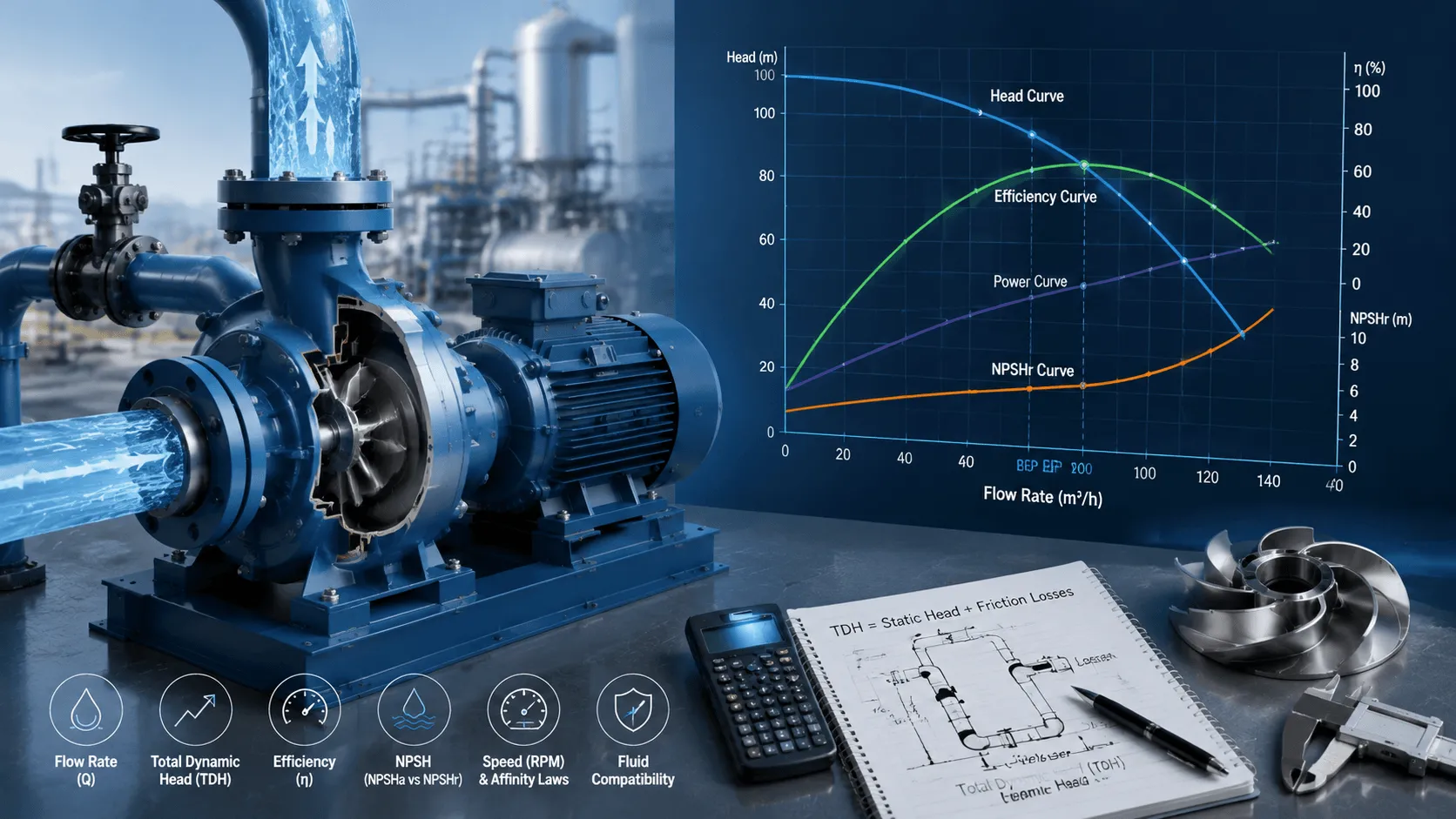
How to Read & Use Manufacturer Pump Curves
Pump curves combine all critical parameters into one graph—provided by every reputable manufacturer. They are the most reliable tool for selecting and operating pumps correctly.
- X-axis: Flow rate
- Y-axis: Head
- Additional curves: Efficiency (%), Power, NPSHr
Best Practice (Manufacturer Guidance): Select and operate near the Best Efficiency Point (BEP)—typically 70–90% of the peak efficiency zone. Operating far left (low flow, recirculation) or far right (high flow, cavitation) increases energy use, vibration, and shortens pump life. Manufacturers can provide customized pump curves for your specific system and offer training to interpret them correctly—take advantage of this service.
Quick Pump Selection Checklist
Before purchasing, confirm these key points—this is the same checklist manufacturers use when sizing pumps for clients:
- Required flow rate (peak + average demand, with 10–15% buffer)?
- Total dynamic head (including all friction losses from pipes, fittings)?
- Full fluid properties (specific gravity, viscosity, corrosiveness, temperature)?
- Energy budget and efficiency priority (IE3/IE4 motor requirement)?
- Sufficient NPSHa to avoid cavitation (with 10–20% safety margin)?
- Compliance with target market standards (CE/UL/ATEX for overseas use)?
- Voltage/frequency compatibility (220V/380V/460V, 50/60Hz)?
Addressing these points ensures you choose a reliable, efficient, cost-effective pump—avoiding common oversizing, undersizing, or mismatch errors that manufacturers see daily.
Need Application-Specific Pump Advice?
From industrial chemical processing to residential water boosting, experienced pump manufacturers offer free, tailored guidance. Share your flow, head, fluid type, and operating conditions to get expert sizing recommendations and avoid costly mistakes.