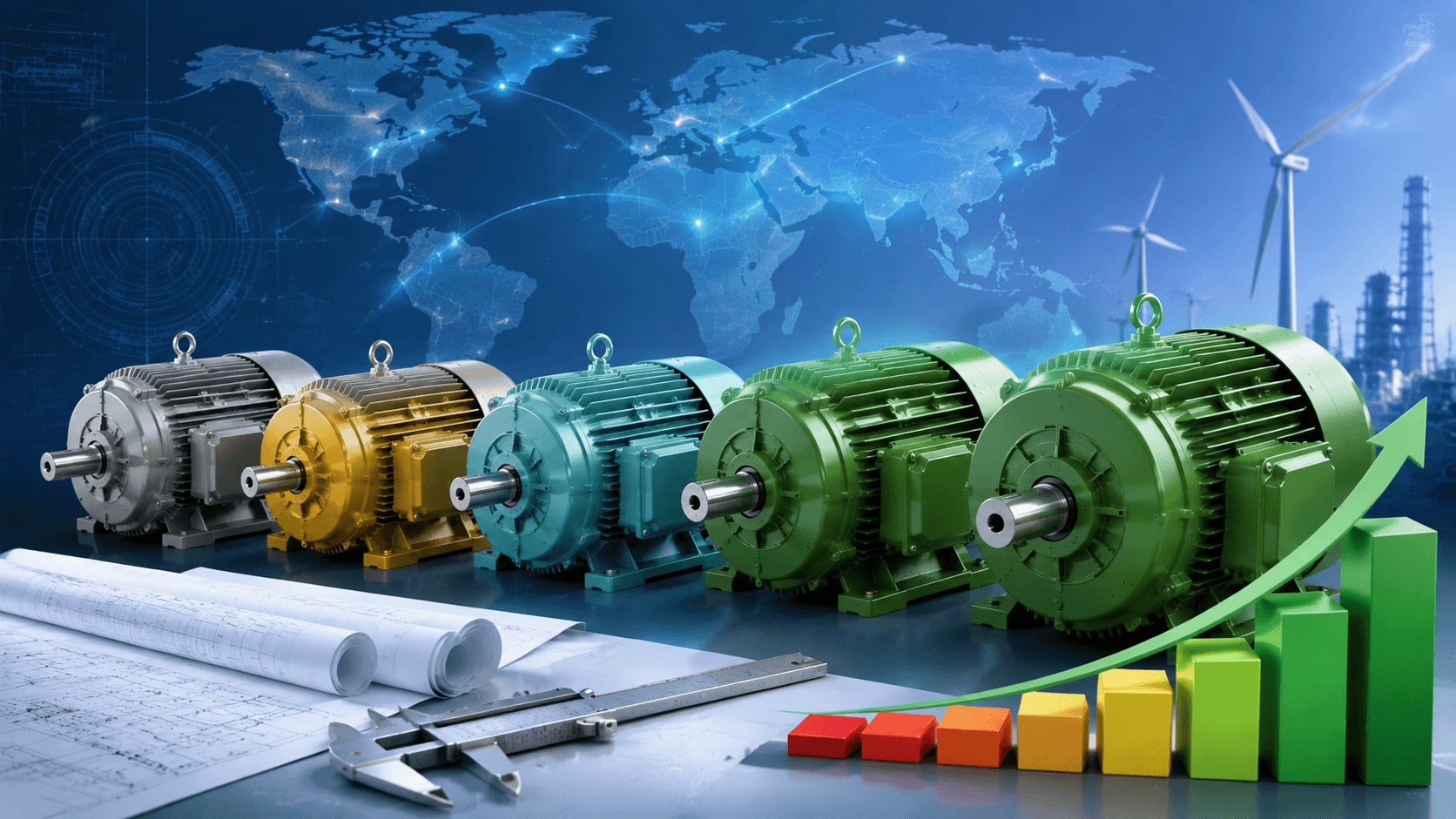
A comprehensive 2026 engineering guide to IE1–IE5 motor efficiency classes, encompassing global regulatory frameworks, electromagnetic design strategies, loss reduction methodologies, and technology pathways to IE4/IE5 achievement. Expert technical guidance from Techo Electrical & Mechanical (Titecho).
1. Introduction
Electric motors consume over 53% of all electricity worldwide and more than 70% of industrial electricity use. In an era of rising energy costs and decarbonisation mandates, motor efficiency has transitioned from a secondary specification to a primary engineering and procurement criterion. The International Electrotechnical Commission (IEC) established the International Efficiency (IE) classification system under IEC 60034-30-1 to harmonise global motor efficiency standards, creating a clear hierarchy from IE1 (Standard Efficiency) through IE5 (Ultra Premium Efficiency).
As of 2026, regulatory frameworks—particularly the EU's Ecodesign Regulation (EU) 2019/1781—have fundamentally reshaped the market landscape. IE3 is now mandatory for most three-phase motors (0.75–1000 kW), IE4 is required for 75–200 kW motors, and IE5 is emerging as the next frontier. This guide provides engineers with a comprehensive technical and regulatory reference for navigating these efficiency classes in 2026.
2. The IE Classification Framework: Technical Foundations
2.1 Standard IEC 60034-30-1
Published in March 2014 and subsequently updated, IEC 60034-30-1 defines efficiency classes for single-speed AC motors rated for direct-on-line operation:
| IE Class | Designation | Description |
|---|---|---|
| IE1 | Standard Efficiency | Baseline efficiency; legacy designs with minimal material optimisation |
| IE2 | High Efficiency | Improved magnetic materials; moderate energy savings over IE1 |
| IE3 | Premium Efficiency | Advanced lamination steel, optimised windings, reduced losses |
| IE4 | Super Premium Efficiency | Superior materials, precision manufacturing, advanced thermal management |
| IE5 | Ultra Premium Efficiency | Emerging class; ~20% lower losses than IE4; cutting-edge technology |
Scope: The standard covers motors from 0.12 kW to 1000 kW, at rated voltages above 50 V up to 1 kV, with 2, 4, 6, or 8 poles, operating at 50 Hz or 60 Hz.
Exclusions: Multi-speed motors, motors fully integrated into machines (pump-motor units), and brake motors where the brake cannot be dismantled.
2.2 Efficiency Thresholds: Quantitative Comparison
Efficiency values are defined at rated load using the test methods specified in IEC 60034-2-1:2014 (indirect method with additional losses measured). Representative values for 4-pole, 50 Hz motors illustrate the progression:
| Rated Power | IE1 (%) | IE2 (%) | IE3 (%) | IE4 (%) | IE5 (%) |
|---|---|---|---|---|---|
| 0.75 kW | ~72.0 | ~77.0 | 82.5 | 85.7 | 88.2 |
| 37 kW | ~89.0 | ~91.0 | 93.9 | 95.2 | 96.1 |
| 250 kW | ~93.0 | ~94.5 | 96.0 | 96.7 | 97.3 |
Key Insight: The absolute efficiency gap between classes narrows at higher power ratings, but the loss reduction (the inverse metric that determines energy savings and heat generation) becomes more significant. An IE5 motor at 250 kW loses only 2.7% of input power versus 4.0% for IE3—a 32.5% reduction in losses.
3. Regulatory Landscape in 2026
3.1 EU Ecodesign Regulation (EU) 2019/1781
The EU has been the most aggressive jurisdiction in mandating motor efficiency upgrades. The regulation entered full application on 1 July 2021, replacing the earlier Regulation (EC) 640/2009.
Current Requirements (as of 2026):
| Motor Category | Minimum Efficiency | Effective Date |
|---|---|---|
| Three-phase motors, 0.75–1000 kW | IE3 | July 2021 |
| Three-phase motors, 75–200 kW | IE4 | July 2023 |
| Single-phase motors > 0.12 kW | IE2 | July 2021 |
| Variable Speed Drives (VSDs) | IE2 | July 2021 |
Critical 2026 Update: The EU is progressively eliminating exemptions that previously allowed brake motors, extreme-temperature motors, and smaller single-phase motors to use lower efficiency classes. Engineers must verify that even long-standing motor models remain compliant, as an incomplete nameplate or outdated efficiency marking can constitute a regulatory violation.
3.2 Global Regulatory Convergence
While the EU leads in stringency, other jurisdictions are converging toward IE3 as a baseline:
| Region/Country | Standard | Minimum Requirement | Timeline |
|---|---|---|---|
| United States | NEMA MG-1 | NEMA Premium (~IE3) | Effective (EISA 2007) |
| China | GB 18613 | IE3 for many applications | 2016 onward |
| Australia/NZ | AS/NZS 1359.5 | IE3 equivalent | 2015 |
| Japan | Top Runner | IE3 equivalent | 2015 |
| South Korea | MEPS | IE3 equivalent | 2015 |
| Mexico, Morocco, South Africa | Updated MEPS | IE3 | 2025 |
Note: The Eurasian Economic Union (Armenia, Belarus, Kazakhstan, Kyrgyz Republic, Russia) has delayed MEPS implementation for industrial motors from 2025 to 2028, representing a notable exception to the global trend.
4. Engineering Design Strategies for Higher IE Classes
Achieving each successive IE class requires systematic loss reduction across all motor subsystems:
4.1 Loss Component Analysis and Reduction Strategies
| Loss Component | Typical Share in IE3 | Reduction Strategy for IE4/IE5 |
|---|---|---|
| Stator copper loss (I²R) | 35–45% | Increased copper mass; higher slot fill factors (75–80%); shorter end-turns; hairpin windings |
| Rotor copper/aluminium loss | 15–25% | Copper rotor die-casting (σ_Cu ≈ 58 MS/m vs. σ_Al ≈ 35 MS/m); optimised bar geometry |
| Core (iron) loss | 20–30% | Thinner laminations (0.35–0.50 mm); higher-grade silicon steel; reduced flux density; amorphous metal cores |
| Stray load loss | 5–15% | Optimised slot/pole combinations; precision air gap control (±5% uniformity); skewing |
| Friction and windage | 5–10% | Optimised fan design; low-friction bearings; aerodynamic rotor profiling |
4.2 Material Innovations
Magnetic Materials:
- Non-oriented silicon steel: Standard for IE2–IE3; 2–3.5% Si content balances permeability and resistivity
- Grain-oriented steel: Used in some IE4 designs for reduced hysteresis
- Amorphous metal: 70–80% lower core losses than conventional steel; emerging for IE5 but limited by lower saturation flux density (~1.5 T vs. 2.0 T)
Conductors:
- Copper rotors: Reduce rotor losses by 15–25% compared to aluminium; now achievable at production scale through proprietary oxygen-free die-casting processes
- Aluminium: Still used in IE3 for cost-sensitive applications; die-cast aluminium offers manufacturing efficiency
Permanent Magnets (for PM-assisted designs):
- NdFeB magnets: Enable highest efficiency in PMSM configurations for IE4/IE5
- Ferrite-assisted synchronous reluctance motors: Reduce rare-earth dependency while maintaining IE4+ performance
4.3 Manufacturing Precision
Higher IE classes demand tighter tolerances:
| Parameter | IE2/IE3 Tolerance | IE4/IE5 Tolerance | Impact |
|---|---|---|---|
| Air gap uniformity | ±10% | ±5% | Reduces unbalanced magnetic pull and stray losses |
| Stator bore concentricity | 0.05 mm | 0.02 mm | Ensures consistent flux distribution |
| Rotor bar placement | ±0.5 mm | ±0.2 mm | Minimises harmonic content |
| Winding resistance balance | ±2% | ±1% | Prevents circulating currents |
5. Motor Technology Comparison for IE4/IE5 Achievement
Not all motor technologies can practically achieve IE5. The CIGRE Working Group A1.47 conducted a global feasibility study identifying viable pathways:
| Motor Technology | IE3 Feasibility | IE4 Feasibility | IE5 Feasibility | Key Characteristics |
|---|---|---|---|---|
| Cage Induction Motor | ✓ Standard | ✓ Achievable (copper rotor) | △ Marginal; requires amorphous core | Robust, low cost, line-start capable |
| Synchronous Reluctance Motor (SynRM) | ✓ With inverter | ✓ Standard | ✓ Achievable | No magnets; lower power factor (0.70–0.85) |
| PM-Assisted SynRM | ✓ | ✓ | ✓ | Ferrite or NdFeB boost; balanced cost/performance |
| Interior PMSM (IPMSM) | ✓ | ✓ | ✓ | Highest efficiency; requires inverter; rare-earth dependent |
| Wound-Field Synchronous | ✓ | △ | ✗ | Complex; mainly for very large machines |
Practical Implication: For line-operated (direct-on-line) applications, copper-rotor induction motors represent the primary path to IE4. For inverter-fed applications, SynRM and IPMSM technologies offer the most promising routes to IE5.
6. Economic Analysis: Lifecycle Cost vs. First Cost
6.1 Energy Cost Dominance
Motor purchase price typically represents only 2–5% of total lifecycle cost; energy dominates at 95–97%. A 2026 economic analysis for a 75 kW motor operating 6,000 hours/year at €0.12/kWh demonstrates this:
| Efficiency Class | Assumed Efficiency | Annual Energy Cost | Annual Savings vs. IE1 | Cumulative 15-Year Savings |
|---|---|---|---|---|
| IE1 | 90.0% | €6,000 | Baseline | — |
| IE2 | 93.0% | €5,806 | €194 (3.2%) | €2,910 |
| IE3 | 95.0% | €5,684 | €316 (5.3%) | €4,740 |
| IE4 | 96.5% | €5,596 | €404 (6.7%) | €6,060 |
| IE5 | 97.5% | €5,538 | €462 (7.7%) | €6,930 |
Payback Period: IE3 motors typically achieve payback within 1–2 years; IE4/IE5 within <1 year for continuous-duty applications.
6.2 System Efficiency: The VFD Factor
Motor efficiency is only one component of system efficiency. The complete system efficiency is:
η_system = η_motor × η_drive × η_transmission
Modern VFDs achieve 96–98% efficiency (IE2-rated per EU regulation). For variable-torque applications (pumps, fans), VFDs can reduce energy consumption by 20–50% by matching motor speed to actual load requirements, independent of motor IE class.
2026 Regulatory Note: The EU removed the previous exemption allowing IE2 motors when paired with VSDs. As of July 2021, the motor itself must meet IE3 regardless of VFD integration.
7. Partial-Load Performance: The Hidden Efficiency Trap
A critical engineering consideration often overlooked is efficiency at partial load. Motors rarely operate at exactly 100% rated load, and efficiency curves vary significantly by technology:
| Technology | 100% Load Efficiency | 50% Load Efficiency | 75% Load Efficiency |
|---|---|---|---|
| IE3 Induction Motor | 95.0% | 88–92% | 93–94% |
| IE4 Induction Motor | 96.5% | 90–94% | 95–96% |
| PMSM (IPM) | 97.0% | 94–96% | 96–97% |
| SynRM | 96.0% | 93–95% | 95–96% |
Key Insight: PMSMs and SynRMs maintain significantly higher efficiency at partial loads compared to induction motors. For applications with variable duty cycles, this partial-load advantage can exceed the rated-load efficiency difference.
8. 2026 Market Status and Procurement Guidance
8.1 Availability by IE Class
| IE Class | Market Availability (2026) | Typical Lead Time | Price Premium vs. IE3 |
|---|---|---|---|
| IE1 | Phased out in EU; limited elsewhere | N/A (non-compliant in EU) | N/A |
| IE2 | Restricted to specific exemptions; being phased out | Standard | Baseline for non-regulated markets |
| IE3 | Broad availability; industry standard | 2–8 weeks | Baseline |
| IE4 | Growing availability; mandatory for 75–200 kW in EU | 4–12 weeks | +15–30% |
| IE5 | Limited availability; emerging technology | 8–16 weeks | +30–50% |
8.2 Procurement Checklist for Engineers
When specifying motors in 2026, verify the following:
- Efficiency class marking on the nameplate (IE code and minimum efficiency value)
- Test method compliance (must reference IEC 60034-2-1:2014 or later)
- Regulatory compliance for target market (EU 2019/1781, DOE EISA, etc.)
- Partial-load efficiency data for variable-duty applications
- VFD compatibility if variable speed is required
- Power factor at rated and partial load (affects infrastructure sizing)
- Thermal class (Class F minimum for IE3/IE4; Class H for high-performance applications)
- Documentation completeness (incomplete nameplates can constitute regulatory violations)
9. Future Outlook: Beyond IE5
9.1 IE5 Standardisation Status
IE5 is currently envisaged but not yet formally defined in IEC 60034-30-1. The target is a 20% loss reduction relative to IE4. CIGRE's feasibility study estimated that achieving IE5 across the global motor installed base by 2030 would save approximately 378 TWh annually—equivalent to 108 GW of power plant capacity and €30.2 billion in electricity costs.
9.2 Emerging Technologies for IE5 and Beyond
| Technology | Principle | Status (2026) |
|---|---|---|
| Amorphous metal cores | Non-crystalline structure eliminates grain boundary losses | Pilot production; cost remains barrier |
| Superconducting motors | Zero-resistance windings at cryogenic temperatures | MW-scale demonstrators; not yet commercial |
| Integrated motor-drives | Co-designed motor and GaN/SiC inverter | Commercial for <50 kW; expanding |
| Digital twin optimisation | Real-time efficiency tuning via IoT sensors | Emerging; predictive maintenance integration |
| Axial-flux motors | Short flux path; high torque density | Niche applications (EVs, aerospace); scaling up |
9.3 Regulatory Trajectory
The EU's ErP 2026 update is expected to further tighten requirements, potentially:
- Expanding IE4 mandates to additional power ranges
- Introducing IE5 as a mandatory minimum for certain categories by 2028–2030
- Requiring smart system integration and enhanced product labelling
- Phasing out inefficient AC motors in favour of EC (electronically commutated) fan-motor combinations in HVAC applications
10. Conclusion
The transition from IE1 to IE5 represents one of the most significant engineering and regulatory shifts in the history of electric motor technology. As of 2026, IE3 is the global baseline for industrial three-phase motors, IE4 is mandatory for mid-range power in the EU, and IE5 is emerging as the next frontier for cutting-edge applications.
For engineers, the implications are clear:
- Regulatory compliance is non-negotiable: The EU's elimination of exemptions and strict nameplate requirements means that procurement must verify compliance at the specification stage.
- Lifecycle cost dominates: Even with 15–30% first-cost premiums, IE4 motors pay back within a year for continuous-duty applications.
- System thinking is essential: Motor efficiency must be evaluated alongside VFD efficiency, partial-load performance, and application duty cycle.
- Technology selection matters: Induction motors with copper rotors serve line-start IE4 needs; SynRM and PMSM technologies are the pathways to IE5 for inverter-fed systems.
The global motor stock turns over slowly—many IE1 and IE2 motors remain in service. Accelerating replacement with IE3+ motors represents one of the most cost-effective decarbonisation strategies available, with payback periods measured in months rather than years. Engineers who master the IE classification system and its regulatory implications will be positioned to deliver both economic value and environmental impact in 2026 and beyond.
Reference Standards:
- Efficiency classification: IEC 60034-30-1:2014 (and subsequent amendments)
- Test procedures: IEC 60034-2-1:2014
- EU regulatory compliance: Regulation (EU) 2019/1781 and Commission Regulation (EU) 2021/341
- North American equivalents: NEMA MG-1 and DOE 10 CFR Part 431
11. High-Efficiency Motor Solutions with Titecho
Techo Electrical & Mechanical (Taizhou) Co., Ltd. (Brand: Titecho) specialises in the design and manufacture of high-efficiency three-phase AC induction motors meeting and exceeding IE3 and IE4 standards. Our product portfolio features advanced electromagnetic designs, premium copper windings, precision-manufactured laminations, and rigorous quality control processes to ensure certified efficiency performance.
We provide comprehensive engineering support, including efficiency verification, partial-load performance analysis, VFD compatibility assessment, and regulatory compliance guidance for global markets.
Explore technical data sheets, efficiency curves, and application engineering support at www.cntecho.com.
© Techo Electrical & Mechanical (Titecho) – Advancing Motor Efficiency for a Sustainable Future