Understanding How Mixed Flow Pumps Work — No Engineering Degree Required
What Is a Mixed Flow Pump? (In Simple Terms)
A mixed flow pump is a type of pump that sits right in the middle between two other common pump types:
- Centrifugal pump → pushes water straight out to the side (radial flow)
- Axial flow pump → pushes water straight up or down (like a propeller)
- Mixed flow pump → pushes water both outward AND upward at the same time
Think of it like a garden hose nozzle that sprays water in a cone shape — not just a straight stream, and not just a flat spray. That is essentially what a mixed flow pump does with water inside the pump.
Why Should You Care? The Key Advantage
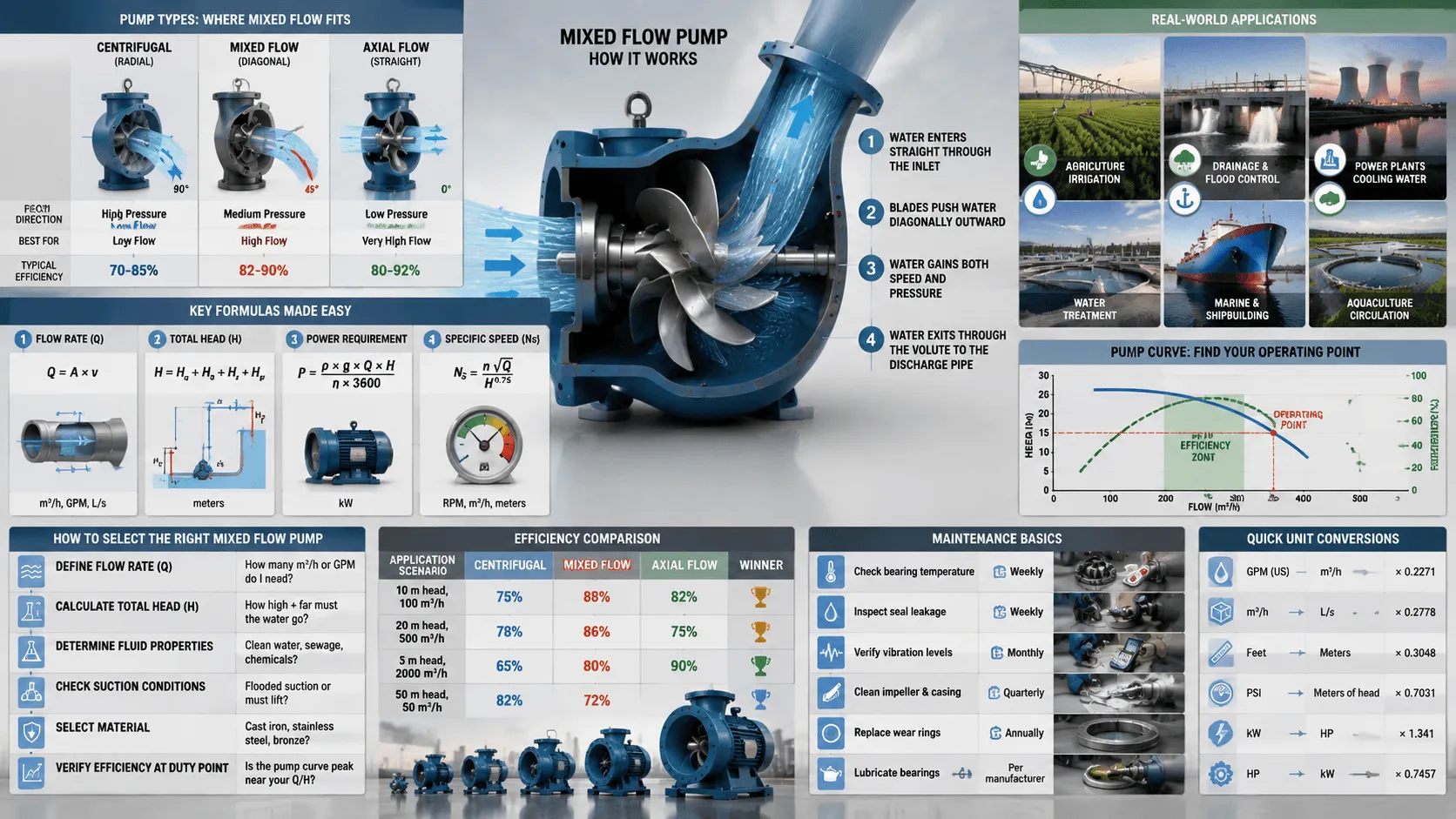
| Pump Type | Flow Direction | Best For | Typical Efficiency |
|---|---|---|---|
| Centrifugal (Radial) | 90° outward | High pressure, low flow | 70–85% |
| Axial Flow | 0° straight through | Low pressure, massive flow | 80–92% |
| Mixed Flow | 45° diagonal | Medium pressure + high flow | 82–90% |
Mixed flow pumps are the "sweet spot" when you need:
- Higher flow rates than centrifugal pumps can deliver
- More pressure than axial pumps can generate
- Better efficiency than either at medium-head applications
How Does It Actually Work? (The Simple Version)
The Core Idea: Impeller Design
Inside every mixed flow pump is a specially shaped spinning wheel called an impeller. Unlike a simple propeller or a flat centrifugal wheel, the mixed flow impeller has blades angled at roughly 30° to 60° to the shaft axis.
Here is what happens when the impeller spins:
- Step 1: Water enters straight through the inlet (eye of the impeller).
- Step 2: Blades catch the water and push it diagonally outward.
- Step 3: Water gains both speed AND pressure simultaneously.
- Step 4: Water exits through the volute (curved casing) to the discharge pipe.
The Math Made Easy: Key Formulas
Do not worry — you do not need to calculate these yourself. But understanding what they mean helps you read pump datasheets like a pro.
1. Flow Rate (Q)
The volume of water the pump moves per unit time.
Q = A × v
| Symbol | Meaning | Common Units |
|---|---|---|
| Q | Flow rate | m³/h, GPM (gallons per minute), L/s |
| A | Cross-sectional area of pipe | m² |
| v | Velocity of fluid | m/s |
Example: A 6-inch pipe (A ≈ 0.0182 m²) with water moving at 2.5 m/s delivers:
Q = 0.0182 × 2.5 = 0.0455 m³/s = 164 m³/h
2. Total Head (H)
The total height + pressure the pump must overcome.
H = H_d + H_s + H_f + H_p
| Component | What It Means | How to Estimate |
|---|---|---|
| H_d | Discharge head (height water goes UP) | Measure vertical distance |
| H_s | Suction head (height water comes FROM) | Usually negative (lift) |
| H_f | Friction losses in pipes | ~5–15% of total length |
| H_p | Pressure requirement at outlet | Check system specs |
Quick Rule of Thumb: For every 10 meters of horizontal pipe, add ~0.5–1 meter of equivalent head loss due to friction.
3. Pump Power Requirement
How much motor power you actually need:
P = (ρ × g × Q × H) / (η × 3600)
| Symbol | Meaning | Value/Unit |
|---|---|---|
| P | Shaft power | kW |
| ρ (rho) | Fluid density | 1000 kg/m³ (for water) |
| g | Gravity | 9.81 m/s² |
| Q | Flow rate | m³/h |
| H | Total head | m |
| η (eta) | Pump efficiency | 0.82–0.90 (82–90%) |
Practical Example:
You need to pump 500 m³/h of water to a height of 12 meters with a mixed flow pump running at 85% efficiency.
P = (1000 × 9.81 × 500 × 12) / (0.85 × 3600)
P = 58,860,000 / 3,060 ≈ 19.2 kW
→ You need approximately a 20–22 kW motor (always add a 10–15% safety margin).
4. Specific Speed (Ns) — The "Pump Personality" Number
This tells you what "family" a pump belongs to:
N_s = (n × √Q) / H^0.75
| Ns Range | Pump Type | Characteristics |
|---|---|---|
| < 2,000 | Centrifugal (radial) | High head, low flow |
| 2,000 – 5,000 | Mixed flow | Medium head, medium-high flow |
| 5,000 – 15,000 | Axial flow | Low head, very high flow |
Mixed flow pumps typically have Ns between 3,000–4,500 — right in that efficient middle ground.
Real-World Applications
| Industry | Typical Use Case | Why Mixed Flow? |
|---|---|---|
| Agriculture | Large-scale irrigation | High volume + moderate lift |
| Drainage & Flood Control | Stormwater pumping stations | Handles huge flow rates efficiently |
| Power Plants | Cooling water circulation | Reliable, energy-efficient |
| Water Treatment | Raw water intake | Balanced pressure and flow |
| Marine & Shipbuilding | Ballast and bilge systems | Compact, high-capacity design |
| Aquaculture | Pond and tank circulation | Gentle on fish, high turnover |
How to Select the Right Mixed Flow Pump
Step-by-Step Selection Checklist
| Step | What to Do | Key Question |
|---|---|---|
| 1 | Define your flow rate (Q) | How many m³/h or GPM do I need? |
| 2 | Calculate your total head (H) | How high + far must the water go? |
| 3 | Determine fluid properties | Is it clean water, sewage, or chemicals? |
| 4 | Check suction conditions | Is it flooded suction or must lift? |
| 5 | Select material | Cast iron, stainless steel, bronze? |
| 6 | Verify efficiency at duty point | Is the pump curve peak near your Q/H? |
The Pump Curve: Your Best Friend
Every pump has a performance curve that looks like this conceptually:
Head (m)
   │
30 ┤      ╭─────
25 ┤    ╭─╯
20 ┤   ╭╯       ← Peak efficiency zone
15 ┤  ╭╯
10 ┤ ╭╯
 5 ┤╭╯
 0 ┼────┬────┬────┬────┬────→ Flow (m³/h)
    0   100  200  300  400
Pro Tip: Always choose a pump where your operating point (Q, H) falls within the middle 60% of the curve — that is where efficiency is highest and wear is lowest.
Efficiency Comparison: Mixed Flow vs. Alternatives
| Application Scenario | Centrifugal | Mixed Flow | Axial Flow | Winner |
|---|---|---|---|---|
| 10m head, 100 m³/h | 75% | 88% | 82% | Mixed Flow |
| 20m head, 500 m³/h | 78% | 86% | 75% | Mixed Flow |
| 5m head, 2000 m³/h | 65% | 80% | 90% | Axial Flow |
| 50m head, 50 m³/h | 82% | 72% | 55% | Centrifugal |
Common Myths Debunked
| Myth | Reality |
|---|---|
| "Mixed flow pumps are just weak centrifugal pumps" | ❌ False. They handle higher flow at lower power for medium-head jobs. |
| "They're too complex to maintain" | ❌ False. Modern designs have fewer parts than many centrifugal pumps. |
| "Only experts can select them" | ❌ False. With Q and H, any supplier can match you in minutes. |
| "They're always more expensive" | ⚠️ Partially true upfront, but energy savings pay back within 1–3 years. |
Maintenance Basics (Keep It Running for Years)
| Task | Frequency | Why It Matters |
|---|---|---|
| Check bearing temperature | Weekly | Overheating = early failure warning |
| Inspect seal leakage | Weekly | Small leaks become big problems |
| Verify vibration levels | Monthly | Unbalance causes shaft damage |
| Clean impeller & casing | Quarterly | Debris kills efficiency fast |
| Replace wear rings | Annually | Maintains design clearance & performance |
| Lubricate bearings | Per manufacturer | Proper grease type & amount critical |
Quick Reference: Unit Conversions
| From | To | Multiply By |
|---|---|---|
| GPM (US) | m³/h | × 0.2271 |
| m³/h | L/s | × 0.2778 |
| Feet | Meters | × 0.3048 |
| PSI | Meters of head | × 0.7031 |
| kW | HP | × 1.341 |
| HP | kW | × 0.7457 |
Final Thoughts
Mixed flow pumps are not magic — they are smart engineering that fills a real gap in the pump world. If your application needs:
- ✅ More flow than a centrifugal pump can deliver
- ✅ More pressure than an axial pump can generate
- ✅ Lower energy bills than either alternative
...then a mixed flow pump deserves a serious look.
Still unsure? Start with these two numbers:
- Your required flow rate (Q) in m³/h or GPM
- Your required total head (H) in meters or feet
With just those two values, any pump engineer can point you to the right mixed flow pump in minutes.
Want a personalized pump selection? Contact our engineering team with your Q and H requirements — we will match you with the optimal mixed flow pump for your application.