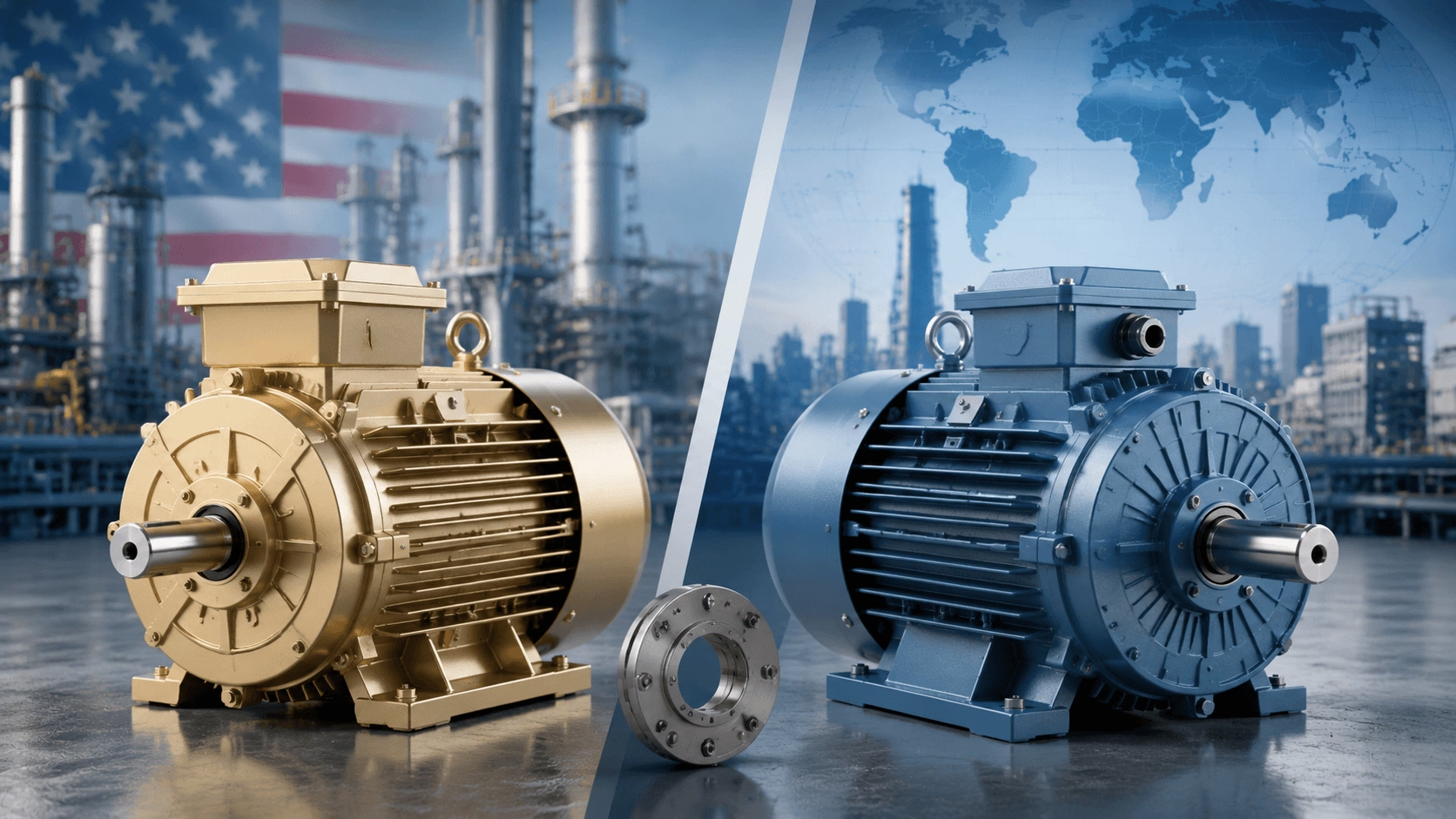
IEC vs. NEMA Motor Standards: Differences, Interchangeability & Selection Guide (2026)
A comprehensive technical analysis comparing IEC and NEMA electric motor standards, covering dimensional compatibility, efficiency classifications, service factors, and strategic selection criteria for global industrial applications.
Introduction: The Strategic Implications of Motor Standard Selection
When specifying electric motors for industrial systems, engineering teams typically prioritize power rating (kW/HP), efficiency class, and acquisition cost. However, a foundational decision that profoundly influences long-term operational success is frequently underestimated: the choice between IEC and NEMA motor standards.
This selection dictates:
- Installation Compatibility: Mechanical interface alignment with driven equipment and infrastructure.
- Maintenance Complexity: Spare parts availability, repair procedures, and technician familiarity.
- Energy Efficiency Trajectory: Compliance with current and future regulatory frameworks.
- Total Cost of Ownership (TCO): Encompassing energy consumption, downtime, adaptation costs, and lifecycle management.
In multinational projects or facilities with mixed-standard legacy equipment, a mismatch can precipitate expensive redesigns, custom adapter fabrication, extended lead times, or catastrophic system incompatibility. This 2026 guide provides the definitive technical reference for navigating these two dominant engineering paradigms.
Defining the Standards: IEC vs. NEMA
NEMA (National Electrical Manufacturers Association)
- Geographic Dominance: North America (United States, Canada, Mexico).
- Governing Document: NEMA MG-1 Motors and Generators.
- Philosophy: Emphasizes durability, application flexibility, and built-in safety margins for diverse and often harsh industrial environments.
IEC (International Electrotechnical Commission)
- Geographic Dominance: Global standard adopted by Europe, Asia, Australia, Africa, and increasingly in export-oriented manufacturing worldwide.
- Governing Documents: IEC 60034 series (Rotating Electrical Machines).
- Philosophy: Prioritizes metric standardization, material efficiency, precise performance matching, and international harmonization.
Market Context: Approximately 70% of motors manufactured globally conform to IEC standards, reflecting its dominance in international trade and OEM supply chains.
Both standards define mechanical dimensions, electrical characteristics, testing methodologies, and performance requirements. However, they originate from fundamentally different engineering cultures, resulting in systematic technical divergences.
Core Engineering Philosophy: Why They Differ Fundamentally
| Aspect | NEMA Philosophy | IEC Philosophy |
|---|---|---|
| Primary Design Goal | Durability, overload tolerance, and application versatility | Efficiency optimization, dimensional standardization, and material economy |
| Physical Build | Larger frame sizes, heavier construction, conservative thermal design | Compact form factor, lightweight materials, precision-engineered thermal management |
| Target Application Profile | Harsh environments, variable loads, maintenance-intensive settings | Standardized global systems, optimized duty cycles, space-constrained installations |
| Safety Margin Approach | Built-in Service Factor (typically 1.15) allows sustained overload | Rated at 1.0 continuous duty; overload capability limited to short-duration emergency ratings |
Key Insight: NEMA motors are conventionally "overbuilt" to provide inherent operational headroom. IEC motors are "precision-matched" to specific duty points, maximizing efficiency at rated load but offering less intrinsic margin. This philosophical divergence underpins virtually all technical differences described below.
10 Critical Technical Differences: Deep Dive Analysis
1. Measurement System and Nomenclature
- NEMA: Imperial units (inches, feet); power rated in horsepower (HP); speed in RPM.
- IEC: Metric units (millimeters, meters); power rated in kilowatts (kW); speed in min⁻¹.
Practical Impact: Direct conversion errors occur when 1 HP ≠ 0.746 kW exactly in frame sizing contexts. Engineering drawings, procurement specifications, and maintenance documentation require careful unit reconciliation in mixed-standard facilities.
2. Frame Size Designation and Mechanical Envelope
Frame size defines shaft center height, mounting bolt patterns, foot spacing, and overall envelope dimensions.
- NEMA Frames: Designated by numbers (e.g., 184T, 286TS). Fewer discrete frame sizes with larger dimensional increments. T-suffix indicates standardized dimensions per MG-1.
- IEC Frames: Designated by metric shaft height in mm (e.g., 112M, 160L). More granular size progression enabling tighter application matching. Letter suffixes (S, M, L) indicate frame length variants within same shaft height.
Critical Note: NEMA and IEC frames are not dimensionally interchangeable. A 10 HP NEMA motor and a 7.5 kW IEC motor have different shaft heights, bolt circles, and foot geometries despite similar power output.
3. Shaft Geometry and Coupling Compatibility
- NEMA Shafts: Generally longer extension lengths; keyways conform to ANSI B17.1; tolerances per NEMA MG-1.
- IEC Shafts: Shorter standard extensions; keyways per ISO/R773 or DIN 6885; tolerances per IEC 60072.
Consequence: Direct coupling replacement is rarely possible. Retrofitting typically requires spacer couplings, custom adapters, or shaft modification. Always verify shaft diameter, length, keyway dimensions, and tolerance class before substitution.
4. Mounting Configurations and Installation Flexibility
- NEMA: Foot-mounted (F1, F2) configurations dominate. Flange-mounted options exist but with less modular variety.
- IEC: Comprehensive mounting designation system per IEC 60034-7:
- B3: Foot-mounted
- B5: Large flange (free-standing)
- B14: Small flange (face-mounted)
- B35: Combined foot and large flange
- Additional variants (V1, V3, etc.) for vertical orientations
Advantage: IEC’s modular mounting taxonomy facilitates OEM integration, space-optimized layouts, and standardized replacement across diverse installation orientations.
5. Service Factor: The Most Critical Operational Difference
- NEMA: Standard motors include a Service Factor (SF), typically 1.15 for integral horsepower AC motors. This permits continuous operation at SF × rated load without exceeding insulation temperature limits. A 10 HP motor with SF 1.15 can continuously deliver 11.5 HP.
- IEC: Motors are rated at S1 continuous duty at 1.0 load. No equivalent service factor exists. Overload capacity is defined only as short-time emergency rating (e.g., S2 duty for specified minutes).
⚠️ Warning: Replacing a NEMA motor operating near its service factor with an equivalently-rated IEC motor will result in chronic overloading, accelerated insulation degradation, and premature failure. Proper upsizing is mandatory when converting from NEMA to IEC in loaded applications.
6. Efficiency Classification Systems
- IEC (IE Code): Globally harmonized tiers per IEC 60034-30-1:
- IE1: Standard Efficiency
- IE2: High Efficiency
- IE3: Premium Efficiency
- IE4: Super Premium Efficiency
- IE5: Ultra Premium Efficiency (emerging)
- NEMA: Historically used "Standard," "Energy Efficient," and "Premium Efficient" labels. Now largely aligned with IE codes through NEMA Premium® program, but legacy terminology persists in North American specifications.
Regulatory Note: IE classification is the basis for minimum energy performance standards (MEPS) in the EU, China, India, Brazil, and other jurisdictions. IEC labeling provides unambiguous global compliance documentation for ESG reporting and regulatory submissions.
7. Starting Current and Electrical Characteristics
- NEMA Motors: Typically designed with lower locked-rotor current (LRC), often 6–7× full-load current (FLC). Code letters on nameplate indicate starting kVA/HP range.
- IEC Motors: Often exhibit higher inrush current, potentially 7–9× FLC, due to optimized magnetic circuits prioritizing running efficiency over starting performance.
System Impact: Higher IEC inrush may necessitate oversized upstream protection, soft starters, or VFDs to avoid voltage dip issues. Coordination studies should account for standard-specific starting characteristics.
8. Terminal Box and Wiring Architecture
- NEMA: Traditionally uses flying leads brought out through conduit openings. Field connections made via wire nuts or lug terminals inside junction box.
- IEC: Standardized terminal block systems with clearly marked U/V/W terminals, ground stud, and often pre-installed links for star/delta configuration changes.
Operational Benefit: IEC terminal blocks enable faster, cleaner, more repeatable field wiring and are better suited to automated production environments and standardized maintenance procedures.
9. Enclosure Protection and Cooling Designations
- NEMA Enclosures: Type designations (ODP, TEFC, TEBC, XPFC, etc.) describe environmental protection qualitatively. Multiple overlapping categories can create specification ambiguity.
- IEC IP Ratings: Quantitative Ingress Protection coding per IEC 60529:
- First Digit: Solid particle protection (0–6)
- Second Digit: Liquid ingress protection (0–9K)
- Example: IP55 = dust-protected + water jet resistant
Clarity Advantage: IP ratings provide unambiguous, internationally recognized environmental specifications. IC cooling codes per IEC 60034-6 further standardize ventilation method descriptions.
10. Regional Adoption and Supply Chain Dynamics
| Region | Predominant Standard | Notes |
|---|---|---|
| United States / Canada | NEMA | Legacy installed base; NEMA remains specification default |
| European Union | IEC | Mandatory CE marking; IE3+ MEPS enforced |
| China / Southeast Asia | IEC | GB standards harmonized with IEC; export production uses IEC |
| Middle East / Africa | IEC | European influence; IEC specified in most EPC contracts |
| Latin America | Mixed | NEMA legacy + growing IEC adoption for new projects |
| Global OEM Equipment | IEC | Machine builders standardize on IEC for worldwide market access |
Interchangeability Assessment: Can IEC and NEMA Motors Be Swapped?
Short Answer: ❌ Not Directly Interchangeable
Direct drop-in replacement between NEMA and IEC motors is not possible without mechanical and/or electrical modifications due to:
- Dissimilar frame dimensions and shaft center heights
- Mismatched shaft diameters, lengths, and keyway specifications
- Different mounting bolt patterns and foot spacings
- Service factor disparity requiring power re-evaluation
- Terminal box location and wiring configuration differences
Conditions Under Which Substitution Is Feasible
Replacement may be accomplished when:
- Power and speed ratings are properly matched (accounting for SF derating)
- Adapter plates or transition bases are fabricated/installled
- Shaft coupling is modified or replaced with adjustable/spacer type
- Electrical protection and starter settings are recalibrated for different starting characteristics
- Physical clearance is verified for potentially different envelope dimensions
Engineering Reality Check
"Dimensional compatibility between NEMA and IEC is essentially nonexistent. Even nominally equivalent ratings require adapter hardware and careful electrical review. Plan for modification, not plug-and-play."
"NEMA’s overbuilt philosophy yields forgiving field performance; IEC’s precision demands correct application matching. Neither is superior—they serve different design intents."
Total Cost of Ownership Comparison
| Cost Factor | NEMA | IEC | Commentary |
|---|---|---|---|
| Initial Acquisition Cost | Generally higher | Generally lower | IEC’s material efficiency and global volume reduce unit cost |
| Physical Footprint | Larger | More compact | IEC saves floor space, structural steel, and enclosure volume |
| Energy Efficiency (at rated load) | High (NEMA Premium ≈ IE3) | Equal or higher (IE3/IE4 readily available) | Comparable at equivalent tiers; IEC offers clearer upgrade path |
| Overload Tolerance | Superior (SF 1.15) | Limited (S1 @ 1.0) | NEMA advantage in variable/unpredictable load applications |
| Lifespan in Harsh Environments | Longer (robust construction) | Adequate with proper IP/specification | NEMA margin beneficial where conditions exceed design basis |
| Lifespan in Optimized Systems | Good | Excellent | IEC excels when correctly applied at BEP with stable loads |
| Global Spare Parts Availability | Regional (North America) | Worldwide | IEC reduces inventory complexity for multinational operations |
| Regulatory Compliance Documentation | Regional | Universal | IEC simplifies multi-jurisdiction certification |
Strategic Conclusion:
- Heavy-duty, harsh-environment, North American-centric operations → NEMA retains advantages in overload margin and proven field robustness.
- Global deployments, energy-regulated markets, space-constrained or efficiency-critical applications → IEC delivers superior value through standardization, compactness, and regulatory alignment.
Expert Selection Framework: Choosing the Right Standard
Select NEMA When:
- Project site is in North America with existing NEMA infrastructure
- Process loads are highly variable or frequently exceed nominal rating
- Environmental conditions are severe (extreme temperatures, heavy contamination, washdown)
- Maintenance staff has deep NEMA-specific expertise and tooling
- Existing spare parts inventory is NEMA-based
Select IEC When:
- Equipment will be exported or deployed across multiple countries
- Installation space is constrained or weight-sensitive
- Energy efficiency regulations (MEPS) apply at point of use
- OEM equipment requires global platform standardization
- Future-proofing against evolving international standards is prioritized
- Capital cost optimization is critical without sacrificing rated performance
Advanced Strategy: Hybrid Compatibility Design
Sophisticated specifiers increasingly adopt a dual-compatibility approach:
- Specify IEC motors as baseline for global efficiency and cost benefits
- Require NEMA-compatible mounting adapters or dual-drilled foot patterns
- Source motors with universal terminal boxes accommodating both wiring conventions
- Maintain cross-reference tables linking IEC and NEMA equivalents for each application
Benefits: Global sourcing flexibility, reduced TCO, simplified future replacement regardless of standard availability, and insulation against supply chain disruptions.
Frequently Asked Questions
Q1: Which motor standard is objectively better, IEC or NEMA?
Neither standard is universally superior. NEMA excels in overload tolerance and harsh-environment durability. IEC leads in efficiency standardization, compact design, and global interoperability. Optimal selection depends on geographic location, application profile, regulatory environment, and organizational maintenance capabilities.
Q2: Can an IEC motor directly replace a NEMA motor?
Not as a direct drop-in. Mechanical dimensions, shaft geometry, and service factor ratings differ systematically. Replacement requires adapter hardware, coupling modification, electrical recalibration, and verification that the IEC motor’s continuous rating adequately covers the actual load previously served by the NEMA motor’s service factor capacity.
Q3: Why are IEC motors physically smaller than equivalent NEMA motors?
IEC design philosophy optimizes material utilization and thermal management for rated-load efficiency rather than incorporating generous overload margins. Advanced electromagnetic design, improved insulation systems, and precision manufacturing enable equivalent performance in a more compact envelope.
Q4: Why do NEMA motors tolerate sustained overload while IEC motors do not?
NEMA’s Service Factor (typically 1.15) reflects a deliberate design choice to embed thermal headroom into the motor, accommodating unpredictable industrial loads. IEC rates motors at true continuous capacity (S1, 1.0), treating overload as an exceptional condition addressed through proper application engineering rather than built-in margin.
Q5: Which standard is more future-proof for long-term asset planning?
IEC demonstrates stronger trajectory toward universal adoption due to global regulatory harmonization, international trade requirements, and expanding MEPS frameworks. However, NEMA’s extensive North American installed base ensures continued relevance for decades. For new installations with >15-year horizons, IEC offers broader strategic optionality.
Conclusion: Strategic Alignment Over Standard Loyalty
IEC and NEMA are not competing products but distinct engineering systems reflecting different historical priorities, regional practices, and design philosophies. Treating them as interchangeable commodities invites costly failures; treating either as inherently superior ignores legitimate application-specific advantages.
The competitive advantage in 2026 belongs to organizations that:
- Understand both standards deeply, including their philosophical origins and practical implications
- Design for compatibility through hybrid specifications and adapter strategies
- Select based on rigorous application analysis rather than habit, tradition, or supplier convenience
- Evaluate total lifecycle value encompassing energy, maintenance, adaptability, and regulatory risk
Motor standard selection is a strategic engineering decision with multi-decade consequences. Invest the analytical effort upfront to secure decades of reliable, efficient, and adaptable operation.
Sourcing IEC & NEMA Compatible Motor Solutions
For high-quality centrifugal pump motors and industrial drive systems engineered to both IEC and NEMA standards, with global compliance documentation and hybrid compatibility options:
🌐 Product Portfolio & Technical Resources: www.cntecho.com
✉️ Engineering Consultation & Quotations: [email protected]
Engineered for global performance. Built for lasting reliability.