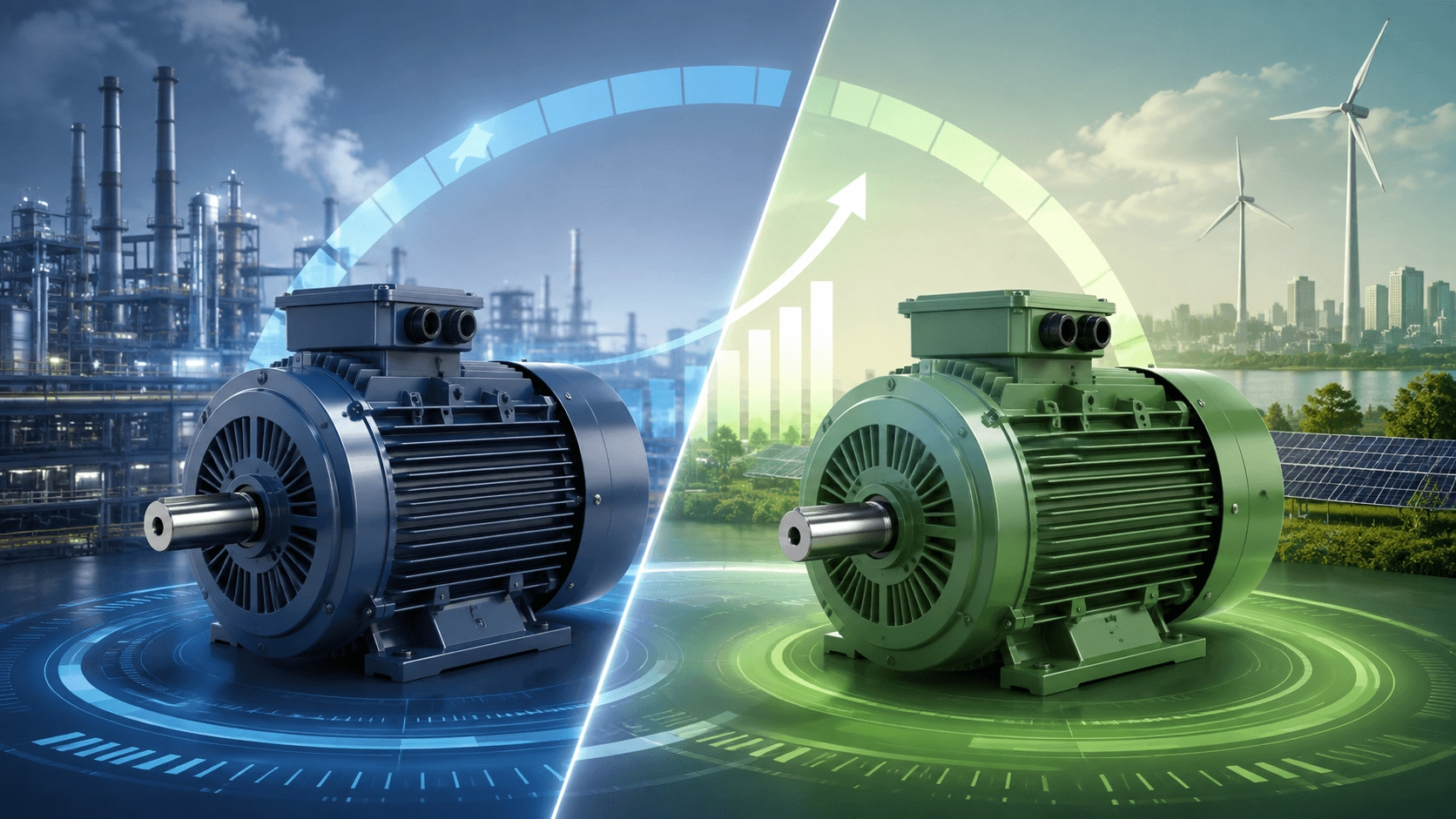
IE3 vs. IE4 Motors 2026: Super-Premium Efficiency, Savings & ROI Guide
A comprehensive technical and economic analysis of IE3 and IE4 motor standards in 2026, covering regulatory mandates, quantified energy savings, return on investment (ROI) modeling, and strategic upgrade pathways for pumps, fans, and industrial systems.
Introduction: The 2026 Efficiency Imperative
In the contemporary industrial landscape, electric motor efficiency has transitioned from an optional sustainability metric to a fundamental operational and regulatory requirement. In 2026, IE3 (Premium Efficiency) and IE4 (Super Premium Efficiency) motors have established themselves as the definitive benchmarks across manufacturing, water treatment, HVAC, oil & gas, and heavy industry.
These super-premium efficiency three-phase AC induction motors represent more than incremental technological improvement; they constitute a systemic response to converging pressures: stringent global energy regulations, volatile electricity pricing, and accelerated corporate net-zero commitments. Organizations adopting IE3 and IE4 technologies are reporting payback periods of 1–3 years, measurable reliability improvements, and competitive advantages that legacy IE1 or IE2 installations cannot replicate.
This guide provides the definitive 2026 reference for understanding, selecting, and implementing high-efficiency motor systems, grounded in current regulations, verified performance data, and practical engineering guidance.
Defining IE3 and IE4: Technical Classification
IE3 and IE4 are efficiency classes defined under IEC 60034-30-1, the international standard specifying efficiency levels for line-operated AC motors.
- IE3 (Premium Efficiency): Achieves 90–95% full-load efficiency depending on rating. Represents the current legal minimum in most developed economies and the baseline for new industrial installations globally.
- IE4 (Super Premium Efficiency): Exceeds 96% efficiency through advanced electromagnetic design, premium materials, and precision manufacturing. Converts electrical losses that previously dissipated as waste heat into productive mechanical torque.
Both classes utilize high-grade silicon steel laminations, optimized copper winding geometries, reduced air gaps, and enhanced thermal management systems to minimize I²R (copper), core (iron), friction, and windage losses. When paired with Variable Frequency Drives (VFDs), system-level savings compound significantly—often yielding an additional 20–30% reduction in energy consumption for variable-torque applications.
Updated Efficiency Classes: 2026 Status Matrix
| Efficiency Class | Designation | Typical Efficiency Range (4-Pole) | Improvement vs. Prior Class | Regulatory Status in 2026 |
|---|---|---|---|---|
| IE1 | Standard Efficiency | ~82–85% | Baseline | Phased out in most markets; prohibited for new sales in EU, US, China |
| IE2 | High Efficiency | ~87–90% | +5–7% over IE1 | Minimum in select emerging markets; superseded elsewhere |
| IE3 | Premium Efficiency | 90–95% | +3–5% over IE2 | Mandatory minimum in EU, US, China, Canada, Australia, India |
| IE4 | Super Premium Efficiency | 95.5–97%+ | +1–2% over IE3 | Mandatory for 75–200 kW in EU since July 2023; expanding scope under review for 2027+ |
| IE5 | Ultra Premium Efficiency | >97% (SynRM/PM tech) | +2%+ over IE4 | Commercially available; gaining adoption in demanding applications; no widespread mandate yet |
Note: Efficiency values vary by power rating, pole count, and frequency. Always consult manufacturer test certificates per IEC 60034-2-1 for specific unit data.
Why 2026 Is the Critical Tipping Point
Global Regulatory Acceleration
Regulatory frameworks worldwide have reached unprecedented stringency:
- European Union: Ecodesign Regulation (EU) 2019/1781 mandates IE4 for motors rated 75–200 kW effective July 2023. Scope expansion to cover broader power ranges and smaller motors is under active review for implementation post-2027. IE3 remains minimum below 75 kW.
- United States: DOE amended energy conservation standards mandate IE4-equivalent performance for mid-range integral horsepower motors beginning June 2027. Utility rebate programs already incentivize IE4 adoption ahead of compliance deadlines.
- China: GB 18613-2020 enforces IE3 as mandatory minimum. IE4 receives preferential treatment in national green manufacturing programs, tax incentives, and government procurement.
- India, Australia, Canada, Brazil: Rapidly aligning domestic MEPS (Minimum Energy Performance Standards) with IE3/IE4 baselines, often with accelerated timelines tied to climate commitments.
Market Dynamics
The global energy-efficient motor market is projected at approximately USD 73 billion in 2026, growing at a CAGR exceeding 9.6% through 2034. Rising industrial electricity demand means every percentage point of efficiency improvement translates directly into substantial cost avoidance and carbon reduction at scale.
Quantified Benefits: Energy Savings, ROI, and Environmental Impact
Energy Reduction Benchmarks
- IE3 vs. IE1/IE2 Legacy Motors: 5–10% energy reduction at equivalent load.
- IE4 vs. IE3: Additional 10–15% savings in constant-torque applications; up to 20%+ when integrated with VFDs in variable-torque duty.
- Complete System Upgrade (IE4 + VFD + Optimized Controls): Up to 40% total energy loss reduction in pump and fan systems compared to uncontrolled legacy installations.
Real-World Validation
- European Copper Producer: Replaced aging motor fleet with IE4/IE5 units and VFDs, achieving annual electricity savings of 25 GWh—equivalent to removing thousands of passenger vehicles from roads—with verified payback under three years.
- Continuous-Duty Pump Application: A 110 kW pump operating at 75% average load saves approximately €4,900 and 5.7 tonnes CO₂ annually after upgrading from IE2 to IE4.
- Multi-Motor Manufacturing Facility: Ten 50 kW motors running 24/7 generate 15,000–35,000 in annual savings upon IE4 conversion, with total cost of ownership (TCO) reduced 20–30% over a 15–20 year service life.
ROI Modeling Framework
Payback period depends on four variables. The annual energy cost savings can be calculated using the following text-based formula:
Annual Savings = P_rated × L_avg × H_op × C_elec × (1 / η_old − 1 / η_new)
Where:
- P_rated = Motor rated power (kW)
- L_avg = Average load factor (decimal)
- H_op = Annual operating hours
- C_elec = Electricity cost ($/kWh)
- η_old = Old motor efficiency (decimal)
- η_new = New motor efficiency (decimal)
For continuous-duty applications with electricity costs above $0.10/kWh, IE4 upgrades routinely achieve 12–36 month payback. Utility rebates, carbon credit monetization, and extended warranty coverage further compress effective payback.
Technical Differentiators: What Makes IE3 & IE4 Superior
Advanced Materials and Construction
- Low-Loss Electrical Steel: Higher-grade silicon steel laminations reduce hysteresis and eddy current core losses.
- Precision Copper Windings: Optimized slot fill factors and end-turn geometries minimize I²R losses and improve thermal distribution.
- Tighter Manufacturing Tolerances: Reduced air gap variation lowers magnetizing current and improves power factor.
Thermal Management Excellence
- Operating temperatures run 10–15°C lower than equivalent IE2 motors at rated load.
- Cooler operation extends bearing grease life exponentially (bearing life doubles approximately every 10–15°C temperature reduction).
- Insulation aging rate decreases significantly, supporting longer rewind intervals and extended service life.
VFD Integration Readiness
- Inverter-rated insulation systems withstand voltage spikes and dv/dt stresses inherent to PWM output.
- Shaft grounding options mitigate bearing currents induced by common-mode voltages.
- Speed-matching capability eliminates wasteful mechanical throttling in pump and fan applications, unlocking cubic relationship savings where power is proportional to the cube of speed (P ∝ n³).
Emerging IE5 Technology
Synchronous Reluctance (SynRM) and Permanent Magnet (PM) motors now achieve IE5 ultra-premium efficiency (>97%) without rare-earth magnets in SynRM variants. These technologies operate cooler, quieter, and with superior partial-load efficiency characteristics, representing the next frontier beyond IE4.
High-Impact Application Sectors
| Sector | Key Applications | Primary Benefit Driver |
|---|---|---|
| Manufacturing & Automation | Conveyors, CNC spindles, robotics, compressors | Reduced thermal stress = zero unplanned downtime; precision speed control |
| HVAC & Building Services | AHU fans, chilled water pumps, cooling towers | LEED/BREEAM compliance; dramatic utility bill reduction; occupant comfort |
| Water & Wastewater Treatment | Raw water intake, transfer pumps, aeration blowers | 24/7 duty cycle maximizes savings; VFD integration yields 30%+ energy reduction |
| Food & Beverage Processing | Mixers, homogenizers, refrigeration compressors | Hygienic aluminum housings; washdown-compatible IP66/IP69K enclosures; reliable cold-chain operation |
| Oil & Gas / Heavy Industry | Pipeline pumps, refinery auxiliaries, mining conveyors | Explosion-proof IE4 certifications (ATEX/IECEx); extreme environment durability; safety compliance |
| Data Centers & Renewables | Precision cooling fans, wind turbine pitch/yaw drives | Ultra-low vibration; partial-load efficiency optimization; mission-critical reliability |
Addressing Implementation Barriers
Higher Initial Investment
IE4 motors typically carry a 20–30% price premium over IE2 equivalents. However, TCO analysis incorporating energy costs, maintenance intervals, and expected service life consistently demonstrates positive net present value (NPV). Utility rebates (often covering 25–50% of premium), carbon tax avoidance, and extended warranties further improve economics.
Retrofit Compatibility Concerns
Modern IE4 designs maintain IEC dimensional standards for drop-in replacement in most frame sizes. Where dimensional differences exist, manufacturers provide engineered adapter kits, transition bases, and coupling solutions. Leading suppliers offer comprehensive retrofit engineering support including site surveys, alignment verification, and commissioning assistance.
Maintenance Perception
Contrary to concerns about complexity, IE4 motors are easier to maintain:
- Lower operating temperatures extend lubrication intervals and bearing replacement cycles.
- Standardized terminal blocks and modular construction simplify field service.
- Integrated IoT sensors in premium models enable predictive maintenance, identifying incipient failures before functional degradation occurs.
Strategic Selection Guide for 2026
1. Match Rating to Actual Duty
Avoid oversizing (which reduces part-load efficiency) and undersizing (which causes thermal overload). Conduct load profiling to determine true average and peak demands. Select motor rated within 75–100% of actual continuous load for optimal efficiency zone operation.
2. Specify Environmental Protection Appropriately
- IP55: Standard industrial indoor use (dust-protected, water-jet resistant)
- IP65/IP66: Washdown, outdoor, or heavy contamination environments
- Corrosion Resistance: Aluminum frames for chemical/marine exposure; epoxy-coated cast iron for severe conditions
- Ambient Temperature: Verify derating curves if ambient exceeds 40°C
3. Confirm VFD Compatibility When Applicable
Specify "inverter-duty" motors with:
- Reinforced insulation systems (Class F or H)
- Shaft grounding brushes or insulated bearings for frames ≥132
- dv/dt filters or sine-wave filters for cable runs >50 m or sensitive applications
4. Calculate True Total Cost of Ownership
Utilize validated ROI calculators incorporating:
- Local electricity rates (including time-of-use differentials)
- Actual operating hours and load profiles
- Expected maintenance cost differentials
- Available rebates and incentive programs
- Discount rate and project horizon
5. Demand Verification and Certification
Require:
- IEC 60034-30-1 efficiency classification confirmed by accredited third-party testing
- Test reports per IEC 60034-2-1 traceable to specific serial numbers
- Regional compliance markings (CE, UL, CSA, CCC, BIS as applicable)
- Manufacturer warranty terms aligned with expected service life
6. Evaluate Supplier Capabilities Beyond Product
Prioritize vendors offering:
- On-site energy audits and load assessments
- Retrofit planning and project management support
- Commissioning and alignment services
- Long-term spare parts availability and repair network
- Digital monitoring platform integration
Future Outlook: IE5, Digitalization, and System Intelligence
The trajectory beyond 2026 points toward:
- IE5 Mainstream Adoption: SynRM and PM technologies achieving >97% efficiency without rare-earth dependency will become economically viable for broader application ranges.
- IoT-Native Motors: Embedded sensors streaming real-time temperature, vibration, current, and efficiency data to SCADA/CMMS platforms, enabling truly predictive maintenance and autonomous optimization.
- Motor-as-a-Service Models: Outcome-based contracting where suppliers guarantee efficiency performance and uptime, aligning incentives across the value chain.
- Regulatory Harmonization: Continued convergence of global MEPS toward IE4 baselines, simplifying multinational compliance and supply chain management.
Analysts project IE4 and IE5 will dominate new installations in developed markets by 2030. Early adopters secure structural cost advantages and regulatory resilience for decades.
Conclusion: The Strategic Case for IE3 and IE4 in 2026
IE3 and IE4 motors represent the intersection of regulatory compliance, economic rationality, and environmental responsibility. They are not merely technology upgrades but strategic business decisions with measurable financial returns and risk mitigation benefits.
Forward-thinking organizations recognize that:
- Every kilowatt-hour saved is permanent margin improvement in an era of energy volatility.
- Every degree of temperature reduction is compounded reliability gain over decades of service.
- Every tonne of CO₂ avoided is regulatory and reputational capital in a decarbonizing economy.
The window for proactive upgrade planning is open now. Delaying action locks in higher operating costs, regulatory exposure, and competitive disadvantage for the remainder of existing asset lifecycles.
Explore Premium High-Efficiency Motor Solutions
For IE3, IE4, and emerging IE5 three-phase AC motors engineered for maximum efficiency, regulatory compliance, and long-term reliability:
🌐 Product Catalog & Technical Resources: www.cntecho.com
✉️ Request Free Energy Audit or Quotation: [email protected]
Engineered for efficiency. Built for 2026 and beyond.