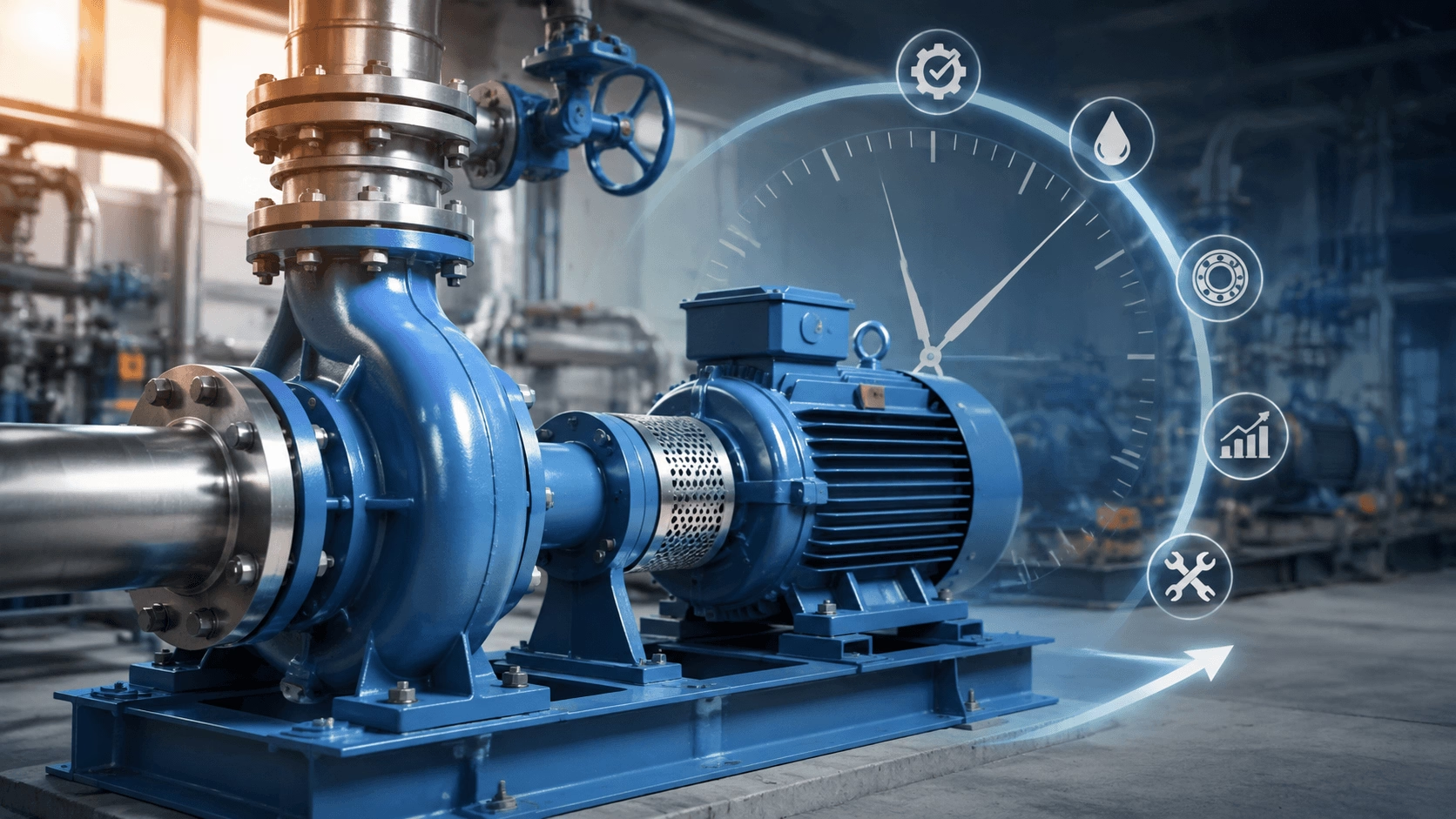
How Long Does a Centrifugal Pump Motor Process Last? Complete Guide 2026
Learn how long a centrifugal pump motor process lasts, key influencing factors, lifecycle stages, and expert strategies to maximize pump efficiency and service life in modern industrial applications.
Understanding Pump Process Duration
Introduction
In contemporary industrial infrastructure, centrifugal pumps serve as the backbone of fluid transportation systems. While operational metrics such as flow rate (Q) and discharge pressure (P) typically dominate performance discussions, a critical yet frequently overlooked parameter is the duration of the complete centrifugal pump motor process.
Comprehending the temporal dynamics of pump operation—from startup transients to steady-state continuity—is essential for optimizing system performance, minimizing unplanned downtime, and extending capital equipment lifespan. This guide provides a comprehensive analysis of process duration, distinguishing between individual operational cycles and total service life, while offering actionable insights for 2026 and beyond.
What Constitutes a Complete Centrifugal Pump Motor Process?
The term "process duration" can refer to two distinct concepts: the operational cycle (a single start-stop sequence) and the service lifecycle (total useful life). A complete operational cycle comprises four discrete stages:
- Startup Phase: The motor accelerates from zero to rated speed (n). During this transient period, current draw is high, and hydraulic forces stabilize.
- Fluid Transfer Phase: The impeller imparts kinetic energy to the fluid, converting it into pressure head (H).
- Stable Operation Phase: The system reaches equilibrium where pump output matches system demand. This is the target state for maximum efficiency (η).
- Shutdown Phase: A controlled deceleration and system isolation to prevent water hammer or reverse rotation.
Each stage imposes unique mechanical and thermal stresses that cumulatively define the equipment's longevity.
Typical Duration Benchmarks
Operational Cycle Duration
The length of a single process cycle is application-dependent:
- Batch/Transfer Operations: Cycles may last from seconds to several hours.
- Continuous Industrial Systems: Processes operate 24/7, effectively making the "cycle" indefinite until scheduled maintenance.
- Variable Demand Systems: Cycles fluctuate based on real-time process requirements.
Unlike positive displacement pumps used in batching, centrifugal pumps are predominantly designed for continuous duty (S1). Under stable conditions, the operational process is theoretically limitless, constrained only by component wear.
Service Life Duration
In well-maintained industrial environments, the total service life of a centrifugal pump motor assembly typically spans 10 to 20 years. However, this range is highly variable and contingent upon the factors detailed below.
Key Factors Affecting Process Duration and Longevity
1. Operating Environment
Environmental conditions are primary determinants of degradation rates:
- Thermal Extremes: Ambient temperatures exceeding motor insulation class ratings accelerate winding degradation. For every 10°C rise above rated temperature, insulation life is halved.
- Corrosive Media: Exposure to acidic or alkaline fluids attacks impellers, casings, and shafts, reducing hydraulic efficiency and structural integrity.
- Abrasive Particulates: Suspended solids cause erosive wear on sealing surfaces and bearings, leading to premature failure.
- Humidity and Contamination: Moisture ingress compromises electrical insulation and lubrication systems.
2. Pump Design and Hydraulic Configuration
The fundamental architecture dictates operational characteristics:
- Single-Stage Pumps: Generally suited for lower head applications; simpler design often correlates with longer mean time between failures (MTBF) but limited process flexibility.
- Multi-Stage Pumps: Required for high-pressure processes; increased complexity introduces more potential failure points but enables extended process capabilities.
- System Matching: Operating the pump near its Best Efficiency Point (BEP) is critical. Deviation >±10% from BEP induces recirculation, cavitation, and radial thrust loads that drastically shorten process duration.
3. Motor Performance and Electrical Characteristics
Motor quality directly influences process stability:
- Starting Torque and Current: Adequate starting torque ensures rapid acceleration through critical speeds, minimizing thermal stress during startup.
- Efficiency Class: IE3/IE4 premium efficiency motors generate less waste heat, supporting longer continuous operation.
- VFD Compatibility: Motors designed for variable frequency drive operation withstand voltage spikes and bearing currents associated with adjustable speed processes.
4. Maintenance Maturity Level
Maintenance strategy is the most controllable variable affecting duration:
| Component | Criticality | Impact on Process Duration |
|---|---|---|
| Bearings | High | Primary cause of rotating equipment failure; proper lubrication extends L10 life significantly. |
| Mechanical Seals | High | Prevent leakage; seal face wear determines run-length between overhauls. |
| Impellers | Medium | Erosion/corrosion reduces head and flow; rebalancing restores hydraulic performance. |
| Couplings | Medium | Misalignment causes vibration and bearing damage; laser alignment optimizes power transmission. |
5. Start-Stop Frequency and Duty Cycle
Cycling frequency is inversely proportional to equipment life:
- Thermal Cycling: Repeated heating and cooling induce expansion/contraction stresses in windings and rotor bars.
- Lubrication Starvation: Bearings may experience boundary lubrication during low-speed transients.
- Mechanical Fatigue: Shaft and coupling components endure cyclic loading during each start event.
Expert Note: Continuous operation at steady load is generally less damaging than frequent cycling. Where process demands require modulation, Variable Frequency Drives (VFDs) are preferred over start-stop control to maintain thermal equilibrium and reduce mechanical shock.
Lifecycle Stages of a Centrifugal Pump Motor Process
Understanding the degradation curve enables proactive intervention:
Early Stage: Commissioning and Peak Efficiency
- Characteristics: Optimal hydraulic performance, minimal vibration (<2.5 mm/s RMS), stable current draw.
- Duration: Typically 1–3 years depending on application severity.
- Focus: Baseline data collection, alignment verification, and operator training.
Mid-Life Stage: Gradual Degradation
- Characteristics: Slight efficiency decline (3–5%), minor increase in vibration and noise, elevated operating temperature.
- Indicators: Seal leakage onset, bearing lubricant degradation, minor cavitation signs.
- Action: Condition-based monitoring intensifies; preventive replacement scheduling begins.
Late Stage: Functional Decline and Risk
- Characteristics: Significant performance loss (>10%), frequent unscheduled interventions, rising energy consumption per unit volume.
- Risks: Catastrophic failure potential, safety hazards, production losses.
- Decision Point: Economic evaluation of overhaul vs. replacement based on remaining useful life (RUL) analysis.
Strategic Approaches to Extend Pump Process Duration
✔ Optimize Pump Selection and Sizing
Correct initial selection prevents chronic off-design operation. Utilize system curve analysis to ensure the pump operates within ±10% of BEP across all expected process conditions. Oversized pumps throttled via valves waste energy and accelerate wear; right-sizing or VFD retrofitting resolves this.
✔ Implement Predictive Maintenance (PdM)
Transition from time-based to condition-based strategies:
- Vibration Analysis: Detect imbalance, misalignment, bearing defects, and cavitation early.
- Motor Current Signature Analysis (MCSA): Identify rotor bar defects, air gap eccentricity, and electrical imbalances.
- Thermography: Monitor winding, bearing, and connection temperatures for anomaly detection.
- Oil Analysis: Assess lubricant condition and wear particle generation in bearing housings.
✔ Mitigate Common Failure Modes
Proactively address the three primary killers of pump processes:
- Dry Running: Install flow switches, level sensors, or power monitors to prevent operation without liquid. Dry running destroys seals and bearings within minutes.
- Cavitation: Ensure adequate Net Positive Suction Head Available (NPSHa) exceeds NPSH Required (NPSHr) by a safety margin (typically ≥1.5 m or 20%). Address suction line restrictions and fluid temperature issues.
- Overloading: Verify motor nameplate ratings match actual process demands; install overload protection and monitor amperage trends.
✔ Execute Precision Component Replacement
Adopt a reliability-centered maintenance approach:
- Replace bearings based on calculated L10 life and condition monitoring, not arbitrary schedules.
- Upgrade to cartridge-type mechanical seals for improved reliability and easier replacement.
- Use OEM or certified equivalent parts to maintain design tolerances and material specifications.
- Document all interventions to build asset history and refine future maintenance intervals.
Why Manufacturer Selection Impacts Process Duration
A high-quality centrifugal pump motor assembly is the foundational determinant of achievable process duration and system stability. Professional manufacturers differentiate themselves through:
- Precision Engineering: Tighter tolerances, superior balancing, and optimized hydraulic designs reduce inherent vibration and improve efficiency.
- Advanced Materials: Corrosion-resistant alloys, hardened wear parts, and premium insulation systems extend service life in demanding environments.
- Rigorous Testing: Full performance testing per ISO 9906, endurance validation, and quality assurance protocols ensure delivered units meet specifications.
- Technical Support: Access to application engineering, troubleshooting expertise, and genuine spare parts sustains long-term operability.
- Customization Capability: Tailored solutions for unique process requirements that standard catalog products cannot adequately address.
Strategic Insight: Partnering with an experienced, reputable supplier is not merely a procurement decision—it is a reliability investment. The total cost of ownership (TCO) over a 15-year lifecycle is often dominated by energy and maintenance costs, not initial purchase price. Superior equipment quality pays dividends through extended process duration and reduced operational expenditure.
Conclusion
The duration of a centrifugal pump motor process is not a fixed parameter but a dynamic outcome shaped by design quality, environmental conditions, operational practices, and maintenance rigor. Rather than focusing exclusively on short-term cycle times, forward-thinking organizations prioritize:
- Long-term operational stability over peak instantaneous performance
- Continuous, steady-state operation over frequent cycling where feasible
- Lifecycle optimization through data-driven decision-making
- Proactive reliability management over reactive repair
With appropriate system design, disciplined maintenance, and quality equipment selection, centrifugal pumps can deliver decades of reliable, efficient service—transforming what is often viewed as a commodity component into a strategic asset for industrial productivity.
Looking for Reliable Pump & Motor Solutions?
For engineered centrifugal pump and motor systems designed for extended process duration and operational excellence:
🌐 Explore Products: www.cntecho.com
✉️ Contact Engineering Team: [email protected]
Achieve sustainable performance with solutions built for longevity.