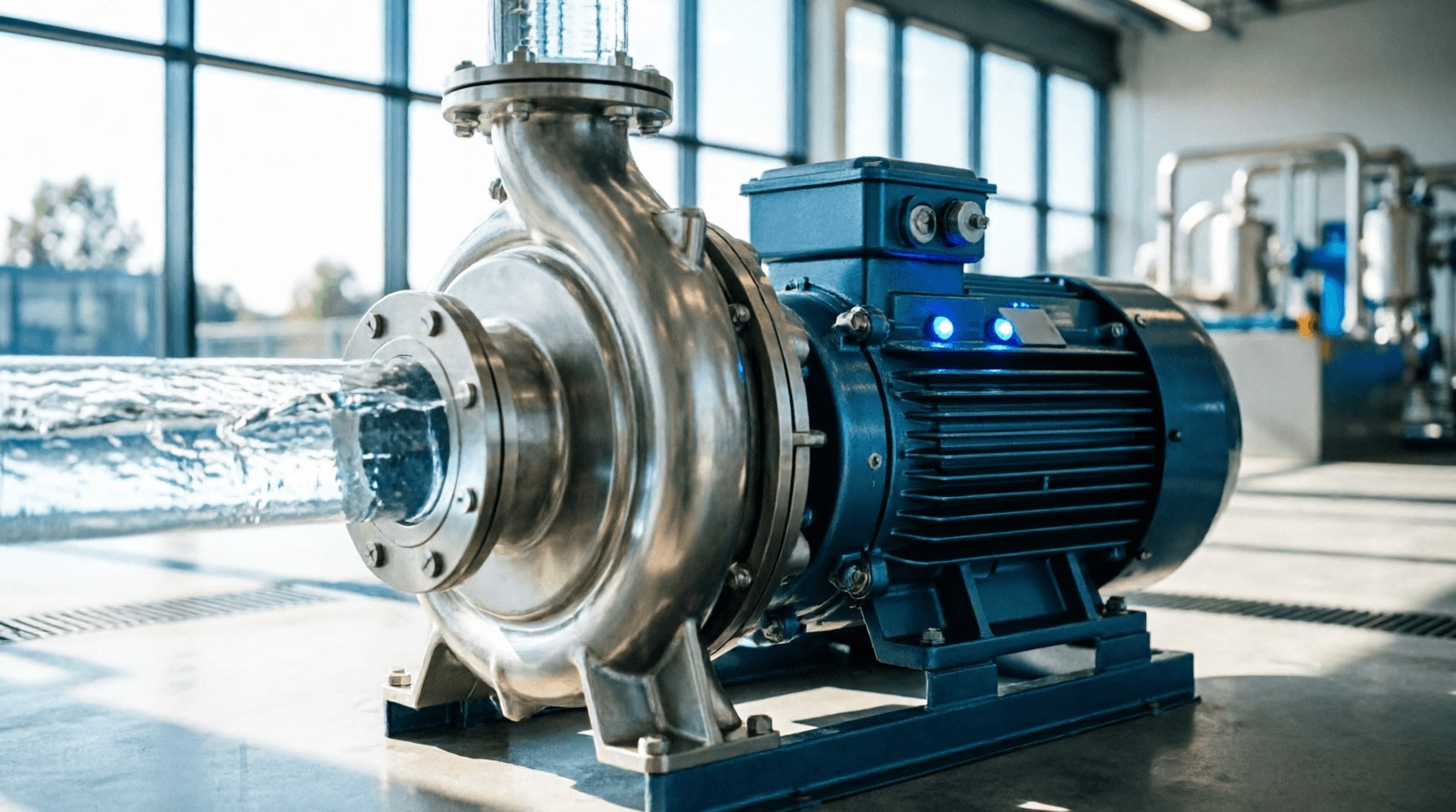
A Technical Guide to Modern Industrial Pumping Systems: Operational Mechanics, System Challenges, and Integrated Efficiency Solutions for Manufacturing, HVAC, and Water Infrastructure
Industrial pumps serve as the critical circulatory system of modern infrastructure, operating as the silent enablers of manufacturing processes, climate control systems, water treatment facilities, and chemical production. While often concealed within mechanical rooms or process lines, their performance directly dictates systemic stability, energy efficiency, and operational continuity. In an era defined by sustainability mandates and digital transformation, understanding pump engineering is no longer optional—it is a strategic imperative.
This comprehensive guide elucidates the fundamental physics of industrial pumping, addresses common failure mechanisms, outlines contemporary technological advancements, and demonstrates how TECHO Electrical & Mechanical (Taizhou) Co., Ltd. delivers integrated, high-efficiency solutions tailored for demanding global applications.
1. Functional Classification: What Industrial Pumps Actually Do
At its most fundamental level, a pump is a turbomachine that converts mechanical energy (typically from an electric motor) into hydraulic energy, enabling fluid transport against friction losses and elevation changes. Industrial pumps are universally categorized into two distinct hydraulic families, each governed by unique physical principles.
Centrifugal Pumps (Rotodynamic)
Centrifugal pumps utilize rotational kinetic energy to impart velocity to a fluid, which is subsequently converted to static pressure. They represent approximately 80% of industrial pump installations due to their versatility and cost-effectiveness.
- Operational Profile: Flow rate varies inversely with system head; power consumption typically increases with flow.
- Ideal Applications: High-volume transfer of low-to-medium viscosity fluids, including HVAC circulation, municipal water supply, cooling towers, irrigation, and general industrial process water.
- Key Advantage: Smooth, non-pulsating flow with simple construction and minimal maintenance requirements.
Positive Displacement (PD) Pumps
PD pumps mechanically trap discrete fluid volumes and force them through the discharge port, generating flow independent of system pressure (neglecting internal slip).
- Operational Profile: Nearly constant flow regardless of discharge pressure; requires overpressure protection via relief valves.
- Ideal Applications: High-viscosity media (oils, polymers, slurries), precise chemical metering, food-grade processing, and high-pressure washing systems.
- Key Advantage: Self-priming capability, ability to handle entrained gases, and linear flow-to-speed relationship enabling accurate dosing.
Selection Imperative: Misclassifying pump type relative to fluid properties and system curve characteristics is the leading cause of premature failure and energy waste. Proper selection requires rigorous analysis of viscosity, solids content, NPSH availability, and duty cycle variability.
2. The Engineering Science Behind Pump Operation
Centrifugal Pump Hydrodynamics
The energy conversion sequence follows four discrete stages:
- Impeller Acceleration: Motor-driven rotation imparts tangential velocity to fluid entering the impeller eye. Centrifugal force drives fluid radially outward through vane passages.
- Kinetic Energy Generation: Fluid exits impeller tips at high velocity, possessing significant kinetic energy proportional to the square of tip speed.
- Pressure Conversion: The volute casing or diffuser gradually expands in cross-sectional area, decelerating fluid and converting kinetic energy to static pressure per Bernoulli’s principle.
- Discharge: Pressurized fluid exits through the discharge nozzle into the piping system.
Performance is characterized by head-capacity curves where H ∝ N² and Q ∝ N (affinity laws), enabling predictable scaling with speed variation.
Positive Displacement Pump Mechanics
PD operation relies on volumetric displacement rather than dynamic acceleration:
- Reciprocating Types (Piston/Plunger/Diaphragm): Cyclic chamber volume change creates suction and discharge strokes. Flow is pulsatile unless dampened or multi-cylinder configured.
- Rotary Types (Gear/Lobe/Screw/Progressive Cavity): Continuous meshing or helical motion creates sealed cavities progressing from suction to discharge. Flow is relatively smooth.
- Slip Characteristics: Internal leakage increases with viscosity decrease and pressure increase, causing actual flow to deviate from theoretical displacement.
Understanding these mechanisms enables engineers to match pump architecture to process requirements, avoiding costly mismatches such as applying centrifugal pumps to high-viscosity duties or PD pumps to clean-water high-flow transfer.
3. Common Technical Challenges and Failure Mechanisms
Even premium-quality pumps experience degradation when operated outside design envelopes. Recognizing these failure modes enables proactive mitigation.
Cavitation
Cavitation occurs when local static pressure falls below fluid vapor pressure, forming vapor bubbles that collapse violently upon reaching higher-pressure regions.
- Symptoms: Distinctive gravel-like noise, erratic vibration, head loss, and impeller pitting.
- Root Causes: Insufficient Net Positive Suction Head Available (NPSHa), excessive suction lift, clogged strainers, or undersized suction piping.
- Mitigation: Increase NPSHa margin, reduce fluid temperature, install inducers, or select low-NPSHr impellers.
Thermal Damage from Low-Flow Operation
Operating significantly below Best Efficiency Point (BEP) causes recirculation, radial thrust imbalance, and inadequate cooling.
- Consequences: Seal face overheating, bearing failure, shaft deflection, and casing distortion.
- Prevention: Install minimum flow bypass lines, implement VFD-based flow control, or specify pumps with extended low-flow stable operating ranges.
Misalignment and Vibration
Angular or parallel misalignment between motor and pump shafts induces cyclic stresses.
- Impact: Exponential reduction in bearing and seal life; increased power consumption; coupling fatigue.
- Best Practice: Laser alignment during installation and periodic verification; use of flexible couplings rated for expected misalignment tolerances.
System-Level Energy Losses
Aging components, oversized pumps operating far from BEP, throttled control valves, and fixed-speed operation in variable-demand systems collectively waste 20–50% of consumed energy.
- Solution Paradigm: Shift from component replacement to system optimization incorporating VFDs, right-sizing, pipe network audits, and intelligent controls.
4. Modern Engineering Innovations Enhancing Performance
Contemporary pump technology integrates advances across hydraulics, materials science, power electronics, and digitalization.
Computational Hydraulic Optimization
CFD (Computational Fluid Dynamics) modeling enables impeller and volute geometries that minimize turbulence, secondary flows, and recirculation zones. Result: 3–8% hydraulic efficiency gains and widened stable operating envelopes compared to legacy designs.
Variable Frequency Drive (VFD) Integration
VFDs modulate motor speed to match real-time demand, exploiting affinity laws where Power ∝ Speed³. A 20% speed reduction yields ~50% power savings. Additional benefits include soft starting (eliminating water hammer), process precision, and extended mechanical life through reduced cyclic loading.
Advanced Material Engineering
- Corrosion Resistance: Duplex stainless steels, Hastelloy alloys, and fluoropolymer linings for aggressive chemicals.
- Abrasion Resistance: Hardened cast iron, ceramic composites, and tungsten carbide coatings for slurry service.
- Lightweight Composites: Carbon-fiber-reinforced polymer impellers reducing rotational inertia and improving part-load efficiency.
Smart Monitoring and Predictive Maintenance
IoT-enabled sensors continuously track vibration spectra, bearing temperature, seal leakage, current signature, and differential pressure. Machine learning algorithms detect incipient faults weeks before functional failure, transforming maintenance from reactive to predictive. Documented outcomes include 30–50% reduction in unplanned downtime and 10–20% energy savings through real-time optimization.
5. TECHO’s Competitive Advantages: Why Global Clients Partner With Us
TECHO Electrical & Mechanical (Taizhou) Co., Ltd. distinguishes itself through vertical integration, application-specific engineering, and unwavering quality discipline. Unlike assemblers sourcing disparate components, TECHO manufactures both AC motors and pump ends in-house, ensuring optimal electromagnetic and hydraulic synergy.
Integrated Motor-Pump Efficiency
Our proprietary matching methodology aligns motor torque-speed characteristics with pump load profiles, eliminating oversizing losses and maximizing wire-to-water efficiency. IE3 and IE4 compliant motor platforms deliver measurable lifecycle cost reductions validated through third-party testing.
Durability Engineered for Harsh Environments
TECHO pumps feature corrosion-resistant metallurgies, dynamically balanced impellers, premium mechanical seals, and reinforced bearing systems designed for continuous industrial, agricultural, and municipal service. Extended Mean Time Between Failures (MTBF) reduces total cost of ownership beyond initial purchase price considerations.
Comprehensive OEM and Custom Engineering Support
We provide end-to-end partnership including hydraulic re-rating, dimensional customization, private labeling, regional certification assistance (CE, UL, CCC, RoHS), and co-development of application-specific variants. Our engineering team collaborates directly with client R&D departments to solve unique challenges.
Rigorous Quality Assurance Protocol
Every unit undergoes multi-stage validation:
- Hydraulic performance testing per ISO 9906 Grade 2 standards
- Vibration analysis and dynamic balancing verification
- Dielectric withstand and insulation resistance testing
- Endurance run-in and thermal stability assessment
- Dimensional inspection and documentation traceability
Proven Global Export Competency
With extensive international supply chain experience, TECHO ensures consistent quality, reliable logistics, multilingual technical support, and responsive after-sales service across diverse regulatory and climatic environments. Our track record spans six continents and dozens of industry verticals.
6. Building a More Efficient Industrial Future
As industries accelerate toward automation, decarbonization, and circular economy principles, pumping systems will remain central to achieving sustainability and productivity targets. The convergence of high-efficiency hydraulics, premium motors, intelligent controls, and predictive analytics represents not merely incremental improvement but a paradigm shift in fluid handling economics.
TECHO is committed to advancing this transition through continuous R&D investment, manufacturing excellence, and collaborative customer partnerships. Whether your application involves precision chemical metering, large-scale municipal water transfer, high-pressure industrial cleaning, or energy-efficient HVAC circulation, TECHO provides the engineering expertise, product reliability, and strategic support necessary to optimize performance and achieve sustainable growth.
For technical consultations, product catalogs, or partnership discussions, please visit www.cntecho.com.
Disclaimer: All performance claims are based on standardized testing conditions. Actual results may vary depending on installation quality, system configuration, fluid properties, and maintenance practices. Always consult TECHO engineering for application-specific recommendations.