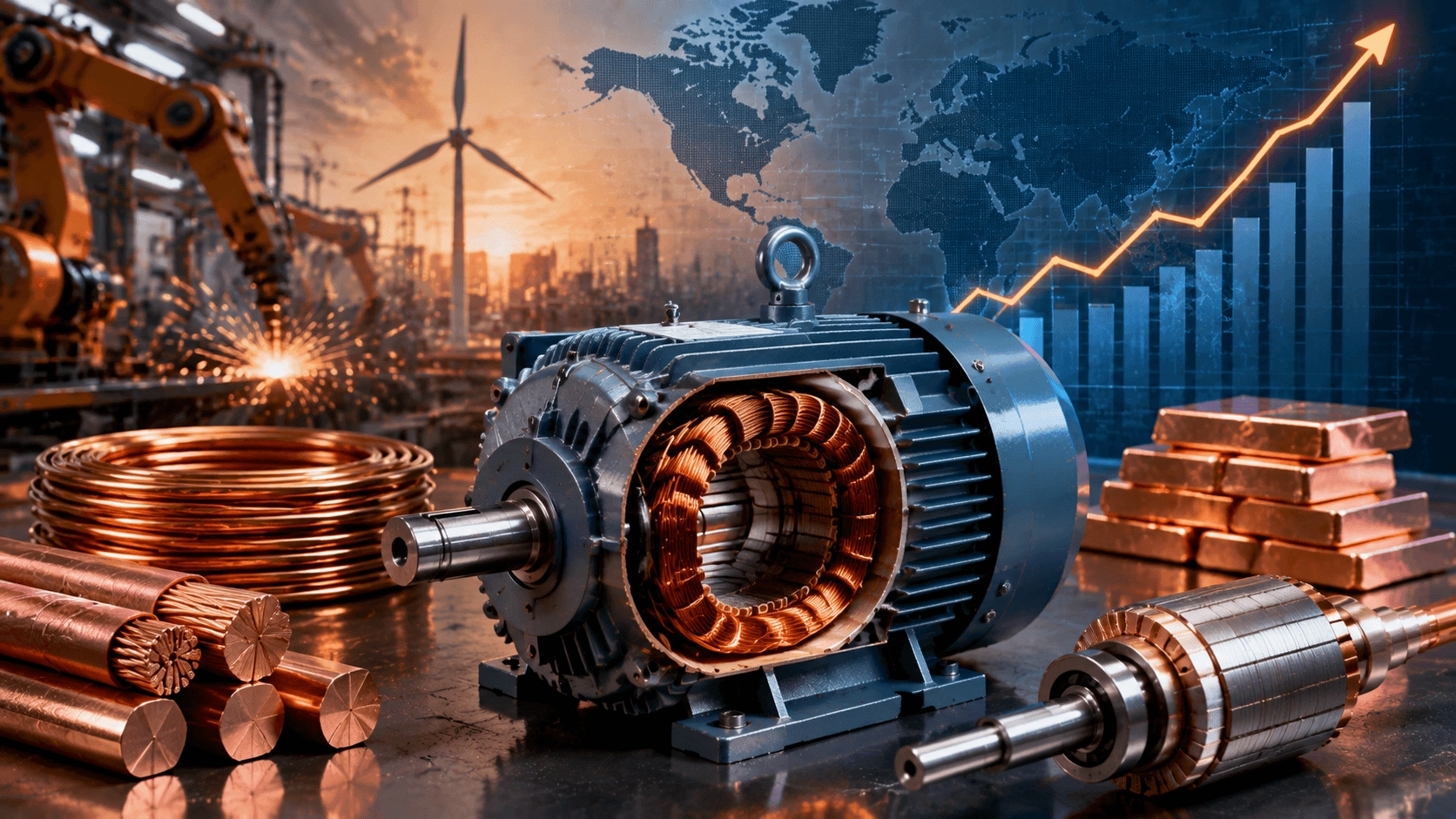
2026 Industrial Market Analysis: A comprehensive guide for OEMs, manufacturers, and procurement leaders navigating the volatility of copper markets. Explore the economic drivers behind rising motor costs, the technical superiority of copper vs. aluminum, hedging strategies, IE4 efficiency ROI, and practical tactics to slash Total Cost of Ownership (TCO). Compiled with TITECHO industry expertise.
Introduction: The Copper Backbone in an Electrified World
In the midst of accelerating global electrification, copper remains the irreplaceable backbone of electric motor production. As of March 2026, London Metal Exchange (LME) copper prices have stabilized around 12,780 per tonne** after surging to record intraday highs above **14,500 per tonne in January 2026.
This volatility directly inflates the cost of three-phase induction motors, industrial AC motors, and specialized drives used across pumps, compressors, conveyors, gearboxes, and renewable energy systems. The ripple effect is felt throughout procurement budgets, pricing models, supply chain planning, and Total Cost of Ownership (TCO) calculations for equipment manufacturers, distributors, and end users.
This in-depth analysis examines the phenomenon from economic, technical, supply-chain, geopolitical, and sustainability perspectives. It delivers actionable strategies, real-world examples, nuanced comparisons, and forward-looking implications to help stakeholders navigate uncertainty and turn challenges into competitive advantages.
Copper’s Indispensable Role: Technical Superiority vs. Substitution Limits
The stator windings (and often rotor bars in squirrel-cage designs) form the electromagnetic heart of any AC motor. Copper’s electrical conductivity—roughly 1.68 times better than aluminum—delivers lower I^2R losses, reduced heat buildup, higher torque density, and superior efficiency under continuous or heavy loads. In IE3 and IE4 premium-efficiency motors, copper windings routinely cut energy losses by 5–10% compared with equivalent aluminum designs.
Copper vs. Aluminum: A Nuanced Trade-Off
| Feature | Copper Windings | Aluminum Windings |
|---|---|---|
| Conductivity | High (Standard Benchmark) | ~60% of Copper |
| Upfront Cost | Higher (10–20% premium) | Lower (30–50% raw material savings) |
| Efficiency Class | Easily achieves IE3/IE4/IE5 | Typically capped at IE2 |
| Thermal Performance | Runs 20–30°C cooler; extends insulation life by 20–50% | Runs hotter; requires larger frame for same dissipation |
| Weight/Size | Compact, high power density | Requires ~60% larger cross-section; bulkier frame |
| Durability | Superior resistance to vibration/fatigue | More prone to creep and connection loosening |
| Best Application | Industrial, Continuous Duty, VFD-driven | Residential, Intermittent Duty, Cost-Sensitive Light Commercial |
Lifecycle Value Insight: A 15 kW IE3 motor with copper windings can save 500–700 kWh annually versus an aluminum equivalent (at typical industrial rates of 0.12/kWh). This recovers the 10–20% higher upfront cost within **2–3 years**. Over a 15-year lifespan, the TCO advantage often exceeds **8,000–$12,000 per motor**.
Edge Cases:
- Corrosive Environments: In highly corrosive marine or chemical-plant environments, aluminum’s natural oxide layer sometimes outperforms bare copper. However, modern copper coatings or Copper-Clad Aluminum (CCA) hybrids mitigate this risk.
- Regulatory Lock-in: Mandates like the EU Ecodesign Directive, China GB 18613, and U.S. DOE standards increasingly lock high-efficiency classes into copper-dominant designs, making full aluminum substitution impractical for premium industrial motors.
2026 Copper Market Dynamics: Record Highs & Structural Deficits
Copper prices exploded in late 2025–early 2026, briefly breaching 14,500/tonne intraday in January amid converging pressures. As of mid-March 2026, the LME 3-month contract trades near 12,780/tonne.
Key Demand Drivers
- Electric Vehicles (EVs): Each EV uses 80–100 kg of copper (vs. ~20 kg for ICE vehicles).
- Renewables: Wind and solar generators use 4× more copper than fossil-fuel equivalents per MW of capacity.
- AI & Data Centers: Hyperscale cooling systems and high-density server racks are driving unprecedented demand for efficient power distribution.
- Grid Modernization: The "electrification of everything" requires massive upgrades to transmission and distribution infrastructure.
Analysts project global copper demand rising from ~28 million tonnes in 2025 toward 42 million tonnes by 2040.
Supply Constraints
- Long Lead Times: New mine development takes 10+ years.
- Operational Challenges: Existing operations face labor strikes, permitting delays, energy cost spikes, and stricter environmental rules.
- Refining Bottlenecks: Refined copper supply remains tight, with some forecasts indicating persistent deficits through 2027.
Geopolitical & Policy Layers
U.S. tariffs on certain copper imports, China’s domestic consumption patterns, and logistics bottlenecks amplify regional price spreads. Currency swings and interest-rate movements add short-term volatility of 15–20%.
Forecast Divergence (2026)
- Goldman Sachs: Sees moderation toward $10,710/tonne average in H1 2026 thanks to surplus inventory release.
- J.P. Morgan: Anticipates $12,500/tonne in Q2 2026 driven by ongoing structural deficits.
- Consensus: Hovers between 11,000–13,000/tonne through year-end, with upside risk from unexpected mine outages or accelerated EV/renewable rollout.
Direct and Indirect Impacts on Motor Manufacturing
Copper typically accounts for 20–30% of a three-phase motor’s total production cost. A sustained 10% price rise can lift finished motor prices by 3–5%, forcing quarterly adjustments or shortened quotation validity. Small and medium manufacturers face margin compression of 15%+ when inventory buffers shrink to 1–2 months.
Hidden Costs for Equipment OEMs
- Budget Distortion: Industrial sectors (water treatment, food processing, mining, logistics) absorb or pass on higher motor prices, distorting project budgets by 10–15%.
- Procurement Uncertainty: Inflates risk premiums and delays capital expenditure decisions.
- Inventory Risk: A sudden price collapse leaves overstocked buyers with devalued inventory, while prolonged highs accelerate consolidation, pushing marginal producers out of the market.
The Lifecycle Reality Check
Electricity often represents >90% of a motor’s 15-year TCO. An IE2 aluminum motor may look cheap upfront but can add thousands in extra energy bills and earlier replacement costs compared with an IE4 copper unit.
Why High-Efficiency Copper Motors Have Become Non-Negotiable
IE3/IE4 standards are now mandatory or strongly incentivized worldwide. Premium copper motors, though 10–20% more expensive initially, offer compelling strategic benefits:
- Cut Running Costs: Reduce energy consumption by 15–25% compared to legacy models.
- VFD Compatibility: Enable pairing with Variable Frequency Drives for additional 20–30% savings in variable-load applications.
- Carbon Compliance: Support corporate carbon-reduction targets and avoid future regulatory penalties.
💡 Real-World ROI Example:
A European chemical plant swapped 100 × 15 kW units for IE4 copper models. They recouped the investment in under 18 months through >500,000 kWh annual savings, while significantly reducing maintenance downtime due to lower operating temperatures.
Practical Mitigation Strategies: Short-Term Tactics & Long-Term Resilience
1. Price Hedging and Contracting
- Lock in 3–6 month forward contracts with suppliers.
- Use LME futures/options or index-linked clauses in purchase agreements.
- Smaller buyers can join cooperative purchasing pools to leverage volume discounts.
2. Supply-Chain Diversification
- Multi-source from regions with stable mining (Chile, Peru, Australia).
- Favor suppliers with integrated recycling capabilities or in-house copper stockpiles.
3. Circular Economy Leverage
- Recycled copper costs roughly one-third of primary metal and achieves 95% recovery rates.
- Leading manufacturers already source 25–30% recycled content, buffering against primary market volatility.
4. Design and Process Optimization
- Flat-Wire Technology: Reduces copper usage by 10–15% while maintaining performance and improving slot fill factors.
- Automated Winding: Enhances precision and reduces waste.
- Modular Platforms: Allow customers to select IE2/IE3/IE4 variants based on budget, minimizing redesign costs when prices swing.
5. Supplier Partnership Model
Choose manufacturers offering flexible mounting (B3 foot, B5/B35 flange), enclosure (TEFC), voltage customization, and rapid prototyping. This agility minimizes redesign costs and lead times.
Edge-Case Adaptations:
- Low-Power Domestic Motors: Can safely shift to aluminum to keep costs down.
- High-End EV/Servo Motors: Demand copper plus rare-earth magnets; no viable substitute exists for peak performance.
- Near-Shoring: Sourcing from Mexico or Southeast Asia reduces tariff and logistics exposure for North American and European buyers.
Long-Term Outlook: Electrification Megatrend Meets Technological Disruption
By 2030, copper demand will remain structurally tight. However, innovations could cut specific copper intensity by 20–40% in select applications:
- High-Temperature Superconductors: Emerging in niche high-power applications.
- Carbon-Nanotube Conductors: Potential game-changer for lightweight, high-conductivity windings.
- Advanced Aluminum Alloys: Improving conductivity and mechanical strength.
Furthermore, AI-driven predictive inventory, blockchain traceability, and certified recycled-copper standards will reshape procurement. The winners will be manufacturers that combine automation, flexible production, and sustainability credentials. Buyers who evaluate motors on full TCO rather than sticker price will lock in lasting cost and performance advantages.
FAQ: Copper Prices and Electric Motor Purchasing
Q: Why do motor prices keep rising?
A: Copper accounts for 20–30% of motor cost. With LME prices hovering near $12,780/tonne due to EV/renewable demand and supply deficits, manufacturers must pass on these costs to maintain margins.
Q: Does copper purity matter?
A: Yes. TITECHO uses 99.99% pure copper to ensure maximum conductivity and minimal resistance. Lower purity increases heat and energy loss, negating efficiency gains.
Q: Can aluminum fully replace copper?
A: Not for high-efficiency industrial applications. Aluminum requires a larger frame to achieve similar performance, caps efficiency at IE2, and has lower durability under vibration. It is suitable only for light-duty, cost-sensitive roles.
Q: How can buyers minimize copper-price exposure?
A: Use forward contracting, prioritize IE4/IE5 motors for long-term TCO savings, and partner with manufacturers who utilize recycled copper and flat-wire technology to reduce material weight.
Q: Will prices fall in late 2026?
A: Forecasts vary. While some analysts predict a moderation to ~10,700/tonne due to inventory releases, structural deficits suggest prices will remain elevated (11k–$13k range). Volatility is the new normal.
Conclusion: Transforming Volatility into Strategic Advantage
Copper-price swings are the new normal in the electrification era, yet they also accelerate industry upgrades toward efficiency, circularity, and resilience. Manufacturers and buyers who move beyond reactive price chasing—embracing hedging, design innovation, recycling, and long-term supplier alliances—will emerge stronger.
In 2026 and beyond, the competitive edge belongs to those who treat copper volatility not as a threat but as a catalyst for smarter, greener, and more profitable motor solutions.
Assess your current motor fleet’s efficiency and copper exposure today. Model multiple price scenarios with trusted suppliers. The motors you choose now will define your operational costs and sustainability profile for the next decade.
Get a Free Custom Quote for Copper Motors
Choose TITECHO's 99.99% pure copper winding motors for lower operational costs, longer equipment life, and compliance with 2026 energy regulations. Our team responds within 24 hours!
- ✉️ Email: [email protected]
TITECHO – TECHO ELECTRICAL & MECHANICAL (TAIZHOU) CO., LTD
Taizhou City, Zhejiang, China | www.cntecho.com | ISO 9001 Certified | Leading Manufacturer of IE3/IE4 Ultra-High Efficiency Motors