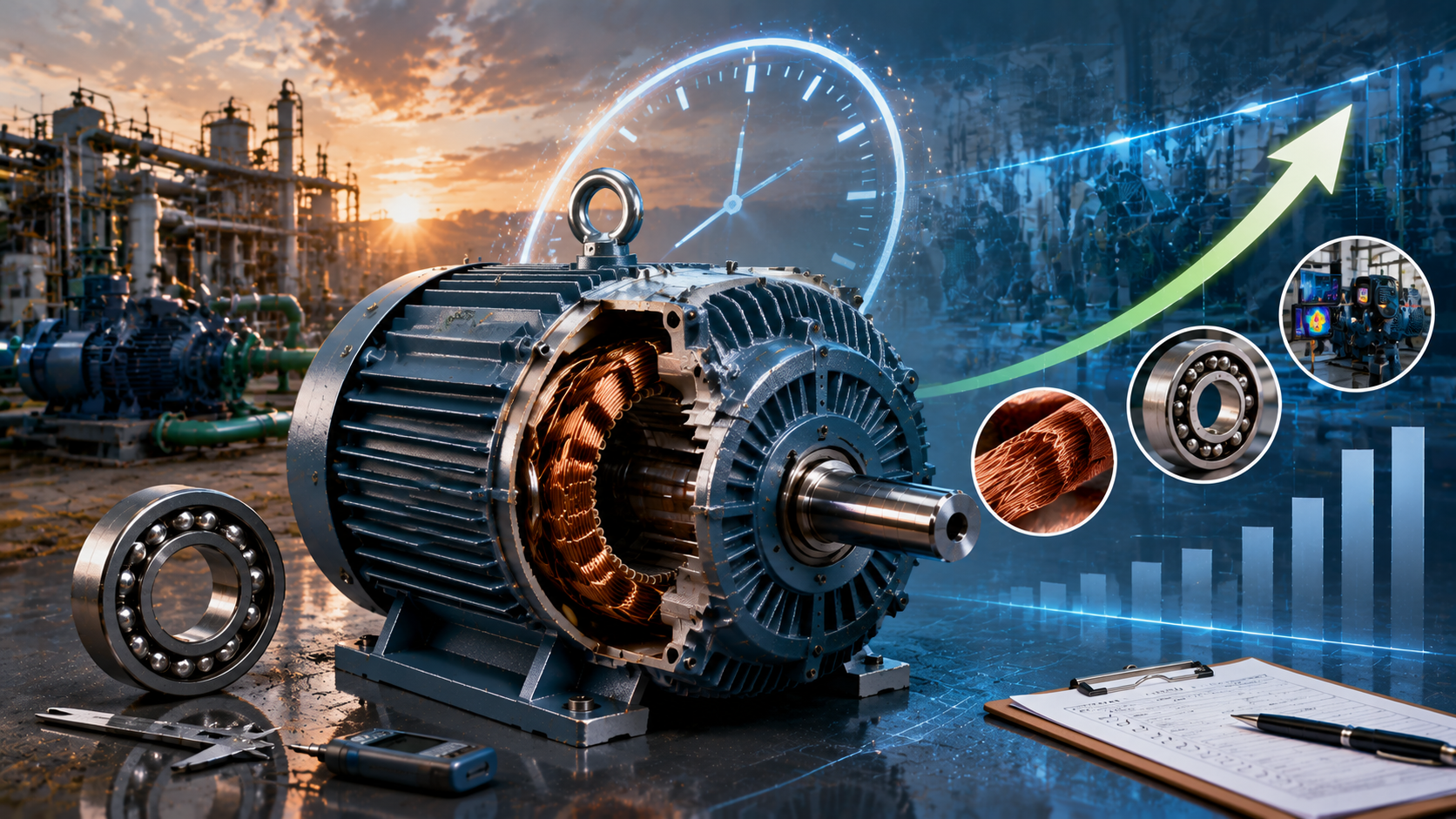
2026 Industrial Reliability Guide: A comprehensive analysis of AC motor life expectancy, failure modes (bearings vs. windings), the impact of VFDs and efficiency standards (IE3/IE4), copper vs. aluminum winding durability, and proven strategies to extend asset life by years. Compiled with TITECHO engineering expertise.
Introduction: Lifespan as a Strategic Asset
Alternating Current (AC) electric motors, particularly three-phase induction motors, power the vast majority of industrial applications—from pumps, compressors, fans, and conveyors to HVAC systems, renewable energy equipment, and manufacturing lines. These robust workhorses are renowned for their reliability, but their lifespan is not fixed. It varies dramatically based on design, operating conditions, maintenance practices, and emerging factors like Variable Frequency Drives (VFDs) and strict efficiency standards (IE3/IE4).
In 2026, with stricter global efficiency regulations (such as the U.S. DOE 2027 standards pushing many motors toward IE4 levels) and a rising emphasis on sustainability and circular economy principles, understanding and extending AC motor life has become a strategic priority. A well-maintained premium-efficiency motor can deliver 20+ years of service, while a poorly operated unit may fail in under 5 years.
This comprehensive guide explores the typical lifespan, primary failure mechanisms, technical nuances, real-world influences (including the critical difference between copper and aluminum windings), and actionable best practices. It covers edge cases, economic implications, and future considerations for manufacturers, OEMs, facility managers, and reliability engineers.
Typical Lifespan of AC Induction Motors: What the Data Shows
There is no universal "expiration date" for an AC motor, but industry benchmarks provide clear guidance based on application and quality:
| Motor Type / Application | Expected Lifespan | Operating Hours (Continuous Duty) | Key Notes |
|---|---|---|---|
| Standard Industrial (IE2/IE3) | 15–25 Years | 40,000–80,000 Hours | Properly applied and maintained; assumes 24/7 operation. |
| Premium Efficiency (IE4/IE5) | 20–30+ Years | 80,000+ Hours | Lower operating temperatures and superior materials extend life significantly. |
| Small Fractional HP (Residential) | 8–15 Years | Intermittent Duty | Single-phase motors; subject to higher thermal cycling stress. |
| Severe Service (Mining/Chemical) | 10–15 Years | Variable | High ambient temps, corrosion, or dust require enhanced protection to reach upper limits. |
Nuance on "Lifespan" Definitions:
Manufacturers often quote "design life" or MTBF (Mean Time Between Failures). However, real-world life depends on the weakest link. Bearings and winding insulation account for the majority of failures, not the motor "dying" uniformly. The statistical L10 bearing life (the hours at which 10% of identical bearings are expected to fail) is a key reference point—many industrial motors are designed for 20,000–40,000+ hours of L10 life under ideal loads.
Primary Failure Modes: Where and Why AC Motors Fail
Comprehensive studies and field data consistently rank the top culprits behind premature motor failure:
1. Bearing Failures (40–50%+ of All Failures)
Bearings are the mechanical heart of the motor. Failure is typically caused by:
- Improper Lubrication: Over-greasing (causing churning and heat) or under-greasing (causing friction).
- Contamination: Dust, moisture, or chemical ingress.
- Misalignment: Shaft misalignment creates excessive radial load.
- Electrical Discharge (Fluting): In VFD-driven motors, high-frequency shaft voltages can arc through bearings, pitting the raceways.
⚠️ Edge Case: In VFD-driven motors without mitigation (insulated bearings, shaft grounding brushes, or common-mode filters), bearing currents can accelerate failure dramatically, reducing life by 50% or more.
2. Winding/Insulation Failures (30–37% of Failures)
Thermal aging is the dominant mechanism. Insulation life follows the Arrhenius Rule: roughly, every 10°C rise above rated temperature halves insulation life. Other triggers include:
- Voltage Unbalance: Causes negative sequence currents and localized heating.
- Harmonics: From VFDs or non-linear loads, causing additional core and copper losses.
- Contamination: Moisture, dust, or chemicals degrading dielectric strength.
- Overvoltage Spikes: Reflected waves from long VFD cables.
High-efficiency IE3/IE4 motors run cooler but can be more sensitive to harmonics if not properly designed or derated for inverter duty.
3. Other Common Causes
- Overloading: Sustained operation above nameplate rating.
- Frequent Starts: Across-the-line starting draws 6–8x full-load current, causing thermal and mechanical stress.
- Environmental Factors: Ambient temperatures >40°C, high humidity, or corrosive atmospheres.
- Power Quality Issues: Voltage imbalance >1–2% severely reduces life; transients and surges damage insulation.
Copper vs. Aluminum Windings: Impact on Lifespan
The material used for stator windings is a critical determinant of longevity and thermal performance.
| Feature | Copper Windings | Aluminum Windings |
|---|---|---|
| Conductivity | High (Standard Benchmark) | ~60% of Copper |
| Operating Temperature | 10–20°C Cooler | Runs Hotter |
| Insulation Life | Extended (Due to lower heat) | Reduced (Due to higher heat) |
| Typical Lifespan | 15–20+ Years (Premium) | 8–12 Years (Similar Application) |
| Durability | Superior resistance to vibration/fatigue | More prone to creep and connection issues |
| Best For | Critical, Continuous, High-Duty, VFD | Light-Duty, Intermittent, Cost-Sensitive |
Key Insight: Copper windings typically yield longer life due to superior conductivity, lower I^2R losses, and significantly cooler operation. Modern copper motors in IE4 classes further enhance thermal margins, providing a buffer against unexpected overloads or poor ventilation. Aluminum designs, while cost-effective, often require larger frames to dissipate heat and may achieve only half the lifespan in similar heavy-duty applications.
Key Factors Influencing AC Motor Lifespan: A Multi-Angle Analysis
1. Temperature (The #1 Accelerator)
The single most critical factor. Class F insulation (155°C) is standard. Exceeding the hotspot temperature by 10°C can halve life. High-efficiency motors help here by generating less heat internally.
2. Load and Duty Cycle
Continuous duty at 100% load shortens life versus 75–85% loading (the "sweet spot" for many motors). Frequent starts/stops or cyclic loads accelerate mechanical wear and thermal fatigue.
3. Power Supply Quality and VFD Usage
VFDs offer energy savings and soft starts (extending mechanical life) but introduce harmonics and bearing currents. Without proper filtering or derating (typically 5–10% for older motors), VFDs can reduce winding and bearing life by 20–50%. Newer IE4 motors and inverter-duty designs mitigate this with reinforced insulation and shielding.
4. Maintenance Practices
Proper lubrication intervals, vibration analysis, thermography, insulation resistance testing, and alignment checks can multiply life by 2–3×. Neglect is the fastest path to failure.
5. Installation and Environment
Correct mounting, adequate airflow, protection from contaminants, and proper grounding are foundational. A misaligned motor will fail prematurely regardless of its quality.
6. Motor Design and Efficiency Class
IE3/IE4 motors often incorporate better bearings, higher-grade insulation, and optimized cooling paths, delivering superior longevity alongside energy savings.
Proven Strategies to Extend AC Motor Lifespan
✅ Operate Within Design Limits
- Avoid sustained overloads; use motors sized for 75–90% load where possible.
- Limit across-the-line starts per NEMA guidelines. Use soft starters or VFDs for high-inertia loads.
✅ Implement Robust Maintenance Programs
- Lubrication: Follow manufacturer schedules strictly. Use the correct grease type and quantity. Avoid over-greasing.
- Cleaning: Clean cooling fins and fans regularly to prevent overheating.
- Monitoring: Monitor vibration, temperature, and current signature regularly. Predictive maintenance tools like Motor Current Signature Analysis (MCSA) or vibration analysis pay for themselves quickly.
- Testing: Test insulation resistance (Megger) and polarization index periodically.
✅ Optimize Power Quality and VFD Integration
- Install output filters, dV/dt filters, or sine-wave filters on VFDs.
- Use insulated bearings or shaft grounding rings for drives above 5–10 HP.
- Derate motors slightly when operating in high-harmonic environments.
✅ Address Environmental Challenges
- Use TEFC (Totally Enclosed Fan Cooled) or severe-duty enclosures in harsh conditions.
- Install space heaters for standby motors to prevent condensation.
- Ensure proper alignment (laser tools recommended) and balanced loads.
✅ Choose the Right Motor from the Start
- Specify inverter-duty or IE4 premium-efficiency motors for VFD applications.
- Consider copper windings for critical, high-duty assets.
- Factor in ambient temperature ratings and service factors (1.15 SF provides a valuable safety margin).
Advanced & Edge-Case Considerations
- Extreme Environments: In high altitude, explosive atmospheres, or very low/high temperatures, select specialized motors (e.g., hazardous-duty, high-temperature insulation Class H).
- Frequent Cycling: For applications with frequent start/stop or regenerative braking, consult manufacturers for custom designs with enhanced thermal mass and braking capabilities.
- Rewinding Opportunities: Rewinding offers an opportunity to upgrade insulation class (e.g., from Class B to F or H), potentially extending post-rewind life beyond the original design.
- Emerging Technologies: Condition monitoring sensors, AI-driven predictive analytics, and better harmonic mitigation are making "zero unplanned motor failures" more achievable in 2026.
FAQ: Common Questions About AC Motor Lifespan
Q: How long do AC motors really last in industrial settings?
A: Typically 15–25 years for standard IE3 motors, and 20–30+ years for premium IE4/IE5 models, assuming proper maintenance and operation within design limits.
Q: Does using a VFD shorten motor life?
A: It can, if not managed correctly. VFDs introduce harmonics and shaft voltages that stress bearings and insulation. However, with proper mitigation (filters, grounding, inverter-duty motors), VFDs can actually extend life by reducing mechanical shock during starts.
Q: Are copper-wound motors worth the premium for longer life?
A: Yes, for critical or continuous-duty applications. Copper runs 10–20°C cooler, significantly extending insulation life and reducing the risk of thermal failure. The TCO advantage over 15 years is substantial.
Q: What is the biggest mistake that kills motor life early?
A: Poor maintenance, specifically improper lubrication and ignoring alignment/vibration issues. Thermal overload due to blocked cooling fins is also a major killer.
Q: Can proper maintenance double motor lifespan?
A: Absolutely. A proactive maintenance program involving vibration analysis, thermography, and precise lubrication can easily extend motor life by 2–3 times compared to a "run-to-failure" approach.
Conclusion: Treating Motor Lifespan as a Strategic Asset in 2026
AC electric motor lifespan is highly controllable rather than predetermined. By understanding the interplay of thermal stress, mechanical integrity, power quality, and maintenance, organizations can shift from reactive "run-to-failure" approaches to proactive reliability strategies. In an era of rising energy costs, stricter efficiency mandates, and sustainability pressures, investing in premium motors, robust installation, and ongoing monitoring delivers compounded returns through reduced downtime, lower energy bills, and extended asset life.
Whether you manage a single critical pump or thousands of motors across facilities, start by auditing your fleet: measure operating temperatures and loads, review maintenance logs, and assess VFD compatibility. The motors you protect today will power your operations more reliably—and profitably—for decades to come.
Get a Free Custom Quote for Copper Motors
Choose TITECHO's 99.99% pure copper winding motors for lower operational costs, longer equipment life, and compliance with 2026 energy regulations. Our team responds within 24 hours!
- ✉️ Email: [email protected]
TITECHO – TECHO ELECTRICAL & MECHANICAL (TAIZHOU) CO., LTD
Taizhou City, Zhejiang, China | www.cntecho.com | ISO 9001 Certified | Leading Manufacturer of IE3/IE4 Ultra-High Efficiency Motors