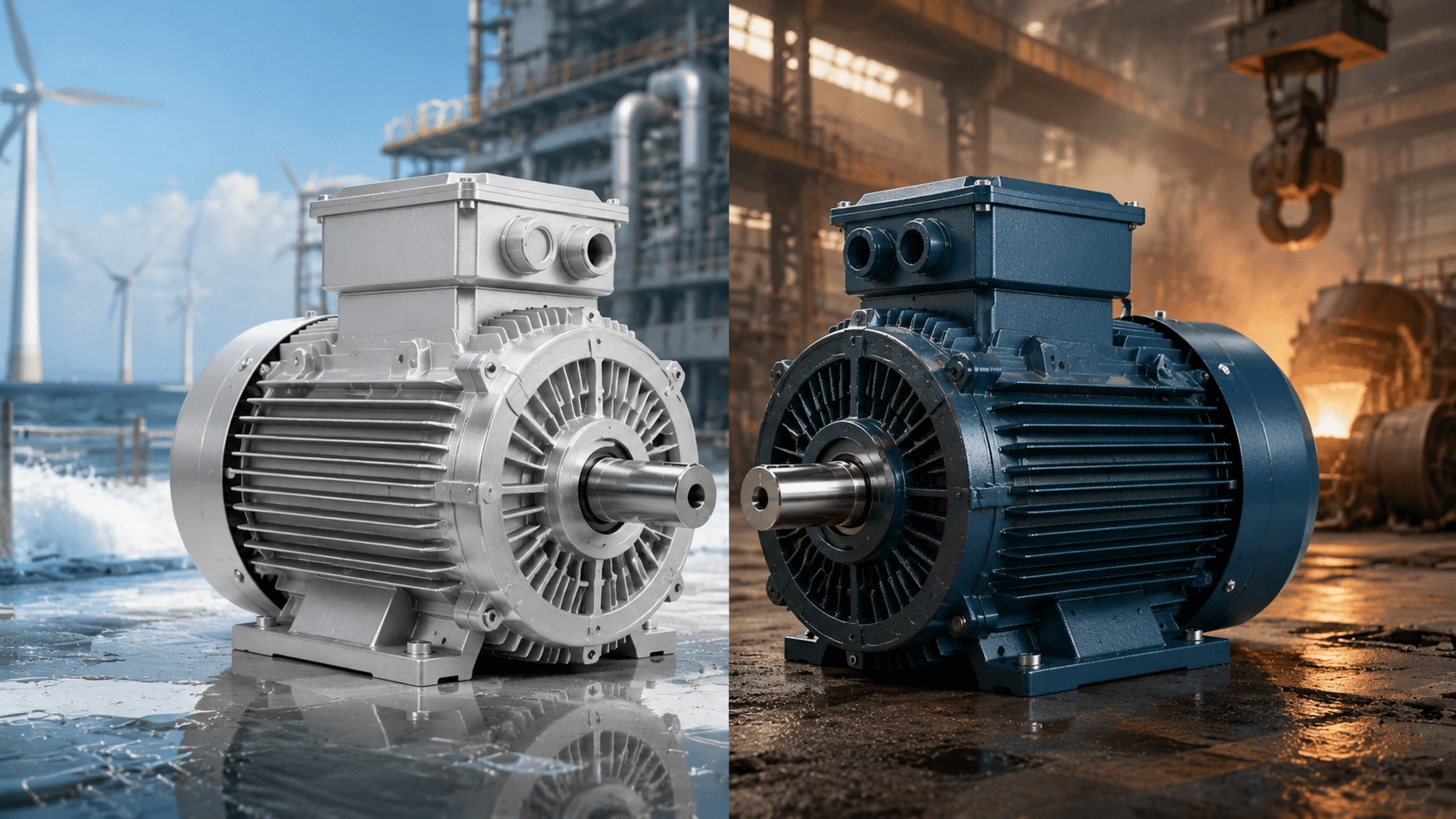
2026 AC Motor Enclosure Engineering Guide: A comprehensive, side-by-side technical analysis of Aluminum versus Iron/Steel motor housings. Covers thermal dynamics, corrosion mechanics, structural integrity, EMI/RFI shielding, IEC/NEMA compliance, Total Cost of Ownership (TCO) modeling, and application-specific selection protocols for wet, corrosive, and heavy-duty environments — compiled with TECHO industrial engineering expertise.
Introduction: The Enclosure as a Critical Electromechanical Component
The AC motor enclosure is far more than a passive protective shell; it is a highly engineered, active component that directly dictates motor performance, thermal management, environmental survivability, and lifecycle economics. In modern industrial ecosystems, where energy efficiency (IE4/IE5 standards) and predictive maintenance are paramount, the housing material plays a pivotal role in heat dissipation and electromagnetic compatibility.
Among the available metallurgical options, Aluminum and Iron/Steel (encompassing both Cast Iron and Fabricated Steel) represent the two dominant paradigms in industrial, commercial, and residential motor design. Selecting the incorrect enclosure material—such as prioritizing initial capital expenditure over corrosion resistance, or sacrificing thermal conductivity for marginal weight savings—inevitably leads to premature insulation degradation, unplanned downtime, and inflated operational expenditures (OPEX).
This guide provides a rigorous, engineering-grade analysis of aluminum and iron/steel AC motor enclosures, detailing material science fundamentals, advanced manufacturing processes, performance metrics, international compliance standards, and a systematic methodology for optimal material selection.
Core Material Properties: Aluminum vs. Iron/Steel Fundamentals
To evaluate enclosure performance, one must first understand the intrinsic metallurgical properties of the candidate materials. These properties govern thermal impedance, structural rigidity, and environmental resilience.
1. Aluminum Enclosures: The Thermal and Lightweight Paradigm
Industrial AC motor enclosures are rarely made of pure aluminum due to its low yield strength. Instead, they utilize specific aluminum alloys, most notably A356 (for high-pressure die casting) and 6061-T6 (for extrusion and fabricated assemblies). These alloys incorporate magnesium and silicon to optimize the strength-to-weight ratio while retaining aluminum’s inherent advantages.
- Density: Approximately 2.7 g/cm³ (roughly 35% the density of ferrous metals). This drastic weight reduction is critical for portable machinery, rooftop HVAC systems, and marine applications where structural load limits are strict.
- Thermal Conductivity: Approximately 150–205 W/(m·K) (nearly 4 to 5 times higher than cast iron or steel). This exceptional thermal conductivity allows the enclosure to act as an efficient heat sink, rapidly transferring heat from the stator core and windings to the ambient environment, thereby preserving insulation life.
• Corrosion Resistance: Aluminum naturally forms a passive, self-healing aluminum oxide (Al₂O₃) layer upon exposure to oxygen. This layer provides robust resistance to atmospheric corrosion, making it ideal for humid, coastal, or mildly chemical environments. For aggressive environments, this layer can be enhanced via hard anodizing or epoxy powder coating. - Tensile Strength: 6061-T6 aluminum offers a tensile strength of approximately 310 MPa. While lower than steel, it is more than adequate for standard industrial duty cycles when properly ribbed or finned during the casting process.
- Electromagnetic Shielding: Aluminum exhibits excellent electrical conductivity (approximately 60% that of copper), providing superior inherent shielding against Electromagnetic Interference (EMI) and Radio Frequency Interference (RFI) compared to untreated steel.
2. Iron/Steel Enclosures: The Structural and Economic Paradigm
In motor manufacturing, "Iron/Steel" typically refers to two distinct categories: Cast Iron (Gray Cast Iron or Ductile Iron) for heavy-duty frames, and Fabricated Mild Steel (carbon steel) for general-purpose enclosures. Both are ferrous metals characterized by high density and structural rigidity.
- Density: Approximately 7.1–7.8 g/cm³ (nearly 3 times denser than aluminum). This mass provides inherent stability, dampens high-frequency vibrations, and prevents resonance in large, high-inertia machinery.
- Thermal Conductivity: Approximately 45–55 W/(m·K). Ferrous metals are relatively poor thermal conductors. Consequently, cast iron or steel enclosures often require external cooling fins, forced ventilation, or oversized frame sizes to achieve the same thermal dissipation as an aluminum counterpart.
- Corrosion Resistance: Ferrous metals possess poor natural corrosion resistance and are highly susceptible to oxidation (rust) when exposed to moisture and electrolytes. Mitigation requires secondary processes such as hot-dip galvanizing, zinc-rich primers, or industrial epoxy powder coating. If this coating is mechanically compromised, rapid galvanic corrosion ensues.
- Tensile Strength & Rigidity: Gray cast iron offers a tensile strength of 200–400 MPa, while structural mild steel ranges from 400–550 MPa. Both offer superior impact resistance, rigidity, and vibration dampening compared to aluminum, making them the default choice for mining, crushing, and heavy manufacturing environments.
- Electromagnetic Shielding: While ferrous metals provide excellent magnetic shielding (due to high magnetic permeability), their lower electrical conductivity makes them less effective than aluminum at shielding against high-frequency electric field interference (RFI) without specialized conductive coatings.
| Material Property | Aluminum Alloy (e.g., A356 / 6061-T6) | Cast Iron / Mild Steel | Engineering Implication for AC Motors |
|---|---|---|---|
| Density | ~2.7 g/cm³ | ~7.2 - 7.8 g/cm³ | Aluminum drastically reduces transport/installation weight; Steel provides superior vibration dampening and mounting stability. |
| Thermal Conductivity | ~150 - 205 W/(m·K) | ~45 - 55 W/(m·K) | Aluminum acts as a superior heat sink, lowering operating temperature and extending insulation life (Arrhenius rule). |
| Tensile Strength | ~250 - 310 MPa | ~200 - 550 MPa | Steel/Cast Iron offers superior impact resistance and rigidity for high-vibration, heavy-duty applications. |
| Corrosion Resistance | Excellent (Self-passivating oxide layer) | Poor (Requires continuous barrier coating) | Aluminum is inherently suited for wet, marine, and washdown environments; Steel requires vigilant coating maintenance. |
| EMI/RFI Shielding | Excellent (High electrical conductivity) | Moderate (High magnetic permeability, lower electrical conductivity) | Aluminum is preferred for VFD-driven motors and precision CNC/medical applications requiring high-frequency noise suppression. |
| Initial Capital Cost | Higher (20% - 50% premium) | Lower (Highly economical for standard duty) | Steel minimizes upfront CAPEX; Aluminum minimizes long-term OPEX and TCO in harsh environments. |
⚠️ Critical Engineering Directive:
Never select an enclosure material based solely on initial purchase price. An inexpensive steel enclosure deployed in a coastal or chemical processing environment will incur catastrophic lifecycle costs due to accelerated corrosion, unplanned downtime, and premature motor replacement. Conversely, specifying premium aluminum for a climate-controlled, dry indoor warehouse represents an unnecessary capital expenditure.
Manufacturing Processes: Metallurgy Meets Precision Engineering
The manufacturing methodology profoundly influences the enclosure’s dimensional accuracy, thermal performance, and structural integrity. Aluminum and ferrous metals require distinctly different fabrication techniques.
1. Aluminum Enclosure Manufacturing
- High-Pressure Die Casting (HPDC): The industry standard for medium-to-large aluminum motor frames (0.5 kW to 100 kW). Molten A356 aluminum is injected into precision steel molds under extreme pressure (up to 150 MPa).
- Advantages: Exceptional dimensional accuracy (±0.1 mm), ability to cast complex, integrated cooling fins directly into the housing, and high production throughput.
- Limitations: High initial tooling costs; potential for microscopic porosity if process parameters are not strictly controlled, which can marginally reduce thermal conductivity.
- Extrusion: Primarily used for small, fractional-horsepower motors or specialized linear motor housings. Heated aluminum billets are forced through a die to create a continuous profile with uniform cross-sections, which is then cut to length and capped.
- Advantages: Highly efficient heat dissipation via continuous, uniform fins; low tooling cost.
- Fabricated Sheet Aluminum: Used for custom, low-volume, or oversized enclosures. Involves CNC cutting, bending, and TIG/MIG welding of 6061 aluminum plates.
- Advantages: Ultimate design flexibility without the need for expensive casting dies.
2. Iron/Steel Enclosure Manufacturing
- Sand Casting (Green Sand or Resin Bonded): The traditional method for manufacturing heavy-duty cast iron motor frames (typically >50 kW). A sand mold is formed around a pattern, and molten iron is poured.
- Advantages: Exceptional vibration dampening (graphite flakes in gray cast iron absorb acoustic energy); high compressive strength; cost-effective for large, heavy components.
- Limitations: Rough surface finish requiring machining of mounting feet and shaft bores; heavy weight; higher carbon footprint in production.
- Fabricated Steel (Rolling and Welding): Dominant for general-purpose, NEMA 1 or NEMA 4 enclosures. Steel plates are laser-cut, roll-formed into cylinders or boxes, and welded.
- Advantages: Very low material and tooling cost; highly scalable.
- Limitations: Weld seams can be potential points of corrosion ingress if not properly sealed and coated; lacks the integrated heat-dissipating fins of cast alternatives.
- Post-Processing (Galvanizing/Coating): Essential for all ferrous enclosures. Hot-dip galvanizing or multi-layer epoxy powder coating is applied to create a barrier against environmental degradation.
Performance Comparison: The Operational Reality
1. Thermal Management and Heat Dissipation
Excessive heat is the primary antagonist of motor longevity. According to the Arrhenius Rate Rule, the thermal life of motor winding insulation is halved for every 10°C increase in continuous operating temperature above its rated class (e.g., Class F at 155°C).
Because aluminum’s thermal conductivity is roughly four times that of cast iron, an aluminum-enclosed motor will typically operate at a 15°C to 25°C lower temperature than an identically loaded steel-enclosed motor. This thermal advantage directly translates to a 2x to 3x extension in insulation lifespan and allows the motor to maintain IE4/IE5 efficiency ratings under continuous heavy load.
2. Corrosion Resistance and Environmental Survivability
Aluminum’s self-healing oxide layer provides inherent protection against atmospheric corrosion, salt spray, and many industrial chemicals. In contrast, steel relies entirely on the integrity of its applied coating. In environments with high humidity, salt mist (C4/C5 ISO 12944 corrosion categories), or frequent high-pressure washdowns (e.g., food and beverage), microscopic scratches in a steel enclosure’s coating will initiate rapid galvanic corrosion, leading to structural weakening and seal failure.
3. Structural Rigidity and Impact Resistance
Ferrous enclosures, particularly cast iron, possess superior tensile strength and modulus of elasticity. They excel in environments subject to heavy mechanical shock, falling debris, or severe vibrational forces (e.g., mining crushers, vibrating screens, heavy conveyors). The inherent mass of cast iron also acts as a superior dampener for magnetic and mechanical vibrations, reducing noise emissions. Aluminum, while sufficiently strong for 90% of industrial applications, is more susceptible to denting or deformation under severe impact.
4. Electromagnetic Interference (EMI) and RFI Shielding
With the ubiquitous adoption of Variable Frequency Drives (VFDs), motors are subjected to high-frequency voltage transients (dV/dt) and common-mode currents. Aluminum’s high electrical conductivity makes it highly effective at reflecting high-frequency electromagnetic waves, acting as a Faraday cage to protect internal windings and prevent the motor from radiating noise that could disrupt nearby PLCs or communication networks. Steel provides good low-frequency magnetic shielding but is less effective against high-frequency RFI without additional conductive gaskets or coatings.
5. Total Cost of Ownership (TCO) Analysis
While steel enclosures typically carry a 20% to 50% lower initial purchase price, TCO modeling over a standard 15-year lifecycle frequently favors aluminum in non-ideal environments.
- Steel TCO Drivers: Higher freight costs (weight), increased installation labor, frequent repainting/re-coating, and higher risk of premature failure due to corrosion or overheating.
- Aluminum TCO Drivers: Higher initial CAPEX, offset by negligible corrosion maintenance, lower shipping/installation costs, and extended motor life due to superior thermal management.
IEC & NEMA Enclosure Standards: Compliance and Material Synergy
Enclosure standards define the level of protection against ingress of solid objects and liquids. Both aluminum and steel can be engineered to meet these standards, but the long-term reliability of that rating is heavily material-dependent.
1. IEC 60034-5 (Ingress Protection - IP Codes)
- IP54 / IP55 (Dust Protected / Water Jet Resistant): Both materials achieve this easily. However, in humid environments, a steel IP55 enclosure may corrode at seam welds over time, compromising the seal. An aluminum IP55 enclosure will maintain its structural and sealing integrity indefinitely.
- IP65 / IP66 (Dust Tight / Powerful Water Jets): Aluminum is the preferred material for IP66 in outdoor or washdown applications due to its resistance to water-induced corrosion.
- IP68 (Continuous Submersion): Aluminum (specifically marine-grade alloys with enhanced sealing) is the only practical, long-term choice for submersible applications. Steel will inevitably succumb to corrosion unless it is expensive, specialized stainless steel (e.g., 316L).
2. NEMA MG 1 Part 9 (Enclosure Types)
- NEMA 1 (General Purpose, Indoor): Fabricated steel is the standard, cost-effective choice.
- NEMA 4 (Weatherproof, Outdoor): Aluminum is highly recommended. Steel can be used if heavily galvanized and epoxy-coated, but requires ongoing inspection.
- NEMA 4X (Corrosion-Resistant): Aluminum is the industry standard for this rating. It inherently meets the "X" (corrosion-resistant) requirement without the exorbitant cost of stainless steel.
- NEMA 7 / 9 (Hazardous Locations): Aluminum is often preferred for explosive atmospheres (Class I, Div 1) because it is non-sparking and dissipates heat rapidly, preventing the enclosure surface from becoming an ignition source. (Note: Specific aluminum alloys and copper content limits must be verified per IEC 60079-0 / ATEX directives to prevent thermite reactions).
Application-Specific Material Recommendations
| Application Environment | Primary Challenges | Recommended Enclosure Material | Engineering Rationale |
|---|---|---|---|
| General Indoor Industrial (Dry warehouses, light manufacturing) | Dust, moderate ambient heat, budget constraints. | Fabricated Steel or Cast Iron | Provides adequate protection (NEMA 1 / IP54) at the lowest possible CAPEX. Thermal limitations are rarely an issue in climate-controlled spaces. |
| Outdoor / Marine / Coastal | Salt spray, high humidity, UV exposure, rain. | Aluminum (Anodized or Epoxy Coated) | Inherent resistance to chloride-induced corrosion. Maintains NEMA 4X / IP66 integrity without the risk of coating failure and subsequent rust. |
| Food, Beverage & Pharma | High-pressure, high-temperature chemical washdowns. | Aluminum (Smooth, crevice-free die-cast) | Resists caustic cleaning agents (e.g., sodium hydroxide). Die-cast aluminum can be designed with minimal seams, preventing bacterial harborage points. |
| High-Temperature / High-Power (Foundries, power generation, large compressors) | Extreme ambient heat, continuous high thermal load. | Aluminum (with integrated cooling fins) | Superior thermal conductivity is mandatory to prevent insulation degradation. Steel would require bulky, inefficient external forced-air cooling systems. |
| Heavy-Duty / High-Impact (Mining, quarrying, heavy construction) | Severe mechanical shock, rock falls, extreme vibration. | Cast Iron or Heavy-Gauge Steel | The high mass and tensile strength of ferrous metals absorb kinetic energy and dampen destructive resonant vibrations that would fatigue aluminum. |
| Precision / VFD-Driven (CNC, robotics, cleanrooms) | High-frequency EMI/RFI, strict thermal tolerances. | Aluminum | Provides excellent high-frequency electromagnetic shielding and ensures stable thermal performance, which is critical for servo motor precision. |
| Weight-Constrained (Rooftop HVAC, portable generators, aerospace) | Strict structural load limits, transportation logistics. | Aluminum (Extruded or Die-Cast) | A 60-70% weight reduction compared to steel, directly lowering structural support costs, shipping freight, and installation labor. |
Step-by-Step Scientific Enclosure Selection Methodology
To eliminate guesswork and prevent costly specification errors, engineers and procurement professionals should adhere to the following systematic selection protocol:
- Define the Environmental Envelope: Quantify the operating conditions. Determine the maximum/minimum ambient temperature, ISO 12944 corrosion category (C1 to C5), expected exposure to liquids/chemicals, and presence of explosive atmospheres (ATEX/IECEx).
- Determine the Required Ingress Protection: Map the environmental envelope to a specific IEC IP rating or NEMA enclosure type (e.g., C4 environment + washdown = IP66 / NEMA 4X).
- Evaluate Thermal Load: Calculate the motor’s continuous thermal dissipation requirements. If the motor is high-power (>50 kW) or operates in an ambient temperature >40°C, prioritize aluminum for its superior thermal impedance characteristics.
- Assess Mechanical and Structural Demands: If the application involves high shock loads, heavy vibration, or requires the enclosure to act as a structural mounting base, specify cast iron or heavy-gauge steel.
- Execute a Total Cost of Ownership (TCO) Analysis: Model the 15-year cost, factoring in initial purchase price, freight (weight-based), installation labor, scheduled maintenance (e.g., repainting steel), and the financial risk of unplanned downtime.
- Verify Manufacturer Quality and Compliance: Ensure the selected manufacturer holds ISO 9001 certification, provides certified test reports for IP/NEMA ratings, and utilizes appropriate metallurgical standards (e.g., ASTM B26 for aluminum castings, ASTM A48 for gray iron).
⚠️ Common Selection Pitfall:
The most frequent and costly error is selecting a fabricated steel enclosure based purely on a 20% lower initial quote, while ignoring the application’s moderate corrosion risk. Over a 10-year period, the cost of one premature motor failure, associated production downtime, and replacement labor will dwarf the initial capital savings by a factor of 10x or more.
Debunking Common Industry Myths
- Myth 1: "Aluminum is too soft for industrial use."
Fact: Modern aluminum motor enclosures are not made of pure, soft aluminum. They are manufactured from high-strength alloys (like A356 or 6061-T6) and are structurally reinforced with ribbing and fins during the casting process. They easily meet the mechanical demands of standard industrial applications. - Myth 2: "Steel is always the cheaper option."
Fact: Steel is only cheaper in terms of initial purchase price. When factoring in freight (due to weight), installation labor, and the high probability of corrosion-related maintenance or replacement in anything but a perfectly dry environment, aluminum frequently demonstrates a lower Total Cost of Ownership. - Myth 3: "Aluminum cannot handle high temperatures."
Fact: While aluminum has a lower melting point than steel (660°C vs. 1500°C), industrial motors are designed to operate with winding temperatures below 155°C (Class F). At these temperatures, aluminum’s superior thermal conductivity actively protects the motor by dissipating heat away from the core far more effectively than steel, making it the superior choice for high-ambient-temperature applications. - Myth 4: "Only stainless steel can be used in corrosive environments."
Fact: While stainless steel (e.g., 316L) offers exceptional corrosion resistance, it is prohibitively expensive and difficult to machine. Properly treated aluminum (anodized or epoxy-coated) provides equivalent or superior corrosion resistance for 95% of industrial corrosive applications (including food washdown and coastal marine) at a fraction of the cost.
Key Takeaways: Engineering the Optimal Enclosure
The selection of an AC motor housing material is a foundational engineering decision that dictates the reliability, efficiency, and economic viability of the driven system.
- Choose Aluminum when thermal management, corrosion resistance, weight reduction, or EMI shielding are primary design drivers. It is the undisputed champion of outdoor, marine, food processing, and high-efficiency (IE4/IE5) applications.
- Choose Iron/Steel (Cast Iron or Fabricated) when maximum mechanical rigidity, vibration dampening, impact resistance, or strict initial budget constraints are the dominant factors in dry, indoor, or heavy-industrial environments.
- Prioritize TCO over CAPEX: A rigorous lifecycle cost analysis will almost always justify the premium of aluminum in any environment presenting moderate to severe environmental challenges.
- Demand Compliance: Never compromise on verified IEC/NEMA ratings and ISO-certified manufacturing quality, regardless of the chosen material.
Secure Your Motor’s Longevity with TECHO Engineering Expertise
Selecting the wrong AC motor enclosure material is a silent liability, inevitably leading to premature failure, corrosive degradation, and catastrophic unplanned downtime. These failures extract a heavy toll on operational budgets and production schedules.
The TECHO team of certified electrical and mechanical engineers brings decades of specialized experience in motor specification, environmental profiling, and lifecycle cost optimization. We partner with you to analyze your unique operational parameters—from coastal salt spray to heavy mining vibrations—and prescribe the exact metallurgical solution, IP/NEMA rating, and protective coating required to guarantee decades of reliable service.
Whether you require standard high-efficiency aluminum TEFC motors, custom sand-cast iron frames for heavy machinery, or specialized hazardous-location enclosures, we deliver precision-engineered solutions tailored to your operational reality.
Request Your Custom AC Motor Enclosure and Material Consultation today, and ensure your electromechanical assets are protected by design, not compromised by specification.
© 2026 TECHO Industrial Engineering Solutions. All rights reserved. This document is intended for professional engineering reference. All motor selections and enclosure specifications must be validated by a qualified engineer in accordance with applicable local electrical codes, IEC 60034, NEMA MG 1, and site-specific safety regulations.