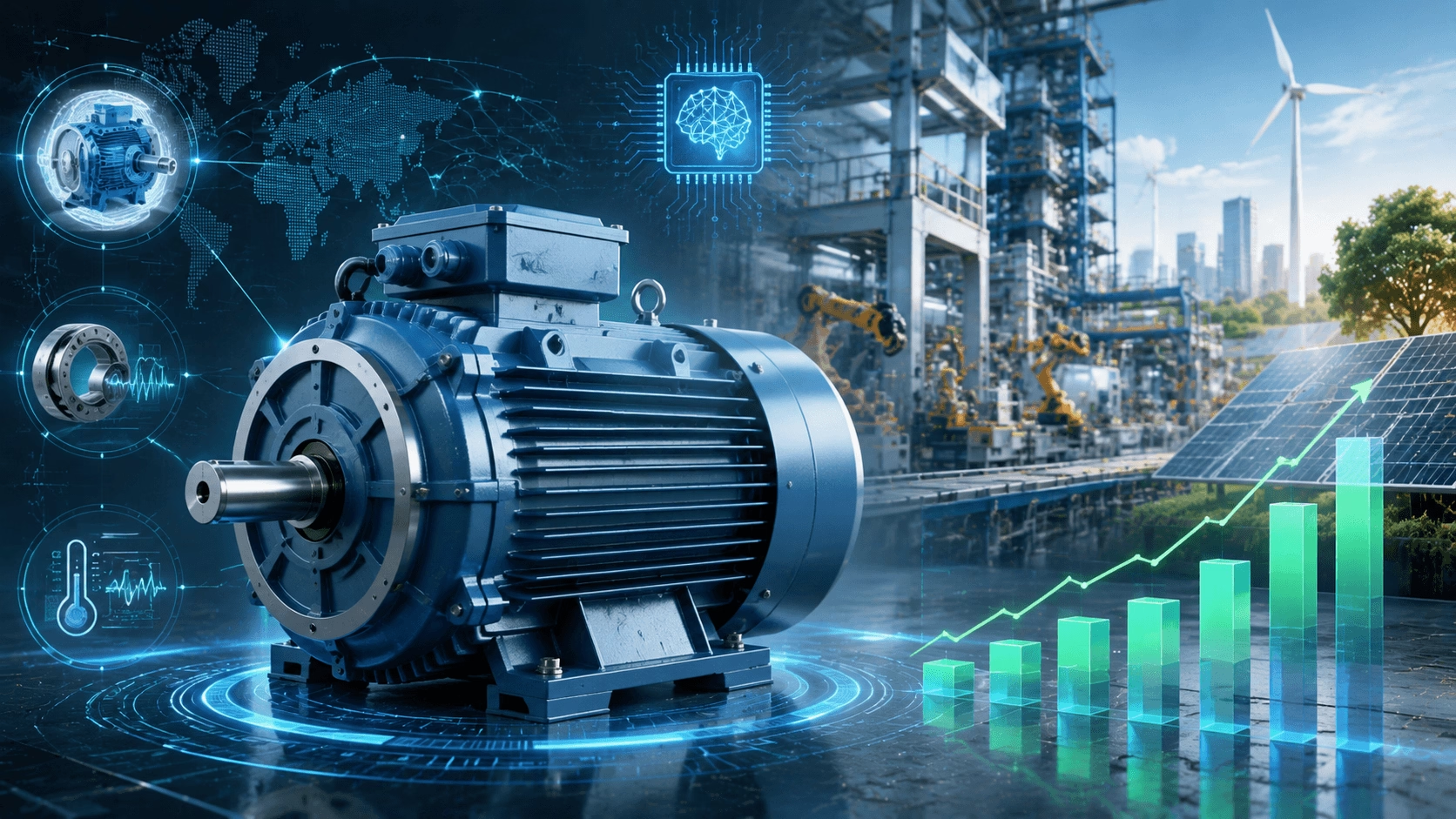
A comprehensive analysis of 2026 three-phase motor trends, encompassing IE5 efficiency classes, smart monitoring integration, wide-bandgap electronics, and global regulatory shifts. Expert engineering insights from Techo Electrical & Mechanical (Titecho).
1. Introduction
The three-phase AC motor industry is currently undergoing its most significant transformation in decades. As of 2026, electric motors continue to consume over 53% of global electricity and more than 70% of industrial power, positioning them at the centre of worldwide decarbonisation efforts. Concurrently, the convergence of advanced materials, power electronics, IoT connectivity, and increasingly harmonised global regulations is redefining the baseline specifications for standard industrial motors.
This guide examines the paramount technical, regulatory, and market trends shaping three-phase motor engineering in 2026—from the commercialisation of IE5 ultra-premium efficiency and magnet-free high-performance designs to the proliferation of smart monitoring systems and the accelerating convergence of international efficiency standards.
2. The Efficiency Frontier: Beyond IE4
2.1 IE5 Commercialisation and Technology Pathways
The IE5 "Ultra Premium Efficiency" class, which targets approximately 20% lower losses than IE4, has transitioned from a theoretical concept to a limited commercial reality by 2026. Unlike IE3 and IE4, which cage induction motors can achieve through incremental material and manufacturing improvements, IE5 generally necessitates a fundamental rethinking of motor topology.
| Technology Path | IE5 Feasibility | Market Readiness (2026) | Key Advantage |
|---|---|---|---|
| Synchronous Reluctance (SynRM) | ✓ Achievable | Commercial for 1–200 kW | Zero permanent magnets; excellent partial-load efficiency |
| PM-Assisted SynRM | ✓ Achievable | Growing availability | Ferrite or low-grade NdFeB boost; balanced cost and performance |
| Interior PMSM (IPMSM) | ✓ Achievable | Commercial; premium pricing | Highest torque density and peak efficiency |
| Copper-Rotor Induction | △ Marginal | Pilot programmes only | Line-start capability; material-limited at IE5 thresholds |
The dominant trend is a strategic shift from traditional induction motors toward synchronous technologies in the 1–200 kW range, driven by high inverter penetration. By 2026, approximately 35–40% of new industrial motor installations in developed markets are paired with Variable Frequency Drives (VFDs), enabling synchronous motor topologies that were previously impractical for direct-on-line (DOL) operation.
2.2 Material Innovations
- Amorphous Metal Cores: Non-crystalline iron-based alloys offer 70–80% lower core losses than conventional silicon steel. In 2026, amorphous metal stator cores are transitioning from niche applications into industrial motor pilot lines. The primary barrier remains mechanical handling, as amorphous metals are thinner (20–25 μm), harder, and more difficult to stamp and stack. However, for continuous-duty applications where energy costs dominate, the lifecycle economics are highly compelling.
- Copper Rotor Die-Casting: Proprietary oxygen-free copper die-casting processes have matured, enabling copper-cage rotors at production volumes previously dominated by aluminium. Copper's 65% higher conductivity (58 MS/m versus 35 MS/m) reduces rotor I²R losses by 15–25%, serving as a critical enabler for IE4 induction motors and a bridge technology toward IE5.
- Advanced Electrical Steel: Grain-oriented and high-silicon (6.5%) non-oriented steels are gaining traction for premium efficiency motors. These materials reduce hysteresis losses and improve magnetic permeability, albeit at a higher material cost and increased stamping tool wear.
2.3 The Magnet-Free Movement
Supply chain volatility in rare-earth elements (neodymium, dysprosium) has accelerated research and development in magnet-free, high-performance motors. By 2026, Synchronous Reluctance Motors (SynRM) have achieved IE4 efficiency across most of the industrial power range and IE5 in optimised designs. The inherent trade-offs—lower power factor (0.70–0.85 versus >0.90 for PMSM) and slightly lower torque density—are increasingly acceptable given the elimination of magnet costs and supply chain risks.
Ferrite-assisted SynRM designs represent a highly effective middle path, utilising inexpensive ferrite magnets to boost torque density by 15–25% without rare-earth dependency. These motors are becoming the default specification for OEMs seeking IE4+ performance with robust supply chain resilience.
3. Smart Monitoring and Industry 4.0 Integration
3.1 Embedded Sensor Ecosystems
The 2026 industrial motor is increasingly designed as a cyber-physical system. Factory-installed sensor packages now commonly include:
| Sensor Type | Measurement Parameter | Diagnostic Value |
|---|---|---|
| Triaxial Accelerometers | Vibration velocity and acceleration | Bearing health, misalignment, rotor unbalance |
| PT100/PT1000 RTDs | Winding and bearing temperature | Thermal overload, insulation ageing, lubrication status |
| Current Transformers (CTs) | Phase current waveforms | Load profiling, rotor bar health, voltage imbalance |
| Shaft Encoders/Resolvers | Speed and precise position | Performance mapping, closed-loop control feedback |
| Humidity Sensors | Internal moisture levels | Insulation contamination, mechanical seal integrity |
These sensors are no longer aftermarket additions but are embedded during initial manufacturing, with wiring routed to terminal boxes equipped with industrial Ethernet or wireless communication modules.
3.2 Edge Intelligence and Digital Twins
Rather than merely streaming raw telemetry to the cloud, 2026-era smart motors increasingly incorporate edge computing capabilities:
- Onboard Processing: DSPs or ARM-based microcontrollers perform real-time Fast Fourier Transforms (FFT) on vibration data, extracting bearing fault frequencies without the need for external analysers.
- Motor Current Signature Analysis (MCSA): Algorithms run locally to detect broken rotor bars, air-gap eccentricity, and load torque oscillations.
- Thermal Modelling: Advanced algorithms estimate winding hotspot temperatures from embedded RTDs and current data, predicting the remaining useful life of the insulation system.
- Digital Twin Integration: Each physical motor is paired with a virtual counterpart—a physics-based model running in parallel that compares predicted behaviour (temperature, vibration, efficiency) against actual measurements. Deviations trigger predictive maintenance workflows before physical degradation occurs.
3.3 Connectivity and Cybersecurity Standards
The proliferation of communication protocols has stabilised around a few dominant standards by 2026:
- OPC UA over TSN (Time-Sensitive Networking): Emerging as the preferred industrial Ethernet for motor-drive systems, enabling deterministic control and monitoring on shared infrastructure.
- MQTT and Cloud APIs: Utilised for higher-level analytics, fleet management, and enterprise resource planning (ERP) integration.
- WirelessHART and BLE: Deployed for retrofit sensor installations where physical cabling is impractical.
Cybersecurity has become a first-class design requirement. Modern motors and drives now incorporate encrypted firmware, secure boot sequences, and network segmentation capabilities to protect against OT-targeting malware.
4. Integrated Motor-Drive Systems and Wide Bandgap Electronics
4.1 The Convergence of Motor and Inverter
The physical and functional boundary between the motor and the drive continues to blur. Integrated motor-drive units—where the VFD electronics are housed within the motor terminal box or mounted directly onto the motor frame—are now commercially available up to 75 kW in 2026.
Key Advantages:
- Elimination of Motor Cables: Removes long lead lengths, thereby eliminating reflected wave issues and voltage amplification at the motor terminals.
- Reduced Installation Footprint: Particularly valuable in HVAC air handling units and compact pump skids.
- Optimised System Efficiency: Enables co-design of motor and inverter parameters, including switching frequency, modulation strategy, and unified thermal management.
4.2 Wide Bandgap Semiconductors
Silicon Carbide (SiC) and Gallium Nitride (GaN) power devices have crossed the cost threshold for mainstream industrial adoption:
| Parameter | Silicon IGBT (2020 Baseline) | SiC MOSFET (2026 Standard) |
|---|---|---|
| Switching Frequency | 2–8 kHz | 20–50 kHz |
| Switching Losses | Baseline | 50–70% lower |
| Inverter Efficiency | 96–97% | 98–99% |
| Heat Sink Volume | 100% (Baseline) | 30–50% reduction |
| dv/dt Control | Requires external filters | Superior intrinsic control |
Higher switching frequencies enable smoother motor current waveforms (reducing torque ripple and acoustic noise), smaller passive filter components, and the viability of higher motor pole counts for direct-drive applications without mechanical gearboxes.
4.3 Regenerative and Active Front-End Drives
For high-cyclic applications (e.g., cranes, centrifuges, test stands), Active Front-End (AFE) drives are becoming standard rather than optional. AFEs regenerate braking energy back to the electrical grid with near-unity power factor and < 5% Total Harmonic Distortion (THDi), eliminating the need for braking resistors and their associated thermal energy waste.
5. Global Standards and Regulatory Convergence
5.1 The Regulatory Landscape in 2026
By 2026, the global framework of motor efficiency regulations is demonstrating significant convergence toward IE3 as a universal baseline, with leading jurisdictions pushing aggressively toward IE4 and IE5:
| Jurisdiction / Standard | Current Requirement | 2026–2027 Developments |
|---|---|---|
| EU (2019/1781) | IE3 (0.75–1000 kW); IE4 (75–200 kW) | Expansion of IE4 to broader power ranges; IE5 under consideration for 2028–2030 mandate |
| US DOE (10 CFR 431) | NEMA Premium (~IE3) | Final rule effective June 2027 aligns with IE4 for 1–500 hp general-purpose motors |
| China (GB 18613) | IE3 for many categories | GB standard revision expected to adopt IE4 as the minimum for key industrial sectors |
| India (BEE Star Rating) | IE2 equivalent | Phased progression toward IE3; MEPS expansion |
| Mexico / Brazil | IE2–IE3 transition | Accelerating adoption of IE3 under regional trade harmonisation pressure |
5.2 Exemption Elimination
A critical 2026 trend is the progressive elimination of regulatory exemptions. Historical loopholes that previously allowed brake motors, submersible motors, and integrated pump-motor units to utilise lower efficiency classes are being systematically closed. The EU's updated Ecodesign implementing measures now require strict compliance documentation even for formerly exempt categories, forcing OEMs to redesign integrated products or source premium-efficiency subcomponents.
5.3 Testing and Certification Harmonisation
While IEC 60034-2-1 (loss determination) and IEC 60034-30-1 (efficiency classification) continue to serve as the global reference, regional discrepancies persist:
- IEEE 112 Method B (US) versus IEC 60034-2-1 (Global): Differences in stray load loss treatment can create 0.5–1.5 percentage point discrepancies in reported efficiency.
- NEMA MG-1 versus IEC 60034: Frame dimensions, service factors, and temperature rise limits remain partially non-harmonised.
By 2026, international industry groups are actively advancing mutual recognition agreements to reduce the compliance and testing burden for global manufacturers.
6. Sustainability and Circular Economy
6.1 Life Cycle Assessment (LCA)
Motor manufacturers are increasingly publishing Environmental Product Declarations (EPDs) based on ISO 14025 and EN 15804. These declarations rigorously quantify:
- Embodied Carbon: CO₂e emissions from raw material extraction, processing, and manufacturing.
- Use-Phase Impact: The dominant factor; the efficiency class directly determines over 95% of lifecycle emissions.
- End-of-Life Recyclability: Copper, aluminium, and electrical steel recovery rates.
The 2026 market reality dictates that use-phase energy dominates embodied carbon by a ratio of 20:1 or greater for motors exceeding 2,000 annual operating hours. This mathematically reinforces the economic and environmental imperative for IE4/IE5 adoption, even accounting for higher initial manufacturing impacts.
6.2 Design for Circularity
Emerging sustainable design practices include:
- Modular Construction: Separate bearing cartridges, terminal boxes, and cooling modules enable component-level replacement rather than full-unit disposal.
- Reduced Rare-Earth Content: SynRM and ferrite-assisted designs vastly simplify end-of-life material separation and recycling.
- Remanufacturing Programmes: Major manufacturers now offer factory remanufacturing with warranties equivalent to new motors, reducing landfill waste by up to 80%.
7. Emerging Architectures and Niche Innovations
7.1 Axial-Flux Motors
Axial-Flux Permanent Magnet (AFPM) motors—where the air gap is oriented radially rather than axially—are achieving commercial scale in 2026 for specialised applications:
- Torque Density: 30–50% higher than radial-flux equivalents due to a shorter magnetic flux path.
- Applications: In-wheel electric vehicle traction, direct-drive wind turbines, and compact pump systems.
- Challenges: Structural complexity in maintaining a uniform air gap and thermal management of end windings.
7.2 High-Speed Motors
Direct-drive high-speed motors (10,000–50,000+ rpm), enabled by SiC inverters and carbon-fibre retaining sleeves, are rapidly displacing geared systems in:
- Air Compression: Turbo blowers and compressors that eliminate gearbox mechanical losses and maintenance.
- Vacuum Pumps: Critical for semiconductor manufacturing and chemical processing.
- Turbomachinery: Energy recovery systems and small-scale power generation.
7.3 PCB Stator Motors
Printed Circuit Board (PCB) stators—where copper windings are etched on layered boards rather than wound in traditional slots—offer distinct advantages:
- Zero Cogging Torque: Ideal for precision positioning and ultra-smooth low-speed operation.
- Automated Manufacturing: Eliminates labour-intensive coil insertion processes.
- Integrated Power Electronics: Potential for fully integrated motor-drive systems on a single substrate.
By 2026, PCB stator motors are commercialised in sub-kilowatt applications (drones, medical devices, robotics) with active scaling efforts underway for low-power industrial fans and pumps.
8. Conclusion
The three-phase motor in 2026 is no longer the simple electromechanical commodity of the 20th century. It has evolved into an intelligent, highly efficient, and digitally connected energy conversion platform. The dominant trends—IE5 efficiency commercialisation via synchronous technologies, embedded smart monitoring with edge AI, integrated wide-bandgap drives, and tightening global regulatory harmonisation—are collectively raising the performance baseline while enabling entirely new application possibilities.
For engineers and asset managers, the strategic implications are profound:
- Specification Must Be System-Level: Motor selection in 2026 requires the simultaneous evaluation of efficiency class, inverter compatibility, sensor packages, and connectivity protocols.
- Total Cost of Ownership Rules: First cost is increasingly irrelevant compared to 15-year energy and maintenance costs, particularly as IE4/IE5 motors and VFDs become the regulatory baseline.
- Data is a Motor Asset: The ability to monitor, predict, and optimise motor performance in real time is now as valuable as the motor's physical nameplate rating.
- Sustainability is Measurable: Carbon accounting and circular economy principles have transitioned from marketing claims to strict procurement criteria.
As the industry advances toward 2030, the trajectory is unequivocal: motors will become more efficient, more intelligent, more integrated, and more standardised globally. Organisations that master these trends in 2026 will be optimally positioned to capitalise on the next wave of industrial electrification and decarbonisation.
Reference Standards:
- Regulatory Compliance: Regulation (EU) 2019/1781 and its amendments, DOE 10 CFR Part 431, IEC 60034-30-1, and NEMA MG-1.
- Smart Motor Standards: IEC 61800-7 (drive profiles) and OPC UA IEC 62541.