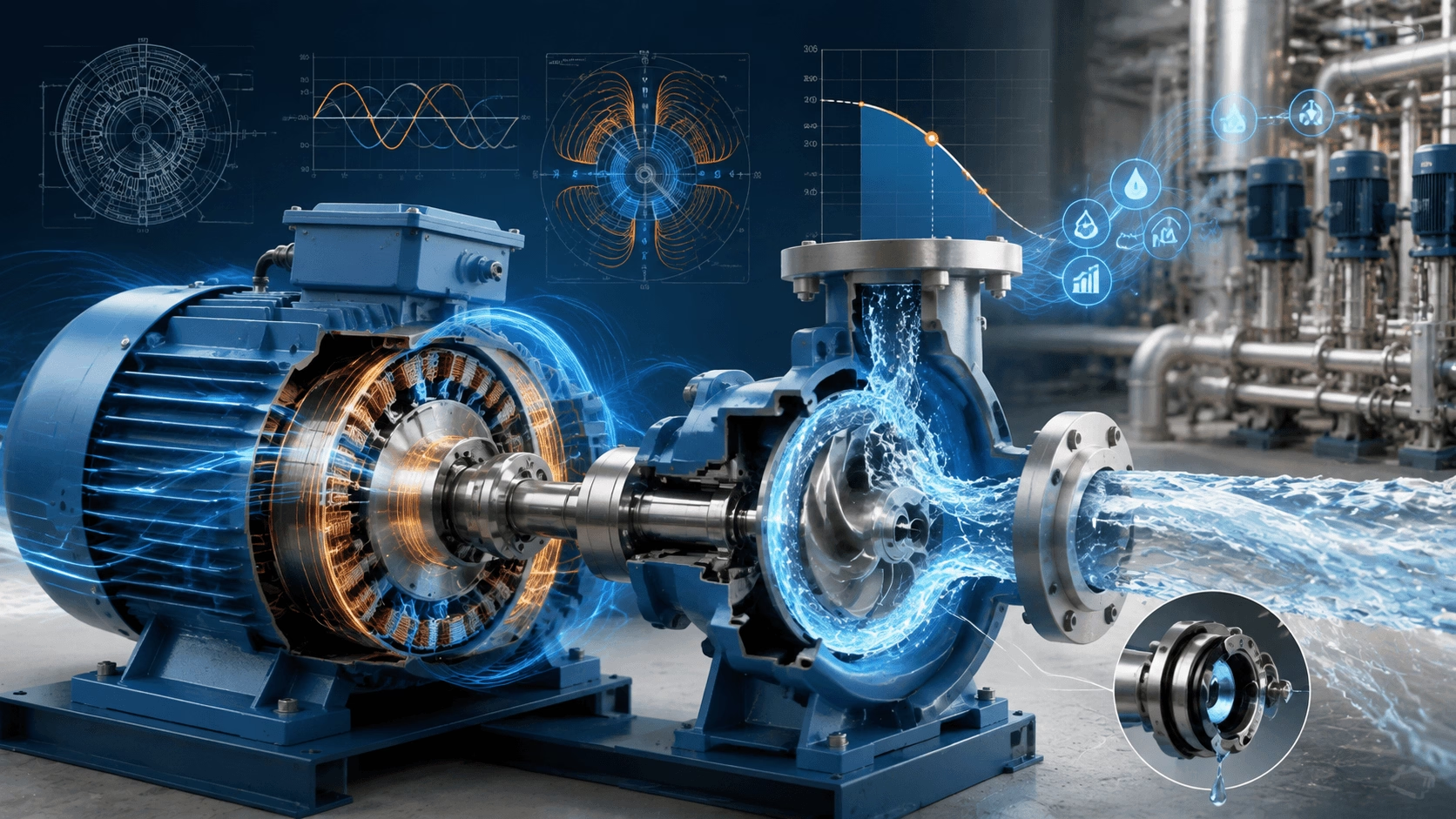
The Invisible Force: Understanding AC Motors and Water Pumps | TITECHO Guide
Abstract: A comprehensive technical guide explaining the fundamental engineering principles behind AC motors and water pumps. This document demystifies electromagnetism, centrifugal hydraulics, system matching, and maintenance protocols. TITECHO translates complex physics into actionable knowledge for optimizing industrial reliability and energy efficiency.
1. Introduction: The Hidden Heroes of Modern Infrastructure
Modern civilization relies on continuous fluid movement and mechanical power. From municipal water supply to climate control and industrial manufacturing, these functions depend on two foundational technologies: the AC motor and the water pump.
While often perceived as simple mechanical enclosures, these devices represent centuries of scientific advancement and precision engineering. For facility managers, business owners, and engineers, understanding their operating principles is not merely academic—it is essential for reducing energy waste, preventing downtime, and ensuring long-term operational profitability.
This TITECHO guide clarifies the physics governing motors and pumps, transforming complex engineering concepts into practical, applicable knowledge.
2. The AC Motor: Converting Electricity into Motion
An Alternating Current (AC) motor transforms electrical energy into mechanical rotation. Understanding this conversion requires examining three core principles.
2.1 Electromagnetic Induction
The foundation of motor operation is electromagnetism. When current flows through a conductive coil, it generates a magnetic field. In an AC motor, these electromagnets are arranged in the stationary outer housing, known as the stator.
2.2 The Rotating Magnetic Field
Unlike Direct Current (DC), Alternating Current reverses direction periodically (50 or 60 Hz). This oscillation creates a Rotating Magnetic Field within the stator—a continuously spinning magnetic flux that acts as the driving force of the motor.
2.3 Rotor Dynamics and Slip
The rotating component, or rotor, interacts with the stator’s magnetic field. In induction motors, the rotor rotates at a speed slightly less than the synchronous speed of the magnetic field. This speed difference, called slip, is necessary to induce current in the rotor and produce torque. The rotor continuously "chases" the rotating field, converting electromagnetic force into sustained mechanical rotation.
2.4 Efficiency and Loss Mechanisms
Not all input electrical energy converts to useful work. Losses manifest as:
- I²R Losses: Resistive heating in copper windings.
- Core Losses: Hysteresis and eddy currents in steel laminations.
- Mechanical Losses: Bearing friction and windage.
- Stray Load Losses: Harmonic and leakage flux effects.
High-efficiency motors (TITECHO IE3/IE4 series) minimize these losses through premium-grade silicon steel, high-purity copper windings, and precision manufacturing, maximizing the conversion of electrical input to mechanical output.
3. The Water Pump: Hydraulic Energy Transfer
If the motor provides mechanical power, the pump converts that power into hydraulic energy to move fluid against resistance.
3.1 Centrifugal Pump Operating Principle
The most prevalent industrial pump type operates on centrifugal force:
- Fluid enters axially at the impeller center (eye).
- Rotating impeller vanes accelerate fluid radially outward.
- High-velocity fluid enters the volute casing, where cross-sectional area increases.
- Velocity energy converts to pressure energy per Bernoulli’s principle, discharging fluid at elevated pressure.
3.2 Head vs. Flow: Fundamental Performance Parameters
| Parameter | Symbol | Definition | Hydraulic Analogy |
|---|---|---|---|
| Flow Rate | Q | Volume of fluid moved per unit time (m³/h, GPM) | River width |
| Head | H | Energy imparted to fluid, expressed as equivalent height (m, ft) | Waterfall height |
Critical Design Insight: Head and flow are inversely related on a pump curve. System design requires identifying the specific operating point where required flow and head intersect the pump’s Best Efficiency Point (BEP).
3.3 Cavitation: Causes and Prevention
Cavitation occurs when local static pressure drops below the fluid’s vapor pressure, forming vapor bubbles that collapse violently upon reaching higher-pressure zones.
- Acoustic Signature: Sounds like gravel or marbles passing through the pump.
- Physical Damage: Micro-jet impacts erode impeller surfaces and degrade performance.
- Prevention Strategy: Ensure Net Positive Suction Head Available (NPSHa) exceeds NPSH Required (NPSHr) by adequate margin. Minimize suction line friction losses through proper pipe sizing and layout.
4. System Integration: Matching Motor and Pump
Motor and pump must be engineered as an integrated system. Mismatched components compromise efficiency and reliability.
4.1 Oversizing Consequences
Excessively large motors operating at light load suffer reduced efficiency and power factor. Poor cooling airflow at low loads may also cause thermal issues.
Solution: Size motor rating to match pump brake horsepower at the actual operating point, with appropriate service factor margin.
4.2 Undersizing Risks
Insufficient motor capacity causes overload conditions, excessive current draw, thermal degradation, and premature failure.
Solution: Apply standard service factors (typically 1.15–1.25) while avoiding excessive oversizing.
4.3 Variable Frequency Drive (VFD) Optimization
VFDs enable speed modulation to match variable demand. Per the Pump Affinity Laws:
P \propto N^3
Where P = Power and N = Speed. Reducing speed by 20% yields approximately 50% power savings. TITECHO motors feature VFD-compatible insulation systems designed to withstand inverter-induced voltage stress.
5. Preventive Maintenance Protocol
| Component | Inspection Method | Failure Indicator |
|---|---|---|
| Motor Bearings | Acoustic monitoring, temperature measurement | Grinding noise, elevated temperature |
| Mechanical Seals | Visual inspection | Leakage, seal face wear |
| Thermal Condition | IR thermography, RTD sensors | Hotspots exceeding nameplate limits |
| Alignment | Laser alignment tools, vibration analysis | Excessive 1×/2× RPM vibration |
| Cooling System | Visual inspection | Blocked fins, damaged fan shroud |
Disciplined maintenance preserves design efficiency and prevents catastrophic failures.
6. Future Trends in Industrial Motion
- Smart Monitoring: Embedded IoT sensors enabling real-time condition monitoring and predictive maintenance.
- Ultra-Premium Efficiency: Global transition toward IE5 standards with advanced materials and topology optimization.
- Sustainable Manufacturing: Recyclable materials and low-carbon production processes reducing environmental footprint.
7. Conclusion: Engineering Empowerment
Understanding AC motor and pump fundamentals enables informed decisions that directly impact operational performance:
- Cost Reduction through proper efficiency class selection.
- Reliability Improvement through correct system matching and maintenance.
- Performance Optimization through hydraulic and electrical integration.
TITECHO combines deep technical expertise with precision manufacturing to deliver solutions that power your success. Whether requiring standard replacements or customized engineering, our team stands ready to support your operations.
Harness the Invisible Force with TITECHO
Optimize your motor and pump systems with expert engineering support.
- Website: www.cntecho.com
- Engineering Inquiries: [email protected]