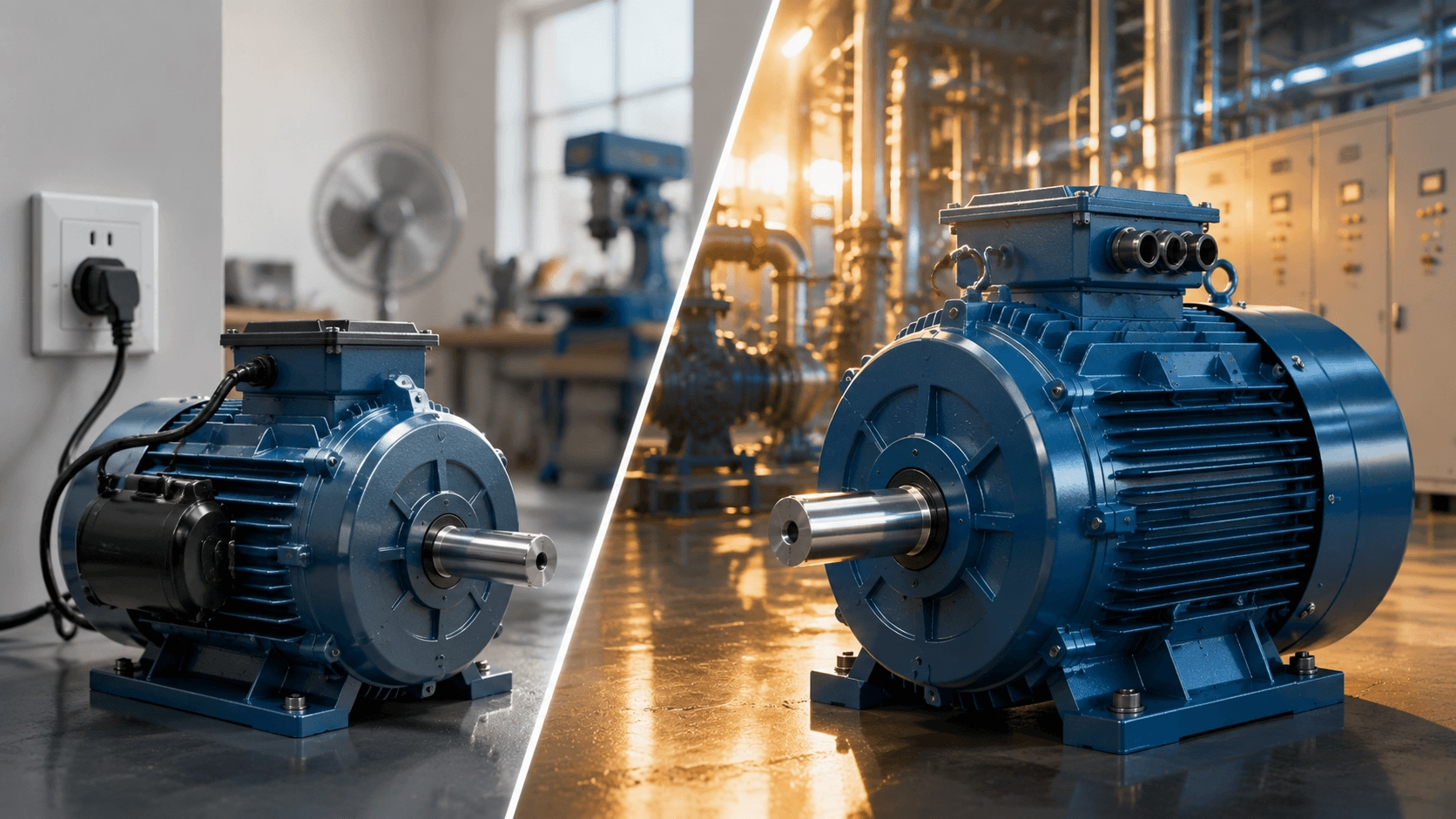
2026 Industrial & Commercial Motor Guide: A comprehensive comparison of single-phase and three-phase AC induction motors. Analyze key differences in efficiency, torque density, power supply requirements, and total cost of ownership (TCO). Learn when to choose each type for residential, workshop, or heavy industrial applications in the era of IE4/IE5 standards and VFD integration. Compiled with TITECHO engineering expertise.
Introduction: The Fundamental Choice in Electrification
Electric motors power the modern world—from household refrigerators and garage tools to massive factory conveyors, water pumps, HVAC systems, and industrial compressors. Yet, one fundamental choice often confuses buyers, facility managers, and engineers alike: Single-Phase or Three-Phase?
Selecting the wrong motor type can lead to higher energy bills, poor starting performance, excessive vibration, premature failure, or unnecessary installation costs. In 2026, with rising global energy prices, stricter efficiency regulations (such as mandatory IE4/IE5 standards in many regions), and the widespread adoption of Variable Frequency Drives (VFDs), understanding the nuances between these two AC induction motor families is more critical than ever.
This guide explores their operating principles, key technical differences, advantages, limitations, real-world applications, and selection criteria—providing you with the insights needed to make an informed, cost-effective decision.
How They Work: The Physics of Rotation
Both single-phase and three-phase motors are typically AC induction (asynchronous) motors. They operate on the same basic principle: alternating current creates a magnetic field in the stator that induces current in the rotor, causing it to spin and produce torque. However, the quality of that magnetic field differs significantly.
Single-Phase Motors: The "Pulsating" Field
Single-phase motors receive power from a single alternating current waveform (typically 120V or 230/240V). A single-phase supply alone produces a pulsating magnetic field rather than a smoothly rotating one. To initiate rotation, these motors require auxiliary components to create a phase shift:
- Capacitor-Start (CS): Uses a capacitor to boost starting torque.
- Capacitor-Start Capacitor-Run (CSCR): Uses two capacitors for high starting torque and efficient running.
- Split-Phase: Uses an auxiliary winding with higher resistance.
- Shaded-Pole: Simple, low-torque design for small fans.
These mechanisms add complexity, reduce overall efficiency, and often result in lower starting torque. Once running, many single-phase motors rely on a run capacitor to maintain performance.
Three-Phase Motors: The "Rotating" Field
Three-phase motors use three alternating currents offset by 120 electrical degrees. This configuration naturally produces a constant, smoothly rotating magnetic field without any auxiliary starting mechanisms.
- Result: Self-starting operation, higher torque density, smoother performance, and superior efficiency.
- Analogy: Think of a single-phase motor as a one-cylinder engine—functional but prone to vibration and less powerful. A three-phase motor is like a balanced V6 or V8 engine, delivering seamless, continuous power delivery.
Key Differences: A Side-by-Side Comparison
| Feature | Single-Phase Motor | Three-Phase Motor |
|---|---|---|
| Power Supply | 1 Live + Neutral (120V/230V) | 3 Live Phases (+ Neutral/Ground) (230V/400V/480V) |
| Starting Mechanism | Requires Capacitor, Split-Phase, or Shaded Pole | Self-Starting (Natural Rotating Field) |
| Power Range | Fractional HP up to ~5–10 HP (3.7–7.5 kW) | Fractional HP to 10,000+ HP |
| Efficiency | Lower (50–70% typical); Higher I^2R losses | Higher (85–96%+); IE3/IE4/IE5 standard |
| Starting Torque | Moderate (100–200% FLT); Can struggle with inertia | High (200–300%+ FLT); Smooth acceleration |
| Size & Weight | Larger/Bulkier for equivalent power | Compact, lighter, higher power density |
| Maintenance | Higher (Capacitors fail; centrifugal switches wear) | Lower (Robust squirrel-cage; no capacitors) |
| Noise & Vibration | Higher (Torque pulsation) | Lower (Smooth magnetic field) |
| Initial Cost | Lower for small sizes; No special wiring needed | Higher upfront (Wiring/Panel upgrades may be needed) |
| Operating Cost | Higher (Lower efficiency; higher current draw) | Lower (Energy savings; better power factor) |
Deep Dive: Critical Performance Factors
1. Efficiency and Energy Consumption
- Single-Phase: Generally less efficient due to higher copper losses and the need for auxiliary windings. They draw more current per horsepower, generating more heat.
- Three-Phase: Delivers the same power with approximately 30–43% less current per conductor. This significantly reduces I^2R losses, heat generation, and energy costs. For continuous-duty applications, the energy savings of a three-phase IE4 motor can pay for the motor itself within 1–2 years.
2. Starting Torque and Performance
- Single-Phase: Often struggles with high-inertia loads. Starting torque is limited by the capacitor size and auxiliary winding design.
- Three-Phase: Provides high starting torque inherently. This makes them ideal for hard-to-start loads like positive displacement pumps, crushers, and large compressors.
3. Reliability and Maintenance
- Single-Phase: More complex internal components (capacitors, centrifugal switches) are common points of failure. Capacitors degrade over time, leading to reduced starting capability or burnout.
- Three-Phase: Simpler construction (no capacitors or switches in standard squirrel-cage designs). Fewer moving parts mean fewer failures and longer service life.
4. Power Factor and Grid Impact
Three-phase motors generally maintain a better power factor, especially when paired with VFDs. This reduces reactive power demand and avoids utility penalties in commercial and industrial settings.
Common Applications: Matching Motor to Use Case
✅ Choose Single-Phase When:
- Residential/Light Commercial: Only single-phase power is available.
- Small Appliances & Tools: Fans, blowers, refrigerators, washing machines, garage door openers, bench grinders.
- Low Power Needs: Small pumps (<2–3 HP), hobbyist air compressors, woodworking tools.
- Intermittent Duty: Applications where the motor runs for short periods and simplicity/low cost is prioritized.
- Budget-Constrained Projects: Where upfront cost is the primary driver and energy savings are negligible.
✅ Choose Three-Phase When:
- Industrial/Agricultural/Commercial: Facilities have access to three-phase power.
- Heavy/Continuous Loads: Large pumps, compressors, conveyors, elevators, HVAC chillers, machine tools, mixers, crushers.
- High Power Needs: Any application >5 HP (3.7 kW) benefits significantly from three-phase efficiency and size advantages.
- Variable Speed Control: Applications requiring VFDs for speed regulation, soft starting, or process control.
- Future-Proofing: Planning for expansion or compliance with strict efficiency mandates (IE3/IE4/IE5).
💡 Edge Case: In rural workshops with only single-phase power, users often employ Rotary Phase Converters or VFDs (single-phase input, three-phase output) to run three-phase motors. While viable, this adds cost, complexity, and may require derating the motor.
How to Choose the Right Motor: Step-by-Step Decision Framework
- Assess Available Power Supply: Check your electrical panel. Is three-phase available? If not, is a utility upgrade feasible or cost-effective?
- Determine Power Requirements: Calculate required HP/kW, starting torque, and duty cycle (continuous vs. intermittent).
- Evaluate Efficiency & Operating Costs: For motors running >2,000 hours/year, three-phase usually offers a rapid ROI through energy savings. Factor in local electricity rates.
- Consider Load Characteristics: High-inertia or hard-to-start loads strongly favor three-phase motors.
- Budget Holistically (TCO): Include purchase price + installation + wiring + energy + maintenance + downtime costs over 5–10 years.
- Check Regulatory Compliance: Ensure the motor meets local efficiency standards (e.g., IE3 minimum in EU/China/US for certain ranges).
- Plan for Controls: Do you need variable speed? Three-phase + VFD is the modern standard for precision and energy optimization.
Emerging Trends in 2026 and Beyond
- High-Efficiency Mandates: Regulations are pushing both types toward premium materials (copper rotors, better laminations), but three-phase motors benefit more from IE4/IE5 designs.
- VFD Integration Explosion: VFDs are making three-phase motors even more versatile for soft starting, speed control, and energy savings, further widening the gap in performance compared to single-phase alternatives.
- Smart Motors & IoT: Integration of sensors for predictive maintenance is more common in three-phase industrial motors.
- Sustainability Focus: Lower lifetime carbon footprint favors efficient three-phase motors in industrial settings.
- Hybrid Solutions: Improved phase converters and single-phase-to-three-phase VFDs are making three-phase power more accessible in single-phase environments.
Final Recommendation
There is no universal “better” motor—only the right fit for your specific needs.
- For Home, Small Workshop, or Light-Duty: Single-Phase is practical, affordable, and sufficient.
- For Industrial, Continuous, High-Power, or Efficiency-Critical Uses: Three-Phase delivers superior performance, lower long-term costs, and greater reliability.
Always prioritize a reputable manufacturer, verify motor ratings against your load, and consider a professional electrical assessment for installation. Investing time upfront in proper selection yields years of reliable, energy-efficient operation.
Get a Free Custom Quote for Copper Motors
Choose TITECHO's 99.99% pure copper winding motors for lower operational costs, longer equipment life, and compliance with 2026 energy regulations. Our team responds within 24 hours!
- ✉️ Email: [email protected]
TITECHO – TECHO ELECTRICAL & MECHANICAL (TAIZHOU) CO., LTD
Taizhou City, Zhejiang, China | www.cntecho.com