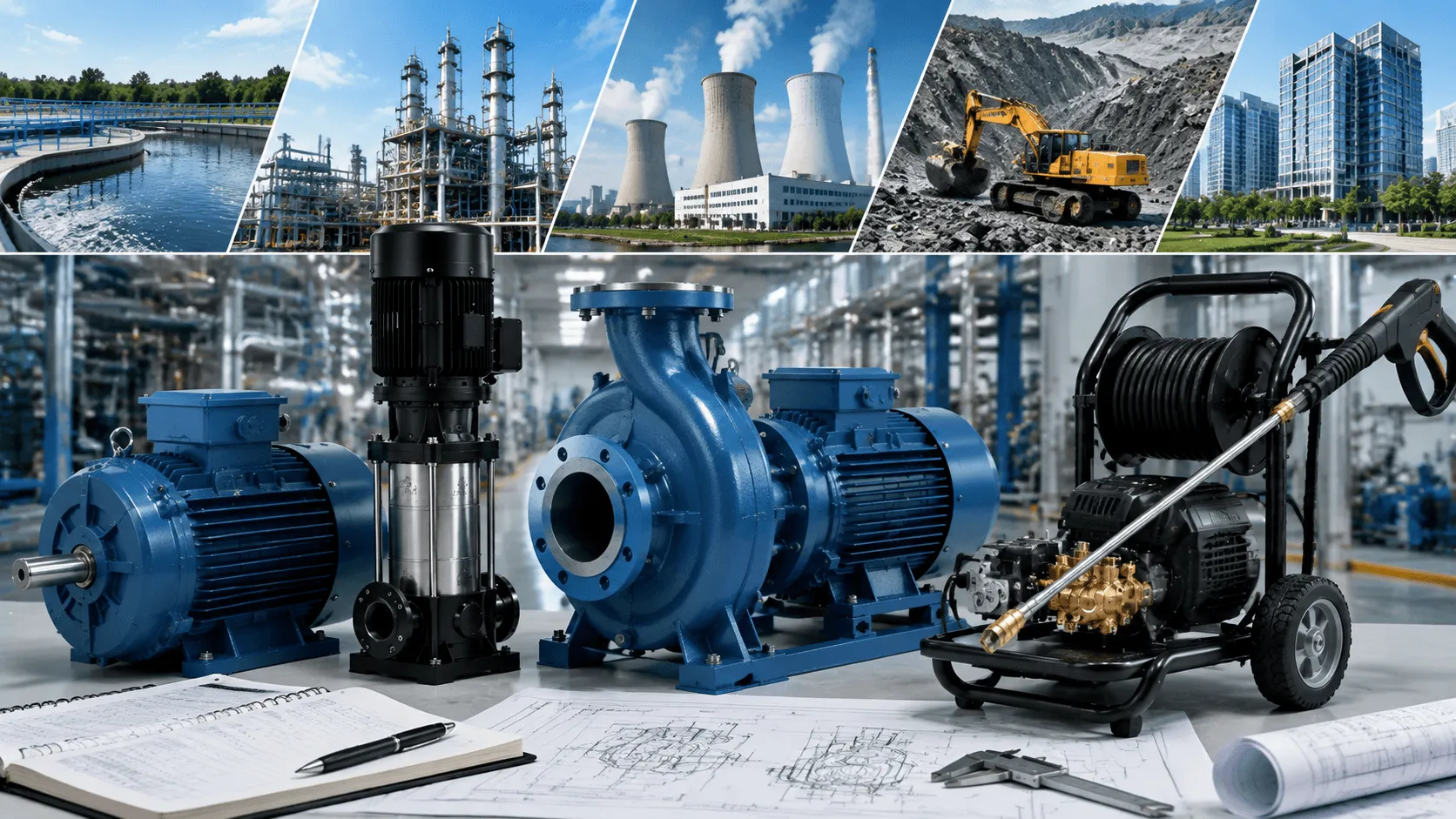
2026 comprehensive guide to industrial motor, pump & high-pressure cleaner selection: demand analysis, working conditions, IE3/IE4 efficiency, TCO optimization & common pitfalls – expert advice from TECHO, 30+ years manufacturer.
Industrial Equipment Selection Guide
This comprehensive guide, developed by TECHO—a Chinese manufacturer with 30 years of expertise in industrial motors, water pumps, and high-pressure cleaners serving 40+ countries—provides a practical, step-by-step framework for selecting industrial equipment. It helps buyers avoid costly errors like reduced lifespan, excessive energy use, unplanned downtime, and mismatched performance. The guide emphasizes starting with clear demand boundaries (functional needs, performance metrics with 10–20% margin, and installation constraints), followed by four key steps: analyzing working conditions (temperature, medium, humidity/dust, voltage, altitude), matching mandatory and optional parameters, balancing energy efficiency (e.g., IE3/IE4 motors) with total ownership costs, and addressing international compliance (certifications, standards, documentation). The article also shares pitfalls to avoid, a post-selection checklist, and concludes that accurate matching—rooted in needs analysis and condition adaptation—delivers optimal cost-performance, with an invitation for free expert consultation on specific applications from TECHO's engineering team.
I. Core Logic: Define Demand Boundaries First
The most important step is not comparing specs—it's defining your exact requirements. Clarify "What problem are we solving?" and "Under what conditions?" to avoid unnecessary features.
Assess needs across three dimensions:
Core Functional Requirements
Identify the equipment's primary role (e.g., motor power output, pump fluid transfer, cleaner decontamination level). Avoid over- or under-specification. Ask: Continuous or intermittent operation? Need VFD speed control or remote monitoring features?
Performance Requirements
Quantify key metrics (e.g., motor kW, pump flow/head, cleaner bar pressure) with tolerance ranges.
TECHO Recommendation: Add 10–20% margin for peak demand to prevent overload damage—our YE3/IE3 series motors, for example, can operate at 110% rated load for short periods without performance degradation.
Space & Installation Constraints
Measure site dimensions (L × W × H), load capacity, and interfaces (e.g., motor shaft diameter, pump flanges). Confirm early to avoid costly modifications. TECHO offers customizable shaft and flange sizes for motors and pumps to fit non-standard installation needs.
II. Key Steps: Working Condition Adaptation + Parameter Matching
The heart of selection is working condition adaptation—the same product performs differently in varied environments (a common pitfall for international buyers). Apply these 4 steps:
1. Analyze Working Conditions & Environment
Evaluate the operating environment with these 5 critical factors:
| Environmental Factor | Key Analysis Points | Selection Impact Examples |
|---|---|---|
| Temperature Range | Min/max temp + fluctuation | High temp → TECHO heat-resistant Class H insulation motors; Low temp → anti-freeze stainless steel pumps |
| Medium Characteristics | Corrosiveness, viscosity, impurities | Corrosive fluids → TECHO 304/316 stainless steel pumps; Impurities → enhanced mechanical sealing for reduced clogging |
| Humidity & Dust | Humidity, dust levels, explosion-proof needs | Harsh conditions → IP54+ rated motors/pumps; Explosive zones → ATEX-certified TECHO equipment for EU markets |
| Voltage & Power Supply | Local standards, frequency, stability | EU/US → 400V/50Hz or 460V/60Hz motors; Unstable supply → voltage stabilizer matching services from TECHO |
| Altitude | Elevation, plateau conditions | High altitude → TECHO motors with enhanced cooling fans to offset thin-air heat dissipation challenges |
2. Core Parameter Matching
General Logic
Prioritize mandatory parameters (basic function), then optional ones (usability). In conflicts, protect core performance first (e.g., flow/power), then balance energy/cost.
Example: Mine drainage pump (high dust, sediment sewage)
- Mandatory: Flow ≥ 50 m³/h, Head ≥ 80 m, IP65 protection
- Optional: Smart remote monitoring, stainless steel impeller
TECHO Solution: Our MD series mine drainage pumps meet these requirements, with a field-tested MTBF (Mean Time Between Failures) of over 40,000 hours in dusty mining environments.
3. Balance Energy Consumption & Total Cost
Operating costs often exceed purchase price—focus on Total Cost of Ownership (TCO):
- Prefer high-efficiency models (IE3/IE4 motors)—TECHO's IE4 motors save 15–20% energy vs. IE2 models, offsetting the 20% higher upfront cost in 1–2 years for continuous operation.
- Evaluate maintenance: TECHO uses universal, easy-to-source components for motors and pumps; global spare parts warehouses in Europe and Southeast Asia ensure fast replacements.
- Avoid over-specification: Use modular/upgradable designs for rare peaks—TECHO's VFD-compatible motors allow for on-demand speed adjustment to match variable loads.
4. International Procurement Compliance
For global procurement, verify these critical points (TECHO's standard offerings for overseas clients):
- Certification: CE (EU), UL (US), IEC, and ATEX for explosive environments.
- Interfaces/Standards: Compliance with local mounting and flange norms (e.g., NEMA for North America, DIN for Europe).
- Documentation: Multi-language (English, Spanish, German) operation manuals, certification copies, and installation guides.
III. Tips to Avoid Common Selection Pitfalls
- Don't chase "high parameters"—higher specs mean higher price/energy; match actual needs. TECHO's engineering team provides free load analysis to recommend the right specs.
- Never ignore working conditions—e.g., using a standard cast-iron pump in corrosive wastewater cuts lifespan by over 50%.
- Prioritize supplier strength: Choose manufacturers with 10+ years of experience, customization capability, and fast after-sales (e.g., TECHO's 48 h remote technical support for urgent issues).
- Request trial runs for high-value orders to verify real-world fit—TECHO offers free sample testing for bulk procurement projects.
IV. Post-Selection Confirmation Checklist
- Core parameters match actual operational needs
- Working condition/environment adaptation (e.g., IP rating, material compatibility)
- Energy efficiency vs. budget (TCO calculation completed)
- Target market certification compliance (CE/UL/ATEX, etc.)
- Supplier after-sales & documentation (multi-language manuals, spare parts availability)
- Delivery/logistics feasibility (TECHO offers door-to-door shipping with customs clearance support)
V. Conclusion
Industrial equipment selection succeeds through accurate matching: Start with needs, analyze conditions, balance cost/compliance—for optimal performance and long-term value.
Questions on motors, pumps, or high-pressure cleaners? Contact TECHO's team for free customized solutions tailored to your working conditions.