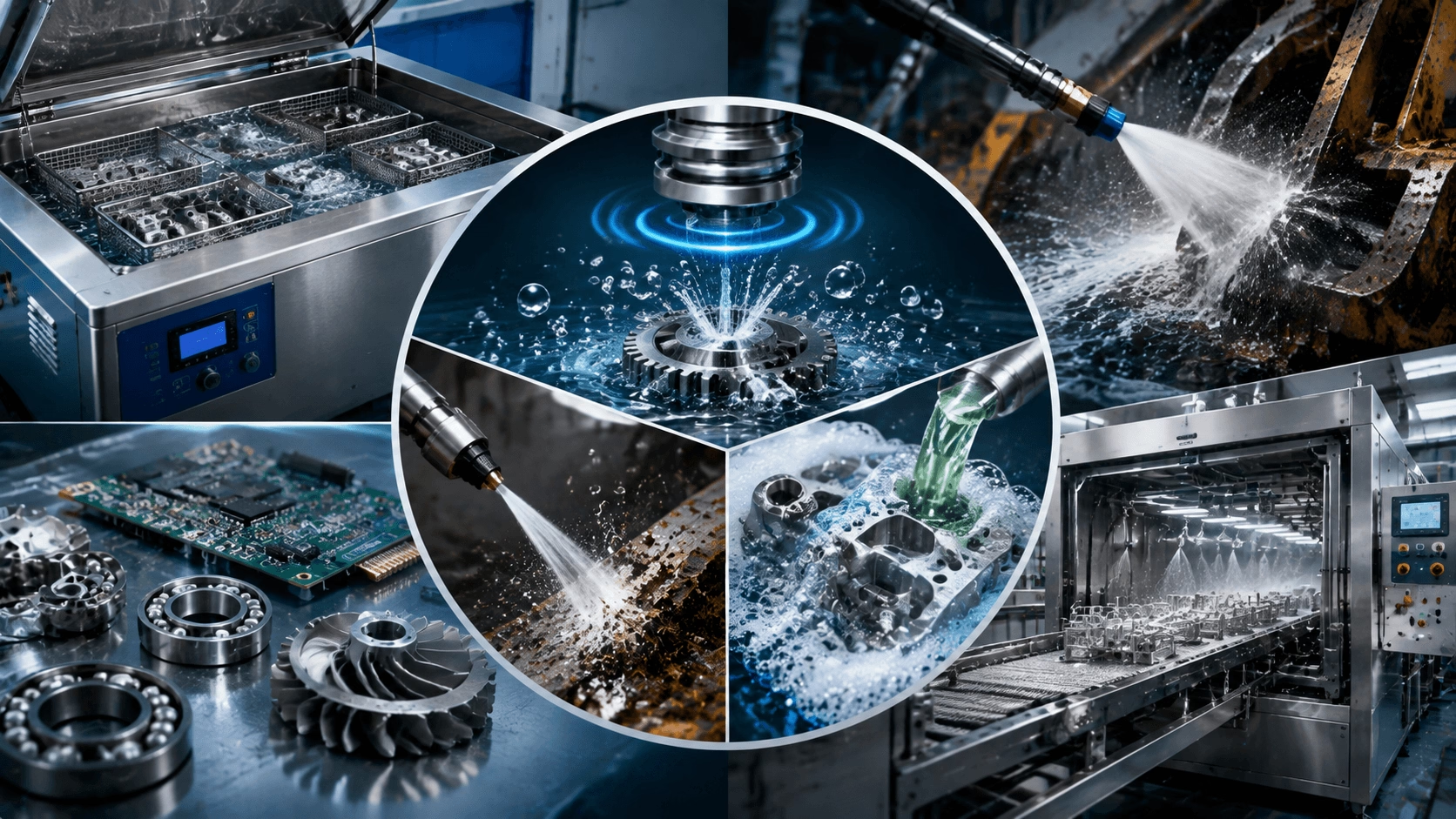
Core Principles of Cleaning Machines: Cavitation, High-Pressure Jet & Industrial-Grade Solutions
A technical exposition of industrial cleaning machine operating principles, covering ultrasonic cavitation mechanics, high-pressure jet dynamics, and chemical synergy. Includes classification by technology type, frequency-dependent application mapping, and selection guidance for precision manufacturing, electronics, aerospace, and heavy industry.
Introduction: Beyond Surface-Level Understanding
In precision manufacturing, semiconductor fabrication, aerospace maintenance, and heavy industrial processing, cleaning is not an ancillary activity—it is a critical process step directly determining product yield, equipment reliability, and operational efficiency. From nanometer-scale wafer decontamination to meter-scale structural descaling, cleaning systems are embedded at every value-chain node.
Yet a significant cognitive gap persists among practitioners. Many conflate "high-pressure water flushing" with comprehensive industrial cleaning or assume "sonic vibration" universally addresses all contamination types. This oversimplification leads to misapplied technology, substrate damage, inadequate cleanliness, and wasted capital expenditure.
This guide dissects the three foundational physical-chemical mechanisms governing industrial cleaning efficacy, maps them to specific equipment architectures, and provides the technical literacy required for evidence-based equipment selection.
I. Core Working Principles: The Physics and Chemistry of Precision Decontamination
The universal objective of industrial cleaning is efficient contaminant removal without substrate degradation. Achieving this requires deliberate orchestration of physical forces, chemical reactions, or synergistic combinations thereof. Three core principles define the operational envelope of modern cleaning systems.
1. Acoustic Cavitation: The Precision Decontamination Mechanism
Cavitation is the defining mechanism of ultrasonic and megasonic cleaning, enabling removal of micron- and sub-micron-scale contaminants from geometrically complex surfaces inaccessible to mechanical methods.
Physical Mechanism
When high-frequency acoustic waves (20 kHz – 1 MHz) propagate through a liquid medium, alternating compression and rarefaction cycles generate localized pressure differentials:
- Rarefaction Phase: Negative pressure stretches the liquid beyond its tensile strength, nucleating microscopic vapor-filled cavities (cavitation bubbles).
- Compression Phase: Positive pressure collapses these bubbles asymmetrically within microseconds, releasing concentrated energy in three forms:
- Localized Temperature Transients: Thousands of Kelvin (confined to bubble volume; bulk fluid remains near ambient)
- Shock Waves: Tens to hundreds of MPa peak pressure radiating spherically
- Microjets: Liquid streams reaching velocities up to 100 m/s, directed toward adjacent solid surfaces
These microjets penetrate blind holes, crevices, and interstitial spaces, mechanically dislodging particulates, oils, oxides, and biofilms through shear stress and impulsive loading—without macroscopic abrasion or substrate deformation.
Frequency-Dependent Cavitation Characteristics
| Frequency Range | Bubble Size | Energy Density | Penetration Depth | Substrate Safety | Optimal Application |
|---|---|---|---|---|---|
| Low (20–40 kHz) | Large (50–200 μm) | High intensity; aggressive collapse | Deep penetration into recesses | Moderate risk to delicate features | Heavy oils, machining residues, robust metal parts |
| Medium (40–80 kHz) | Medium (20–50 μm) | Balanced intensity and density | Moderate penetration | Safe for most engineered surfaces | Electronic assemblies, precision hardware, optical components |
| High / Megasonic (80 kHz–1 MHz) | Small (2–20 μm) | Low individual energy; high spatial density | Shallow; boundary-layer dominated | Non-damaging to nanostructures | Semiconductor wafers, MEMS, photomasks, polished optics |
Critical Distinction: Megasonic cleaning (>400 kHz) operates via acoustic streaming and stable cavitation rather than transient inertial cavitation. Energy transfer is gentler and more uniform, making it suitable for sub-100 nm feature sizes where conventional ultrasonics would cause pattern damage or particle redeposition.
2. High-Pressure Jet Impingement: Macro-Scale Contaminant Fracture
High-pressure jet cleaning relies on converting hydraulic potential energy into kinetic energy, generating focused fluid streams whose impact stress exceeds contaminant-substrate adhesion strength.
Hydraulic Performance Parameters
Impact Force ∝ P × Q × v²
Where P = pressure (MPa), Q = volumetric flow rate (L/min), v = jet velocity at target surface.
Pressure determines fracture capability (breaking adhesive/cohesive bonds); flow rate governs debris evacuation capacity (removing dislodged material). Both must be matched to the specific soil-substrate system.
Pressure-Flow Application Matrix
| Contaminant Type | Substrate Sensitivity | Recommended Pressure | Flow Priority | Nozzle Geometry |
|---|---|---|---|---|
| Loose particulate, dust, light oil | Fragile (glass, plastic, coated) | 10–30 MPa | High flow for coverage | Fan (15°–40°) |
| Grease, carbonized deposits, paint overspray | Moderate (painted metal, composites) | 30–70 MPa | Balanced | Fan or rotary turbo |
| Rust, mill scale, concrete laitance, marine growth | Robust (structural steel, cast iron) | 70–150 MPa | Adequate flow for evacuation | Rotary turbo or zero-degree spot |
| Coating removal, surface profiling, UHP blasting | Industrial substrate preparation | 150–280+ MPa | Specialized high-pressure nozzles | Rotating multi-jet or abrasive-injected |
Nozzle Selection Impact
- Fan Nozzles: Uniform sheet distribution; large-area coverage; lower point impact
- Rotary/Turbo Nozzles: Concentrated spinning jet; 2–3× higher effective impact vs. equivalent fan nozzle; ideal for tenacious localized contamination
- Zero-Degree Needle: Maximum point impact; narrow working envelope; high substrate damage risk; reserved for spot treatment of extreme contamination
- Abrasive Injection Nozzles: Entrained solid media amplifies cutting action; used for coating removal and surface profiling
3. Chemical Synergy: Reducing Adhesion Energy Through Molecular Interaction
Physical mechanisms alone often cannot overcome strong chemical bonding between contaminants and substrates. Chemical agents reduce interfacial adhesion energy, lowering the mechanical threshold for contaminant release and enabling milder physical parameters.
Reaction Mechanisms by Contaminant Class
| Contaminant | Effective Chemistry | Mechanism | Substrate Compatibility Notes |
|---|---|---|---|
| Hydrocarbon oils, greases | Alkaline detergents (pH 10–13) | Saponification of esters; emulsification of non-polar soils | Avoid on aluminum, zinc, magnesium unless inhibited |
| Mineral scale, rust, oxides | Acidic cleaners (pH 1–4) | Dissolution/chelation of metal compounds | Corrosion inhibitors mandatory for ferrous substrates; avoid on acid-sensitive alloys |
| Flux residues, adhesives, polymers | Polar solvents, glycol ethers, specialty formulations | Solvation/swelling; hydrogen bond disruption | Verify elastomer/plastic compatibility; VOC/flammability assessment required |
| Proteins, biofilms, organic films | Enzymatic or oxidizing agents | Catalytic hydrolysis; oxidative chain scission | Temperature and pH sensitive; rinse thoroughly to prevent residue |
| Mixed/unknown contamination | Multi-component formulated cleaners | Combined mechanisms | Always conduct coupon testing before full-scale deployment |
⚠️ Mandatory Validation Protocol: Never assume chemical compatibility. Conduct standardized coupon tests simulating worst-case exposure (concentration, temperature, time) on representative substrate samples. Evaluate for etching, discoloration, embrittlement, or residual film formation. Document results before production implementation.
II. Equipment Classification by Operating Principle and Application Domain
Ultrasonic Cleaning Systems: Precision Decontamination Platform
| Subtype | Frequency | Cavitation Character | Primary Applications | Key Specification Considerations |
|---|---|---|---|---|
| Low-Frequency Ultrasonic | 20–40 kHz | Aggressive; deep cleaning | Machined parts, engine components, heavy degreasing | Power density ≥20 W/L; sweep modulation to prevent standing wave dead zones |
| Mid-Frequency Ultrasonic | 40–80 kHz | Balanced; versatile | PCB assemblies, medical instruments, precision hardware | Dual-frequency or multi-transducer arrays for uniform field distribution |
| Megasonic | 400 kHz–1 MHz | Gentle; boundary-layer | Semiconductor wafers, flat panels, nano-devices | Transducer uniformity ±5%; particle-free filtration; DI water compatibility |
| Multi-Frequency / Sequential | Programmable 20 kHz–1 MHz | Adaptive per process stage | Complex assemblies with mixed contamination | Independent generator channels; recipe-controlled sequencing |
High-Pressure Cleaning Systems: Heavy-Duty Contaminant Removal
| Configuration | Power Source | Mobility | Duty Cycle | Best Application Profile |
|---|---|---|---|---|
| Electric Stationary | Grid-connected AC motor | Fixed installation | Continuous (S1) | Indoor facilities, production lines, emission-restricted zones |
| Electric Mobile | Corded or battery-electric | Portable | Intermittent to continuous | Maintenance bays, food processing, indoor construction |
| Diesel Engine Drive | Tier 4F / Stage V diesel | Fully mobile | Continuous | Remote sites, shipyards, mining, oilfield services |
| Hydraulic Drive | External hydraulic power source | Skid-mounted or vehicle-integrated | Continuous | Hazardous areas, existing hydraulic infrastructure, offshore platforms |
Spray Wash Systems: Automated Batch and Inline Processing
| Architecture | Throughput Mode | Typical Industries | Customization Parameters |
|---|---|---|---|
| Batch Cabinet Washer | Load-process-unload cycle | Job shops, MRO, small-batch manufacturing | Basket/rack design; programmable multi-stage cycles; heated drying |
| Conveyor Belt Inline | Continuous pass-through | Automotive, appliance, fastener production | Conveyor speed; stage count; nozzle array geometry; integrated blow-off/dry |
| Rotary Drum / Indexing | Semi-continuous indexed | Bearings, gears, small turned parts | Fixture design; rotation speed; targeted spray zones |
| Robotic Cell Integration | Flexible automated | Aerospace, turbine blade, complex geometry | Robot path programming; adaptive nozzle positioning; in-process verification |
III. Integrated Selection Framework: Matching Mechanism to Requirement
Effective specification requires systematic evaluation across four dimensions:
| Dimension | Evaluation Questions | Decision Output |
|---|---|---|
| Contaminant Characterization | What is the chemical composition? Particle size distribution? Adhesion mechanism? Layer thickness? | Determines primary mechanism (cavitation, jet, chemical, or combination) |
| Substrate Constraints | Material composition? Surface finish sensitivity? Geometric complexity? Thermal/chemical limits? | Defines safe operating envelope; eliminates incompatible technologies |
| Throughput & Integration | Batch size? Takt time? Automation level? Footprint constraints? Utility availability? | Selects equipment architecture and configuration |
| Lifecycle Economics | Energy/water/chemical consumption? Maintenance intervals? Consumable costs? Regulatory compliance cost? | Validates TCO justification; identifies hidden operational expenses |
Anti-Pattern Warning: Selecting equipment based solely on maximum pressure rating, wattage, or tank size without completing this four-dimensional analysis is the most common root cause of cleaning system underperformance and premature obsolescence.
Conclusion: Engineering Literacy as Competitive Advantage
Industrial cleaning is an applied science, not a commodity purchase. Mastery of cavitation physics, jet impingement dynamics, and interfacial chemistry transforms equipment selection from speculative procurement into predictable engineering. Organizations that invest in this technical literacy achieve measurably superior outcomes: higher first-pass yields, lower rework rates, extended asset life, reduced consumable waste, and defensible quality documentation.
The next installment in this series will address preventive maintenance protocols, performance validation methodologies, and advanced troubleshooting techniques to maximize realized value from installed cleaning systems.
Engineer Your Optimal Cleaning Solution
For application-specific consultation on ultrasonic, high-pressure, or spray cleaning system selection—including contaminant analysis, substrate compatibility testing, throughput modeling, and TCO projection:
📧 Request Technical Assessment & Custom Proposal: [Contact Our Engineering Team]
🌐 Technology Portfolio & Application Resources: www.cntecho.com
Titecho: Where cleaning science meets industrial performance.