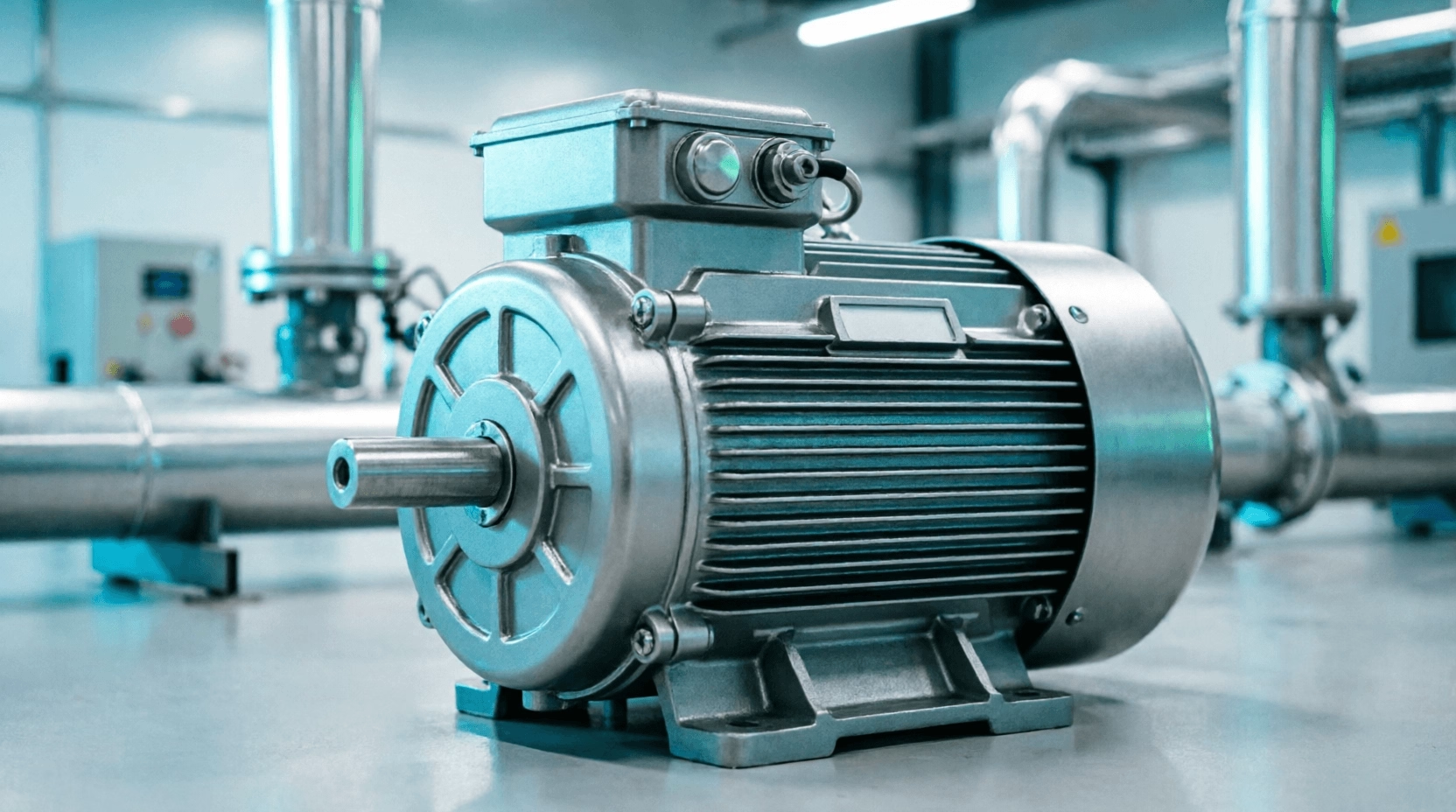
A comprehensive guide to reducing energy costs, improving reliability, and optimising industrial motor systems through high-efficiency IE3 and IE4 technologies. Expert insights from Techo Electrical & Mechanical.
1. Why Motor Efficiency Matters
Electric motors constitute the backbone of modern industry, driving critical equipment such as pumps, fans, compressors, conveyors, and process machinery. Given that these assets frequently operate for thousands of hours annually, their energy consumption represents one of the largest controllable operating expenditures in industrial facilities.
Upgrading from legacy IE1 or IE2 motors to IE3 (Premium Efficiency) or IE4 (Super Premium Efficiency) classes yields substantial benefits:
- Significant reduction in lifetime energy consumption.
- Lower operating temperatures, reducing thermal stress on insulation and bearings.
- Extended Mean Time Between Failures (MTBF) and improved system reliability.
2. Key Evaluation Metrics
When assessing motor performance, consider the following technical parameters beyond simple nameplate ratings:
- Rated Efficiency: Utilise certified efficiency values at rated load as the primary baseline for comparison.
- Load Profile Analysis: Motors operating predominantly at partial load may derive greater benefit from right-sizing or Variable Frequency Drives (VFDs) than from efficiency class upgrades alone.
- Power Factor & Harmonics: Evaluate reactive power requirements and harmonic distortion impacts, as these influence utility penalty charges and overall system power quality.
3. Matching Motors to Real-World Applications
The Perils of Improper Sizing
Oversizing is among the most prevalent procurement errors. An oversized motor operates at low load factors where efficiency degrades significantly, resulting in wasted energy and elevated operating costs. Conversely, undersized motors experience thermal overload, excessive current draw, and premature failure.
Best Practices for Selection
- Base selections on accurate duty cycle data and driven-equipment torque-speed curves.
- Ensure the motor operates near its Best Efficiency Point (BEP) under normal conditions.
- Account for starting torque requirements, overload capacity, and ambient environmental conditions.
- Evaluate mechanical coupling methods, alignment tolerances, and load inertia characteristics.
4. System-Level Optimisation Strategies
Motor efficiency cannot be isolated from the driven system. Holistic optimisation includes:
- Reducing frictional losses in pumps, fans, and conveyor systems.
- Improving shaft alignment and eliminating mechanical imbalance.
- Optimising driven equipment (e.g., impeller trimming, ductwork redesign, pulley ratio adjustments).
Variable Frequency Drives (VFDs)
For variable-load processes, pairing high-efficiency motors with VFDs delivers compounding savings by matching motor speed to actual demand rather than relying on mechanical throttling. Additional benefits include:
- Soft starting capabilities that reduce electrical and mechanical stress.
- Enhanced process control precision.
- Reduction in peak demand charges.
5. Maintenance, Monitoring, and Reliability
Essential Preventive Maintenance
- Regular visual inspections for overheating, contamination, and loose electrical connections.
- Adherence to manufacturer-specified lubrication intervals.
- Electrical testing including insulation resistance, current balance, and winding temperature monitoring.
- Vibration analysis to detect imbalance, misalignment, or incipient bearing wear.
Predictive Maintenance Technologies
Condition-based monitoring and remote telemetry enable predictive maintenance strategies, minimising unplanned downtime while preserving energy performance over the asset lifecycle.
6. Procurement Strategy: Total Cost of Ownership (TCO)
Procurement decisions must be predicated on TCO rather than initial purchase price. A comprehensive TCO model encompasses:
| Cost Component | Description |
|---|---|
| Acquisition & Installation | Purchase price, shipping, rigging, and commissioning |
| Energy Consumption | Projected kWh usage over expected service life |
| Maintenance & Repair | Scheduled servicing, parts replacement, and labour |
| Downtime Risk | Production losses attributable to motor failure |
| End-of-Life | Disposal, recycling, or refurbishment costs |
High-efficiency motors typically achieve payback within 1–3 years when energy savings and reduced maintenance are quantified.
Critical Procurement Requirements
- Certified efficiency data compliant with IEC, NEMA, or equivalent standards.
- Comprehensive warranty terms with clear coverage definitions.
- Supplier support for commissioning, spare parts availability, and technical assistance.
- Verified compliance with applicable IE3/IE4/IE5 regulatory standards.
7. Practical Implementation Example
A continuous-process manufacturing facility replaced a fleet of decade-old motors with IE3 units and integrated VFDs on variable-load applications. Documented outcomes included:
- Double-digit percentage reduction in annual energy consumption.
- Measurable decrease in maintenance interventions and unplanned downtime.
- Project payback period of under three years.
Success was contingent upon accurate load logging, precise right-sizing, and post-installation commissioning to validate performance against projections.
8. Implementation Checklist
- Measure: Log operating hours, load profiles, and baseline energy consumption.
- Audit: Identify high-impact candidates for replacement or retrofit based on ROI potential.
- Right-Size: Select motors based on actual duty cycles, not nameplate oversizing.
- Integrate: Deploy VFDs and advanced controls where variable speed yields measurable savings.
- Commission: Validate performance through baseline and post-installation measurements.
- Monitor: Implement condition monitoring protocols for critical assets.
9. Reduce Energy Costs & Improve Reliability with Techo
Techo Electrical & Mechanical (Taizhou) provides end-to-end motor selection, supply, retrofit execution, and lifecycle support for industrial facilities worldwide.
Visit www.cntecho.com to download product specifications, access efficiency calculators, or schedule a complimentary consultation.
© Techo Electrical & Mechanical – Advancing Industrial Energy Efficiency