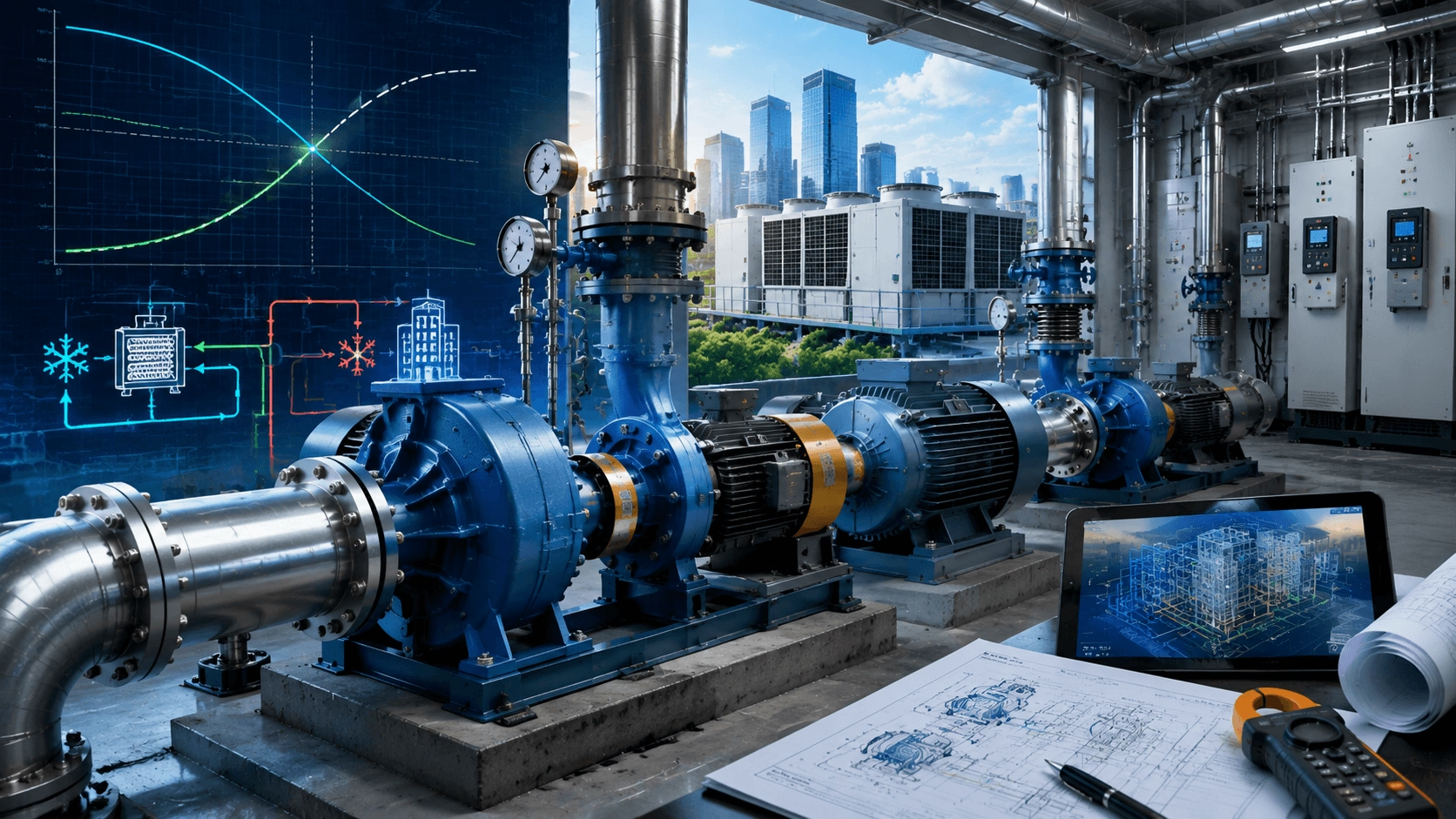
Practical guidance on selecting and sizing HVAC pumps to enhance thermal comfort, reduce energy consumption, and minimise lifecycle costs. Technical principles and cost-effective strategies from Techo Electrical & Mechanical.
1. Introduction: Pumps as the Heart of HVAC Systems
Pumps serve as the primary circulation mechanism for chilled water, condenser water, and domestic hot water within HVAC infrastructure. The selection of an appropriate pump directly dictates system comfort levels, energy efficiency, and long-term maintenance expenditures. This guide delineates the technical principles required to select pumps that deliver reliable performance and optimised lifecycle costs.
2. Understanding System Hydraulic Requirements
Accurate pump selection begins with a rigorous definition of system hydraulics. Key parameters include:
- Design Flow Rate: Expressed in m³/h or GPM.
- Total Dynamic Head (TDH): The total system resistance at design flow.
- Fluid Properties: Temperature range and quality (e.g., glycol concentration, particulate content).
System Curve Matching
For HVAC applications, the system curve—representing hydraulic resistance across piping networks, heat exchanger coils, and control valves—must be precisely matched to the pump performance curve. The objective is to ensure the operating point resides near the pump’s Best Efficiency Point (BEP) under normal operating conditions.
3. Pump Topologies and Application Suitability
Selecting the correct pump architecture is critical for system efficiency and spatial constraints.
| Pump Type | Characteristics | Ideal Application |
|---|---|---|
| End-Suction Centrifugal | Simple design, cost-effective, widely available | Moderate heads and flows; general HVAC circulation |
| Split-Case | Higher efficiency, easier internal maintenance | Large chilled water and condenser water systems |
| Vertical Inline | Compact footprint, integrates directly into piping | Space-constrained mechanical rooms |
| Submersible / Vertical Turbine | Designed for deep liquid sources | Deep wells, sumps, or campus raw water intake |
4. Sizing Methodologies and Avoiding Oversizing
Oversized pumps represent one of the most prevalent sources of inefficiency in HVAC systems. When a pump operates significantly below its BEP due to oversizing, it suffers from:
- Increased specific energy consumption
- Hydraulic instability and recirculation
- Accelerated bearing and seal wear
Best Practice for Sizing
Utilise accurate system curves rather than rule-of-thumb estimates. For variable-demand systems, design for the most frequent operating condition rather than solely for peak load. Part-load behaviour must be analysed to ensure stable operation across the entire load profile.
5. Variable Flow Strategies
Modern HVAC design prioritises variable flow to dynamically match thermal load, significantly reducing pumping energy compared to constant-volume systems.
- Variable Frequency Drives (VFDs): Enable substantial energy savings by modulating pump speed rather than dissipating energy through throttling valves. Power consumption varies with the cube of speed reduction.
- Primary-Secondary Piping: Provides hydraulic stability between production and distribution loops, though with increased complexity and component count.
- Variable Primary Flow (VPF): Offers superior efficiency by eliminating secondary pumps, provided robust control logic and low-flow protection are implemented.
- Parallel Pumping: Enhances system redundancy and improves part-load efficiency by staging multiple smaller pumps rather than running a single large unit at low load.
6. Materials and Sealing Specifications
HVAC fluids impose specific material requirements to prevent degradation:
- Chilled Water Systems: Require corrosion-resistant wetted parts and reliable mechanical seals to handle treated water over decades of service.
- Aggressive or Particulate-Laden Fluids: Necessitate hardened impellers, abrasion-resistant coatings, and robust seal configurations.
Proper material specification at the procurement stage significantly reduces unplanned downtime and extends mean time between failures (MTBF).
7. Installation and Commissioning Protocols
Even a perfectly selected pump will fail prematurely if installed incorrectly. Critical installation factors include:
- Precision shaft alignment
- Adequate piping support to prevent nozzle loading
- Proper isolation valve placement for maintenance access
Commissioning Verification
Commissioning must validate actual flow, head, and control logic against design intent. Document as-installed pump curves and verified control setpoints to establish a baseline for future troubleshooting and performance benchmarking.
8. Maintenance and Spare Parts Strategy
Operational continuity depends on maintainability and parts availability:
- Select pump models with accessible spare parts and established local service support.
- Standardise pump models across facilities to simplify inventory management and reduce Mean Time To Repair (MTTR).
Essential Monitoring Activities
- Vibration analysis for early fault detection
- Bearing temperature trending
- Mechanical seal leakage inspection
- Motor current signature analysis
9. Energy and Lifecycle Cost Analysis
Energy expenditure typically dominates the total lifecycle cost of an HVAC pump, often exceeding 85% of ownership costs over a 20-year horizon.
When evaluating pump options, calculate projected lifecycle energy consumption based on expected annual operating hours and load profiles. Additionally, investigate available utility rebates and government incentives for high-efficiency pump and VFD installations, which can significantly improve project economics.
10. Optimize Your HVAC Pump System with Techo
Techo Electrical & Mechanical supplies a comprehensive range of HVAC pumps and provides expert services including:
- System hydraulic audits
- Pump selection and sizing studies
- Commissioning and performance verification
- Aftermarket support and maintenance planning
Visit www.cntecho.com to request a pump selection consultation or system optimisation study.
© Techo Electrical & Mechanical – Engineering Excellence in HVAC Fluid Systems