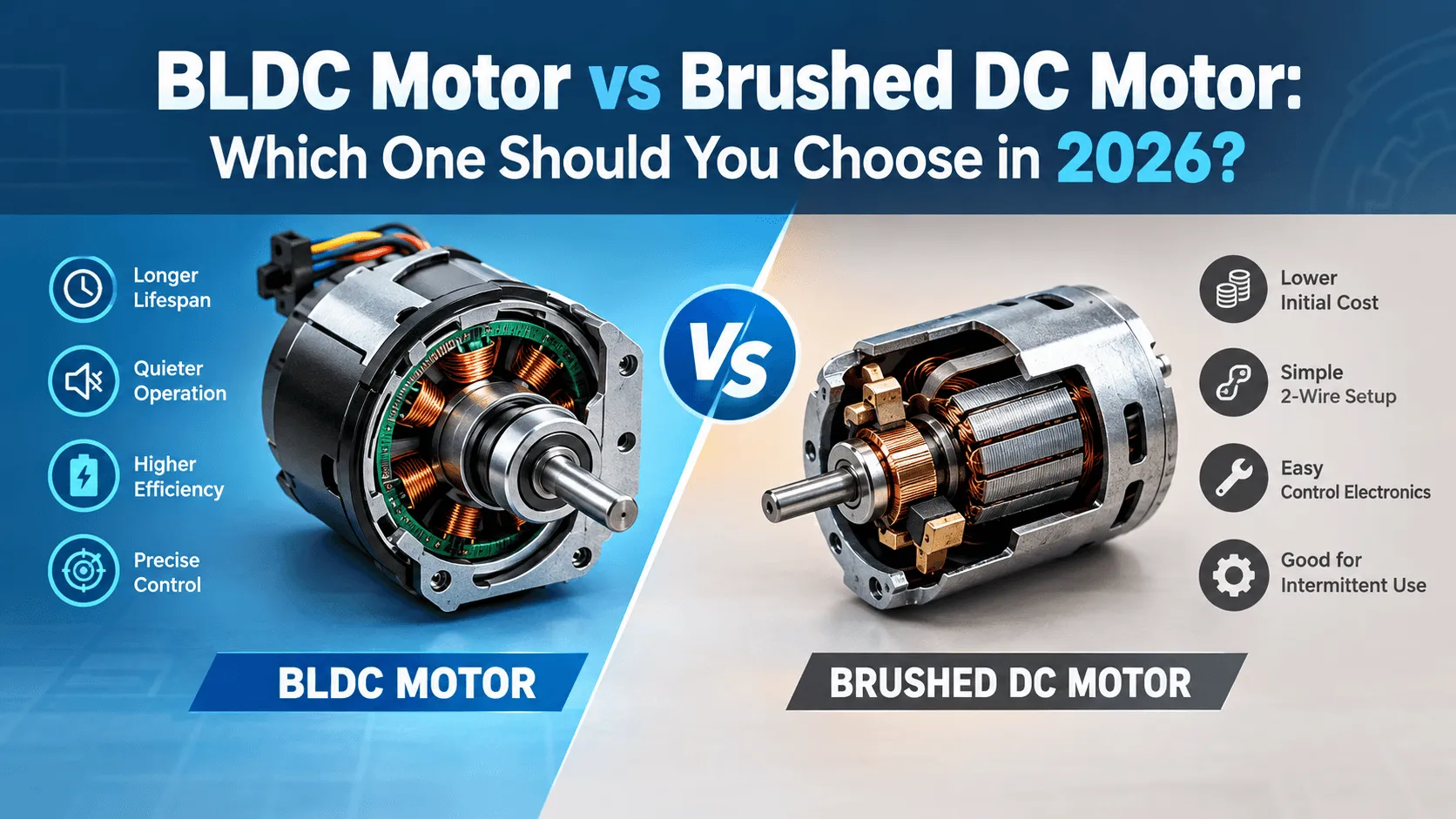
If you are selecting a motor for a fan, pump, actuator, robot, vehicle, appliance, or battery-powered product, the choice between a BLDC motor and a brushed DC motor is rarely just a motor choice. It is a choice between two different drive architectures: one uses electronic commutation and the other uses brushes and a mechanical commutator.
Short answer: choose a BLDC motor when the product must run for long periods, operate quietly, conserve battery energy, or provide controlled speed and torque. Choose a brushed DC motor when the design prioritizes the lowest initial cost, simple two-wire operation, compact control electronics, or intermittent duty. BLDC is usually the better lifecycle choice; brushed DC is often the better “simple and inexpensive” choice.
This guide compares the two technologies for engineers, product designers, maintenance teams, and equipment buyers. The conclusions are based on public technical guidance from maxon, Oriental Motor, Renesas, and Monolithic Power Systems; individual motor models can differ substantially.
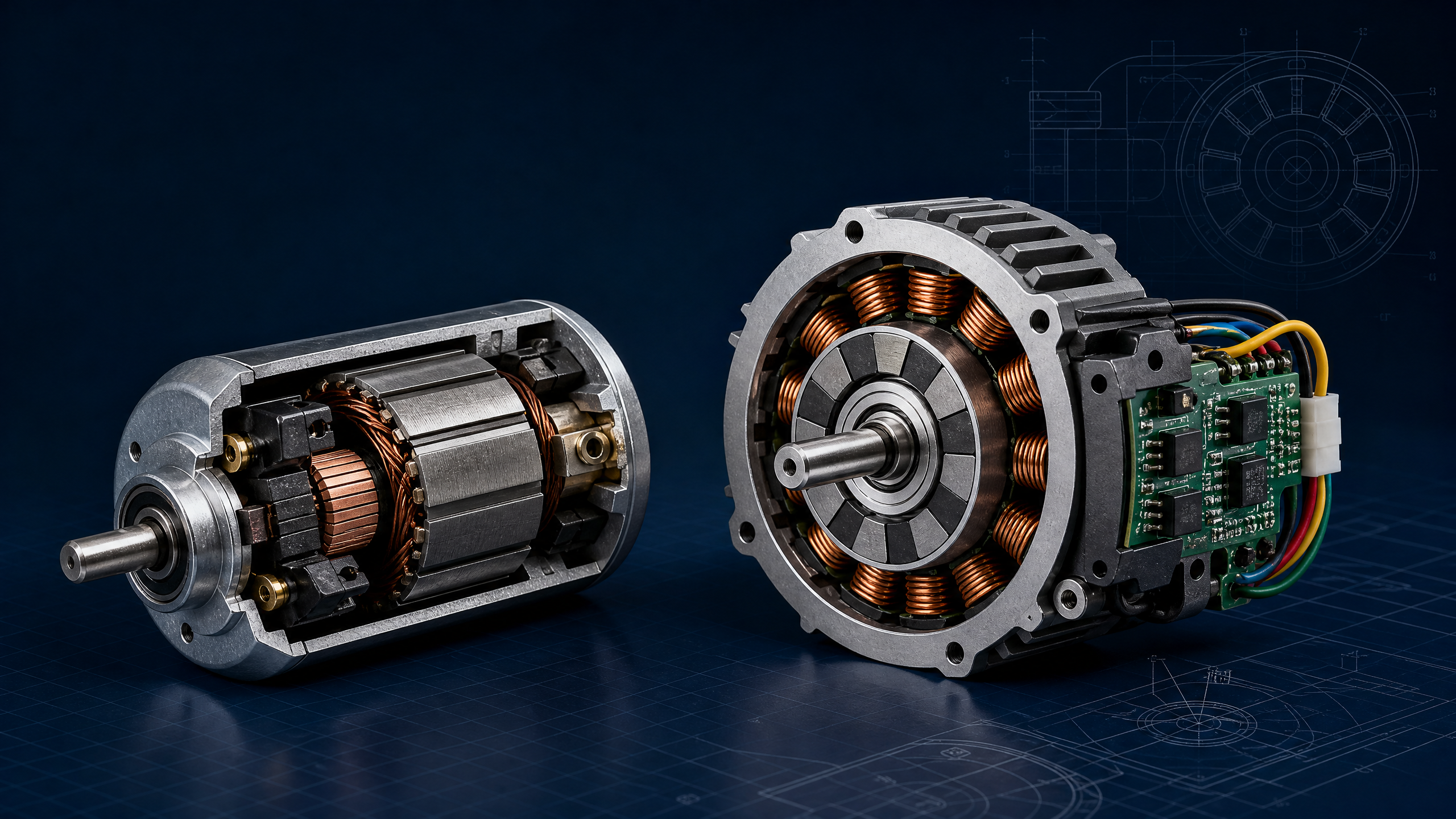
Figure 1. A neutral visual comparison of mechanical commutation in a brushed motor and electronic commutation in a BLDC motor.
BLDC Motor vs Brushed DC Motor: Quick Comparison
| Decision criterion | BLDC motor | Brushed DC motor |
|---|---|---|
| Commutation | Electronic; typically uses a driver and may use Hall sensors, an encoder, or sensorless control | Mechanical; brushes transfer current through a commutator |
| Upfront system cost | Usually higher because the drive electronics are part of the system | Usually lower; a suitable motor can run directly from a DC supply through simple switching |
| Operating life | Long; no brush/commutator wear, with bearings and insulation becoming key limits | Shorter in many designs; brushes and the commutator wear and may need replacement |
| Efficiency | Generally high, especially in continuous-duty and low-to-medium-load applications; exact result is model-dependent | Often lower because of brush friction and electrical losses, although specialized coreless designs can be highly efficient |
| Noise and EMI | Low mechanical wear noise and generally lower electrical noise; controller switching still requires proper EMC design | Brush contact and arcing can create audible and electrical noise |
| Speed and torque control | Excellent with feedback and a suitable controller; high-speed operation is practical | Simple voltage control is easy, but high-speed and precise closed-loop control can be more limited |
| Maintenance | Low routine maintenance; inspect bearings, controller, wiring, and cooling | Brush inspection/replacement and commutator wear are recurring concerns |
| Best fit | Continuous operation, quiet products, battery systems, high speed, high reliability, and precise control | Intermittent mechanisms, cost-sensitive products, simple actuators, and applications where easy direct-DC operation matters |
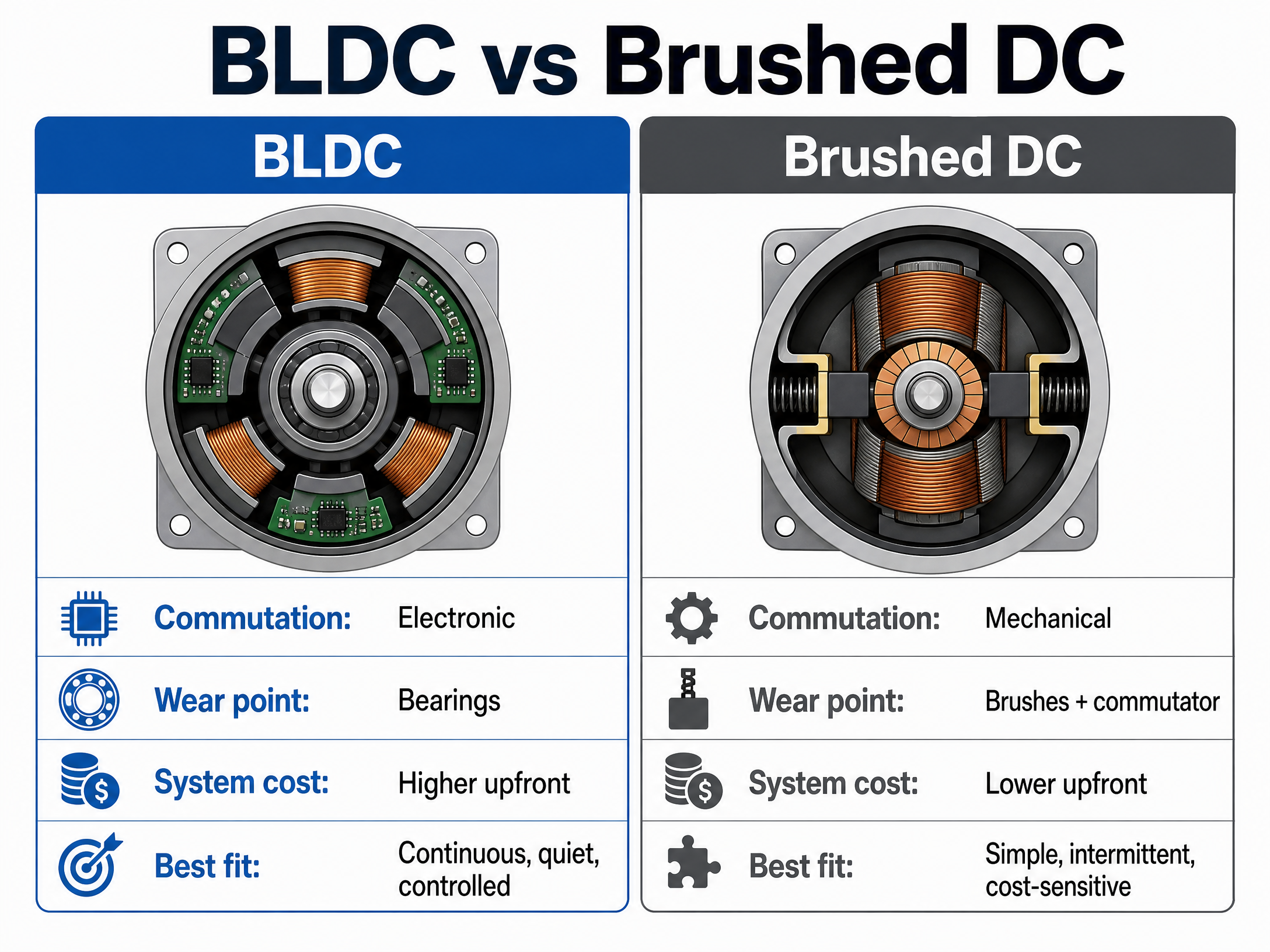
Figure 2. The four differences that most often determine the correct motor architecture.
What Is the Fundamental Difference?
A brushed DC motor places the energized windings on the rotor. Carbon or graphite brushes contact a rotating commutator, mechanically switching current from one winding to the next so that torque continues in the same direction. This is why a basic brushed motor can often be operated with a DC voltage source and a simple switch or PWM controller.
A BLDC motor moves the windings to the stationary stator and uses a permanent-magnet rotor. An electronic driver switches current through the stator phases in the correct sequence. Rotor position may be determined with Hall-effect sensors, an encoder, or a sensorless algorithm. Renesas describes this architecture as the key reason a BLDC motor can avoid brushes and a commutator while maintaining rotation and precise control [3].
The distinction matters beyond terminology. In a brushed motor, part of the commutation mechanism is inside the motor and physically wears. In a BLDC system, the commutation intelligence is outside the motor, so the motor has fewer wear parts but requires compatible power electronics and control logic.
1. Efficiency: BLDC Usually Wins, but Do Not Generalize Blindly
For many conventional motors, BLDC technology has a system-level efficiency advantage because it removes brush friction and brush-contact losses. Oriental Motor states that BLDC motors generally convert more input power into mechanical output than brushed DC motors, with the advantage especially visible in no-load and low-load regions [2]. Renesas also highlights BLDC efficiency and controllability as core reasons for its use in energy-conscious products [3].
However, “brushless” is not an efficiency guarantee. Efficiency depends on winding design, magnetic circuit, operating point, controller losses, switching strategy, gearbox losses, cooling, and the load profile. A poorly matched BLDC motor and driver can perform worse than a well-designed brushed motor in a specific operating region. maxon explicitly cautions that its ironless brushed motors can outperform some of its brushless designs at certain speeds because brushless designs may experience speed-dependent eddy-current losses [1].
Criterion winner: BLDC for most continuous-duty systems; model-specific testing still matters. Compare the complete drive system, not only the motor nameplate.
2. Service Life and Maintenance: The Biggest Practical Advantage of BLDC
Brushes and commutators are consumable mechanical interfaces. They experience friction, electrical arcing, material transfer, and wear. As a brushed motor ages, brush contact can become less reliable, commutator surfaces can degrade, and conductive dust or electrical noise can become a design concern.
maxon gives a useful indicative range: brushed motor life can average 1,000 to 3,000 operating hours, while brushless motors can reach tens of thousands of hours on average, with bearings becoming a primary limiting factor [1]. These are not universal guarantees. Load, speed, temperature, brush material, current density, duty cycle, and bearing selection can move the result significantly.
The practical implication is straightforward: if the motor is installed inside a sealed appliance, runs continuously, or is expensive to access, the cost of brush replacement may outweigh the initial saving. A BLDC motor is not literally maintenance-free—bearings, seals, insulation, connectors, and its controller can still fail—but it removes the most obvious scheduled-wear component.
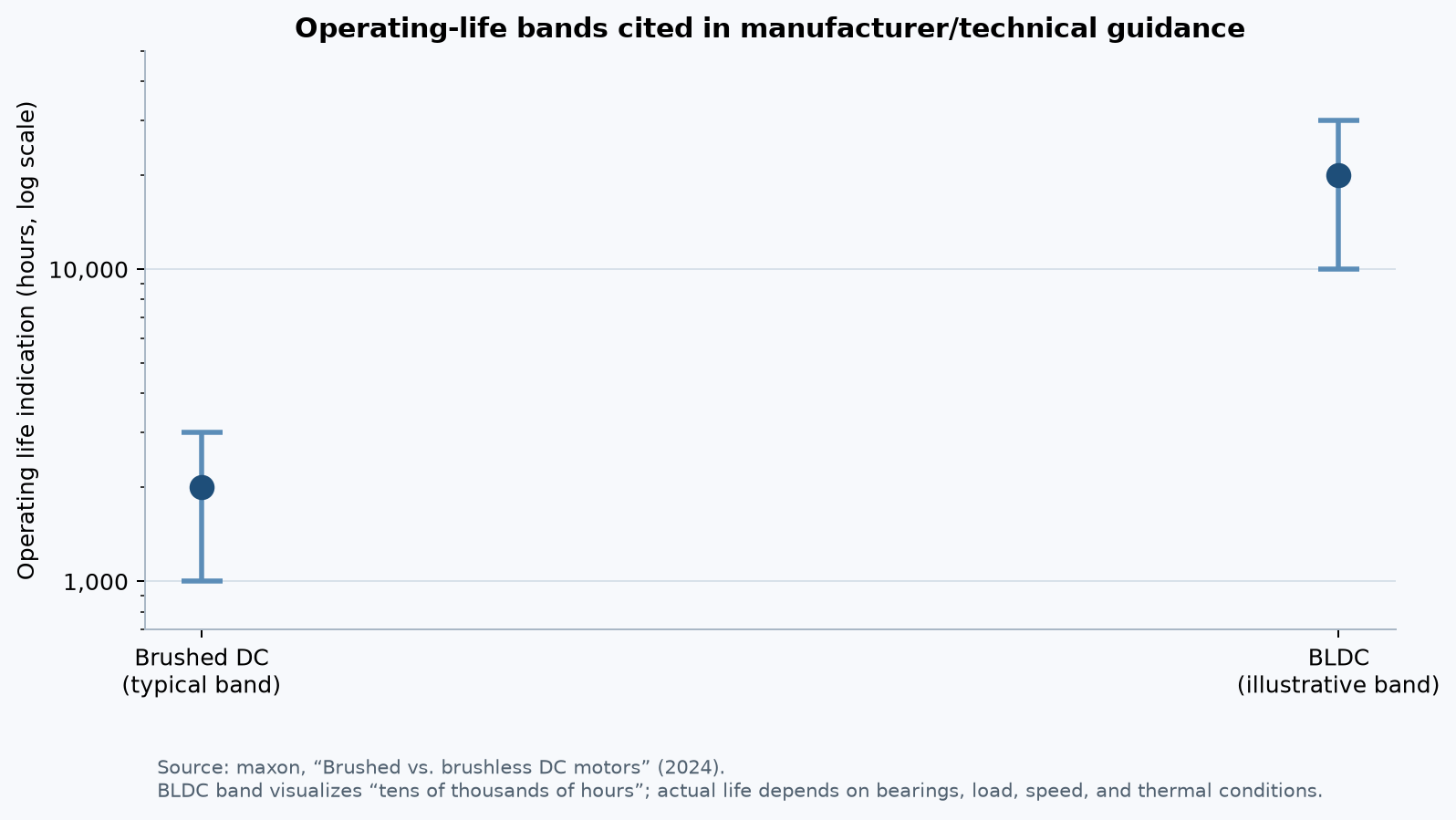
Figure 3. Indicative operating-life bands from maxon guidance; actual life depends on motor construction and operating conditions, and the BLDC range is shown as a visual interpretation of “tens of thousands of hours.”
Criterion winner: BLDC for long service intervals and difficult-to-access installations. Brushed DC remains reasonable when the product is cheap, replaceable, or used only for short cycles.
3. Control and Integration: Brushed DC Is Simpler; BLDC Is More Capable
The control trade-off is the clearest argument for each technology.
A brushed motor may need only two power connections. Speed can often be adjusted by changing voltage or applying PWM. For a simple latch, valve, window mechanism, toy, or small actuator, this simplicity reduces design time, board area, software requirements, and potential failure modes.
A BLDC motor needs an electronic commutation stage. Depending on the application, this can include a three-phase inverter, gate drivers, a microcontroller, Hall sensors, an encoder, current sensing, protection circuits, and firmware. maxon notes that BLDC systems can use sensorless block commutation, Hall-based block commutation, or more sophisticated sinusoidal commutation with Hall sensors and/or an encoder [1].
That added complexity is also the source of BLDC’s strength. With feedback, the controller can regulate speed and torque more accurately, manage acceleration and deceleration, detect faults, and optimize energy use. It is especially valuable when the motor must maintain a target speed under changing load, operate from a battery, or coordinate with a larger motion-control system.
Criterion winner: brushed DC for the fastest low-complexity prototype; BLDC for controlled, connected, or performance-sensitive equipment.
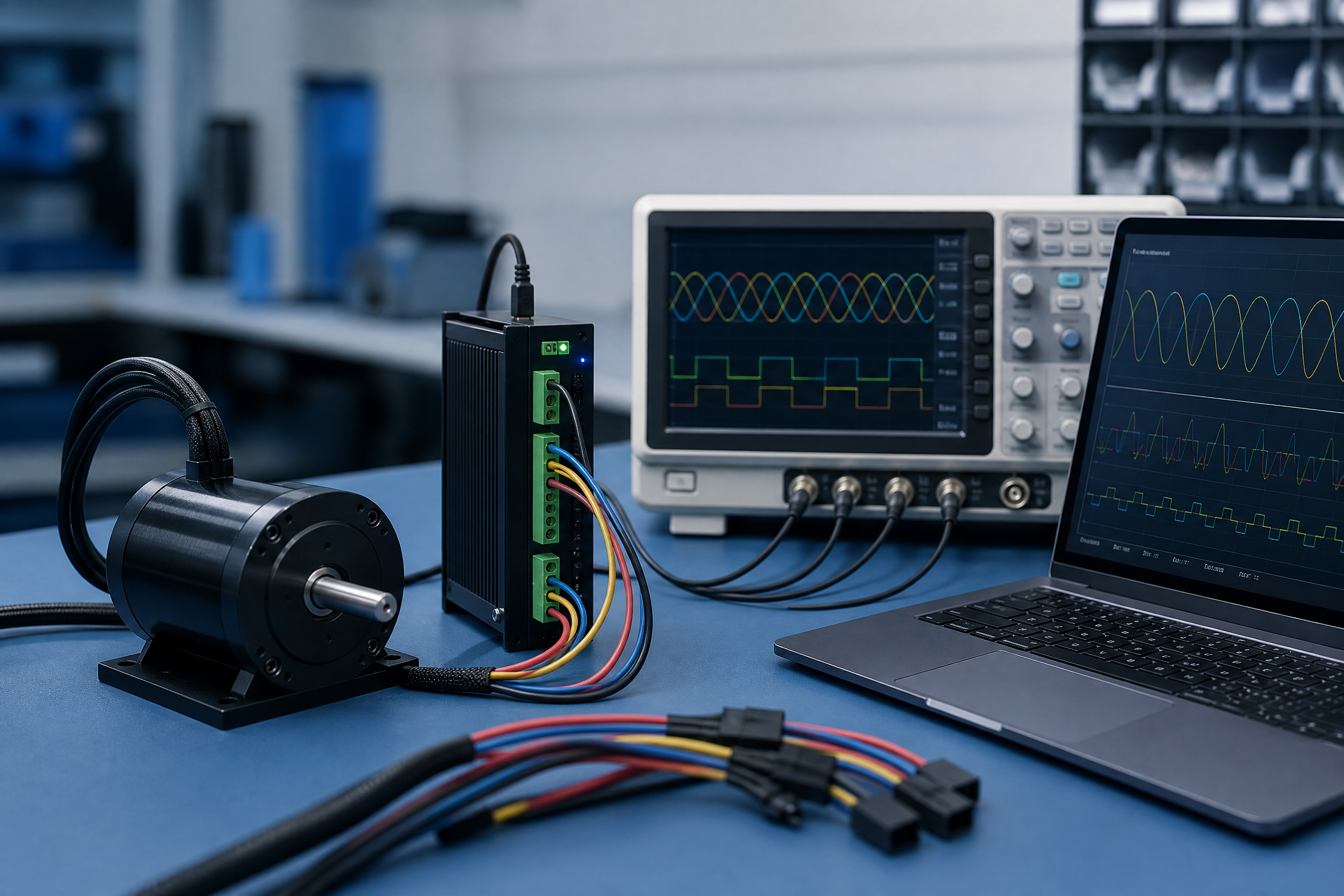
Figure 4. A typical BLDC evaluation setup emphasizes the fact that the driver and feedback path are part of the product architecture.
4. Noise, EMI, and Product Experience
Brushed motors can generate both audible noise and electromagnetic interference (EMI). The brush and commutator repeatedly make and break a high-current inductive circuit, producing arcing and broadband electrical noise. Mechanical contact also contributes friction noise and vibration. Capacitors, snubbers, filtering, and mechanical isolation can reduce these effects, but they do not remove the underlying switching interface.
A BLDC motor eliminates brush arcing and usually runs more quietly mechanically. Renesas identifies lower electrical noise as a BLDC advantage, while Monolithic Power Systems distinguishes electrical noise from acoustic noise and torque ripple [3][4]. A trapezoidal BLDC drive can still produce torque ripple and audible switching tones; a sinusoidal or field-oriented controller may improve smoothness at additional cost.
Criterion winner: BLDC for noise-sensitive products, but validate the motor-driver combination. A quiet motor paired with a poorly designed inverter can still create unacceptable EMI or acoustic tones.
5. Speed and Power Density
Mechanical brushes and commutators impose practical limits on speed. At high rotational speed, brush contact can become unstable and arcing can increase. The rotor mass of a conventional brushed design can also limit acceleration.
BLDC motors can use a permanent-magnet rotor with low rotational inertia and stationary windings that are easier to cool. This supports high speed, fast acceleration, and a high power-to-size ratio. Oriental Motor lists BLDC products with speed-control ranges extending from very low speed to several thousand rpm, although the appropriate range depends on the specific product and controller [2].
This does not mean every BLDC motor is smaller, faster, or stronger. Thermal limits, magnet strength, winding insulation, bearings, centrifugal stress, and controller current all matter. The correct engineering question is whether the chosen motor can deliver the required torque at the required speed while staying within its thermal envelope.
Criterion winner: BLDC when speed, acceleration, or power density is a primary requirement.
6. Upfront Cost vs Total Cost of Ownership
Brushed DC motors generally win the initial bill-of-materials comparison. The technology is mature, widely available, and easy to drive. In a short-life product, the cost of a separate BLDC controller may not be justified.
BLDC motors usually have a higher initial system cost because the motor must be paired with a suitable driver. The real comparison is therefore not “motor price versus motor price,” but:
-
motor plus driver and feedback hardware;
-
engineering and firmware development time;
-
certification and EMC-design effort;
-
energy consumed over the product’s life;
-
scheduled brush replacement and service labor;
-
downtime and replacement cost;
-
the value of quiet operation, compact packaging, and controllability.
For a low-duty actuator sold at a very low price, brushed DC can be the economically correct choice. For a continuously running pump, fan, compressor auxiliary, robot joint, or battery-powered vehicle, the BLDC premium can be recovered through lower energy use, longer service intervals, or smaller packaging.
Criterion winner: brushed DC for lowest upfront cost; BLDC often wins on lifecycle economics in continuous or high-utilization applications.
Pros and Cons
BLDC motor
Pros
-
Long operating life because there are no brushes or commutators to wear.
-
High efficiency and lower heat in many operating regions.
-
Precise speed and torque control with appropriate feedback.
-
Low brush-related electrical noise and generally quieter operation.
-
Well suited to continuous duty, high speed, compact products, and battery systems.
Cons
-
Requires a compatible electronic driver.
-
Higher upfront system cost and more complex integration.
-
Firmware, sensors, commutation, EMC, and fault handling may increase development effort.
-
Actual efficiency, acoustic behavior, and lifetime remain highly model-dependent.
Brushed DC motor
Pros
-
Simple two-wire interface and straightforward voltage/PWM control.
-
Low initial cost and broad availability.
-
Strong starting torque and useful behavior in simple intermittent mechanisms.
-
Easy to prototype without a dedicated three-phase inverter.
Cons
-
Brushes and commutator wear over time.
-
More electrical noise and potential arcing.
-
More maintenance and less attractive for sealed or inaccessible installations.
-
High-speed operation and precise control can be more challenging.
-
Brush dust, contact wear, and torque ripple can affect product quality.
Which Motor Should You Choose?
Choose BLDC if you need:
-
continuous or high-utilization operation;
-
long service intervals or a sealed product;
-
quiet operation or low brush-related EMI;
-
accurate speed, torque, or acceleration control;
-
high speed, compact packaging, or battery efficiency;
-
connectivity with a motion-control, diagnostic, or safety system.
Choose brushed DC if you need:
-
the lowest initial cost;
-
a simple two-wire motor that can run from a DC supply;
-
intermittent operation with an acceptable replacement interval;
-
a low-volume product where controller development is not economical;
-
a mechanism such as a latch, window actuator, tray, or small positioning device where sophistication is unnecessary.
A practical selection rule
Start with the duty cycle and maintenance model, not the motor label. If the motor will run thousands of hours, sit behind a sealed enclosure, or consume meaningful battery energy, evaluate BLDC first. If it will run for seconds at a time, be easy to replace, and compete primarily on purchase price, brushed DC may be the more disciplined engineering decision.
Then compare complete systems at the required operating point: motor, driver, gearbox, sensors, wiring, cooling, software, and service requirements.
Frequently Asked Questions
Is a BLDC motor always more efficient than a brushed DC motor?
No. BLDC motors are generally more efficient than conventional brushed motors because they avoid brush friction and contact losses, but efficiency depends on the motor design, driver, speed, load, and thermal conditions. Specialized ironless brushed motors can outperform a brushless design in particular operating regions [1].
Is a BLDC motor more expensive?
Usually, the complete BLDC drive is more expensive upfront because it needs electronic commutation hardware. The difference can narrow in high-volume production, and the lifecycle cost may favor BLDC when energy use, maintenance, and downtime matter.
Can a BLDC motor run directly from a battery?
Not in the same simple way as a two-wire brushed motor. A battery can power a BLDC system, but a compatible controller must switch the motor phases. The controller may use Hall sensors, an encoder, or sensorless position estimation.
Which motor lasts longer?
A BLDC motor normally lasts longer in applications where brush and commutator wear would dominate. Bearings, insulation, magnets, cooling, overloads, and contamination still determine the actual lifetime.
Are BLDC motors silent?
No motor is perfectly silent. BLDC motors eliminate brush-contact noise and arcing, but controller switching, torque ripple, bearings, airflow, and mechanical resonance can still create sound. Sinusoidal or field-oriented control may reduce some noise at higher system cost.
Bottom Line
For most modern products that run continuously, must be quiet, operate from a battery, or need dependable speed and torque control, BLDC is the stronger default. It trades a more capable controller and higher initial system cost for longer life, lower maintenance, and better controllability.
For simple, intermittent, price-sensitive mechanisms, brushed DC remains a rational choice. It is easy to power, easy to control, and often cheaper to buy. The professional answer is not that one technology has replaced the other; it is to choose the commutation architecture that matches the duty cycle, service model, control requirements, and total cost of ownership.
Sources and Verification Notes
-
maxon, “Brushed vs. brushless DC motors”, accessed September 10, 2026. Used for indicative life bands, efficiency caveats, and controller complexity.
-
Oriental Motor, “Brushless DC Motor vs. AC Motor vs. Brushed Motor”, accessed September 10, 2026. Used for construction, efficiency, maintenance, Hall-sensor speed feedback, and speed-control context.
-
Renesas, “What are Brushless DC Motors”, accessed September 10, 2026. Used for operating principles, control, noise, and applications.
-
Monolithic Power Systems, “Brushless Vs Brushed DC Motors”, accessed September 10, 2026. Used for the qualitative comparison of lifetime, speed, efficiency, noise, torque ripple, and cost.
Publishing note: Motor performance is model-specific. Before publishing a procurement recommendation, replace the qualitative cost row with supplier quotations and add verified motor/driver specifications for the intended voltage, torque, speed, duty cycle, ambient temperature, and enclosure.