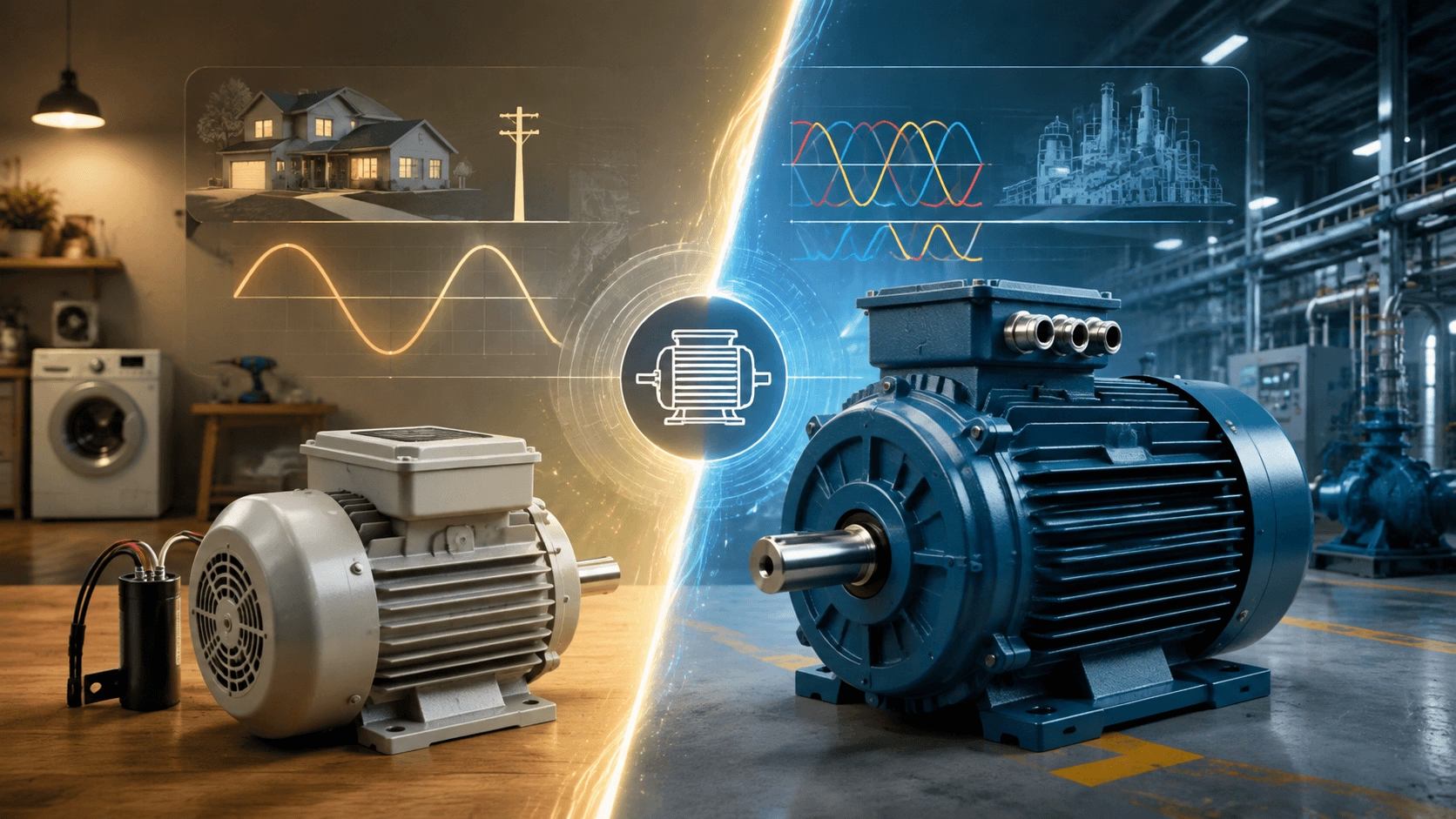
Single Phase vs. Three-Phase Motors: Complete Technical Comparison Guide | TITECHO
Abstract: A detailed engineering comparison of single-phase and three-phase AC motors, covering efficiency, cost analysis, application suitability, wiring considerations, and conversion options. TITECHO provides expert guidance to help you select the optimal power configuration for your specific industrial or commercial requirements.
1. Introduction: The Power Supply Decision
When selecting an AC motor for industrial or commercial applications, the primary decision involves the power supply configuration: single-phase versus three-phase. This choice fundamentally impacts motor performance, energy efficiency, installation complexity, and long-term operational costs.
TITECHO frequently assists customers in navigating this critical selection process. This guide provides a comprehensive technical comparison to facilitate informed decision-making aligned with your specific operational needs and infrastructure constraints.
2. Fundamental Operating Principles
2.1 Single-Phase Motors
- Power Supply: Utilizes one live conductor and one neutral conductor.
- Voltage Range: Typically 110 V, 220 V, or 240 V.
- Starting Mechanism: Requires auxiliary components (capacitor or starting winding) to generate initial torque, as a single phase cannot produce a rotating magnetic field independently.
- Typical Applications: Residential appliances, small power tools, light commercial equipment.
2.2 Three-Phase Motors
- Power Supply: Utilizes three live conductors (with optional neutral).
- Voltage Range: Typically 208 V, 380 V, 400 V, or 480 V.
- Starting Mechanism: Self-starting; the three phases naturally create a balanced rotating magnetic field without auxiliary devices.
- Typical Applications: Industrial machinery, large pumps, compressors, conveyor systems, heavy-duty processing equipment.
3. Performance Comparison
| Feature | Single-Phase Motor | Three-Phase Motor |
|---|---|---|
| Efficiency | Lower (70–85%) | Higher (85–96%) |
| Power Factor | Lower | Higher |
| Starting Torque | Lower (requires assistance) | Higher (self-starting) |
| Vibration & Noise | Higher (pulsating power delivery) | Lower (smooth, continuous torque) |
| Maintenance | Higher (capacitor failure risk) | Lower (simpler construction) |
| Maximum Power Rating | Typically < 5 kW | Up to hundreds of kW |
4. Comprehensive Cost Analysis
4.1 Initial Equipment Cost
- Single-Phase: Generally lower for small power ratings (< 1 kW) due to simpler construction and widespread residential availability.
- Three-Phase: Unit cost may be marginally higher at low ratings, but cost per kilowatt decreases significantly as power rating increases.
4.2 Installation Cost
- Single-Phase: Lower if existing residential infrastructure is adequate.
- Three-Phase: May require electrical supply upgrades (transformers, panelboards, wiring), representing significant upfront capital expenditure.
4.3 Operational Cost
- Three-Phase Advantage: Significantly lower operating costs due to superior efficiency. For continuous-duty applications, energy savings typically offset higher installation costs within the first 12–18 months.
5. Application Selection Criteria
5.1 When to Select Single-Phase
- Small horsepower requirements (< 2 HP / 1.5 kW).
- Locations where three-phase power is unavailable (remote residential sites, rural areas).
- Intermittent duty applications (gate operators, small fans, occasional-use equipment).
- Budget-constrained projects with minimal annual running hours.
5.2 When to Select Three-Phase
- Industrial applications requiring > 2 HP / 1.5 kW.
- Continuous duty operations (pumps, compressors, conveyors, HVAC systems).
- Applications demanding high starting torque or precise speed control.
- Facilities targeting energy efficiency compliance (IE3/IE4 standards).
- Mission-critical environments where reliability and uptime are paramount.
6. Conversion Options: Single-Phase to Three-Phase
If three-phase motors are required but only single-phase power is available, conversion methods exist but carry trade-offs:
| Method | Description | Advantages | Disadvantages |
|---|---|---|---|
| Variable Frequency Drive (VFD) | Converts single-phase input to three-phase output | Smooth control, soft start, programmable | Higher cost, minor efficiency loss |
| Rotary Phase Converter | Idler motor generates synthetic third phase | Suitable for heavy loads | Bulky, noisy, high maintenance |
| Static Phase Converter | Capacitors provide starting torque only | Low initial cost | Motor operates at ~2/3 rated power |
TITECHO Engineering Recommendation: For industrial applications, installing native three-phase power is always preferable to conversion. Native three-phase supply ensures optimal motor lifespan, full-rated performance, and maximum energy efficiency.
7. Wiring and Safety Considerations
- Single-Phase Systems: Require precise capacitor sizing. Incorrect wiring can cause starting winding burnout. Regular capacitor inspection is recommended.
- Three-Phase Systems: Require phase balance monitoring. Phase loss (single-phasing) can destroy a motor rapidly without proper protection.
- Protection Requirements: Both configurations require overload protection. Three-phase motors additionally benefit from phase-loss relays and voltage monitoring devices to prevent catastrophic failure.
8. Future Trends and Regulatory Outlook
As global energy regulations tighten, single-phase motors face increasingly stringent efficiency standards. Three-phase motors, particularly those compatible with VFDs, are becoming the preferred standard even for smaller applications due to their superior controllability, efficiency, and compliance with emerging IE4/IE5 standards.
The industry trajectory clearly favors three-phase technology for any application exceeding intermittent light-duty use.
9. Conclusion
The choice between single-phase and three-phase motors depends on power availability, load requirements, duty cycle, and long-term operational objectives. While single-phase motors remain appropriate for small, intermittent tasks, three-phase motors are the definitive choice for industrial efficiency, reliability, and lifecycle value.
TITECHO offers a comprehensive range of both single-phase and three-phase motors across multiple efficiency classes, ensuring you have the right solution for your power infrastructure and application requirements.
Contact Information
For technical consultation, motor selection support, or product specifications:
- Website: www.cntecho.com
- Email: [email protected]