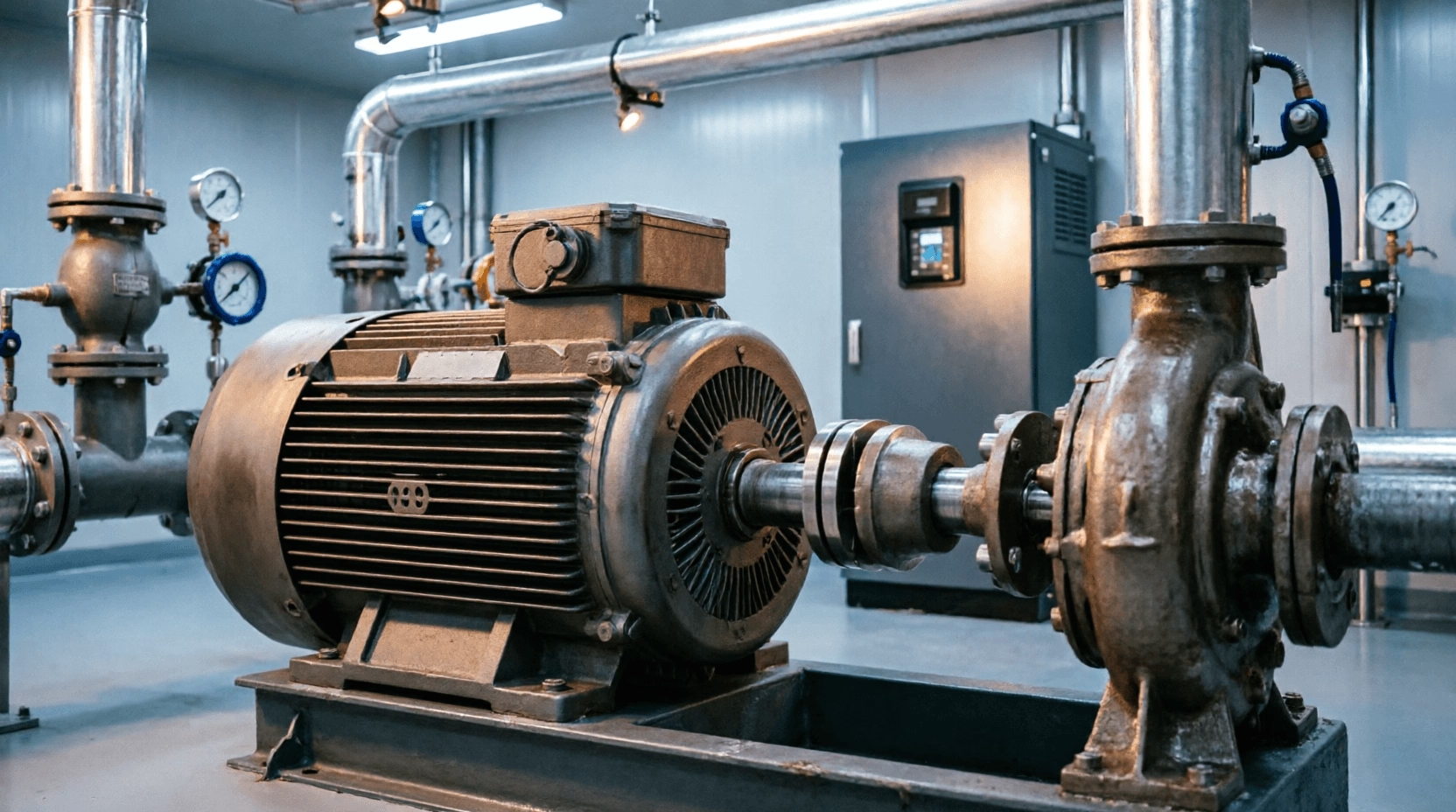
How targeted retrofits—encompassing motors, VFDs, impellers, and controls—deliver rapid ROI through energy savings and enhanced system reliability. Strategic guidance from Techo Electrical & Mechanical.
1. Improve Efficiency Without Full Replacement
Retrofitting existing motor and pump systems is frequently the most cost-effective pathway to achieving significant energy savings and reliability improvements without the capital intensity of full system replacement. This guide outlines common retrofit measures, assessment methodologies, control upgrades, and practical considerations for phased implementation.
2. Why Retrofit Instead of Replace?
Strategic Rationale
Retrofitting is appropriate when existing equipment remains functionally adequate but suffers from inefficiency, unreliability, or incompatibility with modern control architectures. Key triggers for retrofit evaluation include:
- Escalating energy expenditures disproportionate to production output.
- Increasing frequency of failures or unplanned downtime events.
- Process modifications that have altered original duty cycle requirements.
- Incompatibility with current automation platforms or digital control systems.
3. Common Retrofit Measures
| Retrofit Category | Description | Primary Benefit |
|---|---|---|
| Motor Replacement | Upgrade legacy motors to IE3/IE4 units right-sized to actual loads | Reduced energy consumption; improved thermal margin |
| VFD Installation | Add variable speed drives to match motor speed to process demand | Significant energy savings; soft starting; process optimisation |
| Impeller Modification | Trim or replace impellers to restore hydraulic performance | Elimination of throttling losses; reduced cavitation risk |
| Seal & Bearing Upgrades | Install advanced mechanical seals and premium bearings | Reduced leakage; extended MTBF; lower maintenance burden |
| Control & Instrumentation | Add sensors, upgrade logic controllers, implement PID tuning | Stable operation; data visibility; automated optimisation |
4. Assessment and Audit Methodology
A rigorous system audit establishes the baseline necessary to quantify retrofit value:
- Field Measurement: Capture flows, heads, motor currents, and operating hours using calibrated instrumentation.
- Data Logging: Record typical and peak operating conditions over representative time periods to characterise load profiles accurately.
- Energy Modelling: Develop baseline and projected retrofit energy consumption models using validated engineering software.
- Financial Analysis: Estimate annual savings, simple payback period, and net present value (NPV) to support investment decisions.
5. Phased Implementation Approach
A phased strategy minimises operational disruption and distributes capital expenditure:
- Prioritise High-Impact Assets: Target continuous-duty, high-failure-rate, or grossly inefficient units first.
- Pilot Validation: Execute a retrofit on a single production line to validate projected savings and refine implementation protocols.
- Scaled Deployment: Roll out validated measures across the facility based on pilot results and updated financial models.
6. Integration and Compatibility Considerations
Successful retrofits require meticulous attention to interface compatibility:
- Verify mechanical compatibility with existing couplings, baseplates, and foundation structures.
- Address harmonic mitigation and electromagnetic compatibility (EMC) requirements when installing VFDs to prevent interference with sensitive plant electronics.
- Plan comprehensive commissioning and control loop tuning to ensure retrofitted systems achieve expected performance targets.
7. Financial and Regulatory Incentives
Leverage available incentives to enhance project economics:
- Utility Rebates: Many utilities offer substantial rebates for high-efficiency motors and VFD installations.
- Tax Incentives: Investigate federal, state, or regional tax credits for energy-saving capital investments.
- Green Financing: Explore preferential financing programmes dedicated to sustainability and efficiency projects.
- Measurement & Verification (M&V): Implement documented M&V plans to qualify for incentive programmes requiring post-installation performance validation.
8. Expected Outcomes and ROI
Well-executed retrofit programmes consistently deliver measurable results:
- Energy Reduction: Typical savings range from 15% to 40% depending on baseline efficiency and load profile.
- Reliability Improvement: Fewer emergency repairs and extended mean time between failures.
- Process Enhancement: Improved control stability and product quality consistency.
- Financial Return: Payback periods typically within 1–4 years, contingent upon operating hours and local energy costs.
9. Upgrade Your Systems with Confidence
Techo Electrical & Mechanical provides comprehensive retrofit services including:
- System audits and feasibility assessments
- Engineering design and specification
- Turnkey implementation and commissioning
- Post-installation performance verification
Visit www.cntecho.com to request a retrofit feasibility study or schedule a consultation with our engineering team.
© Techo Electrical & Mechanical – Maximising Asset Value Through Strategic Retrofits