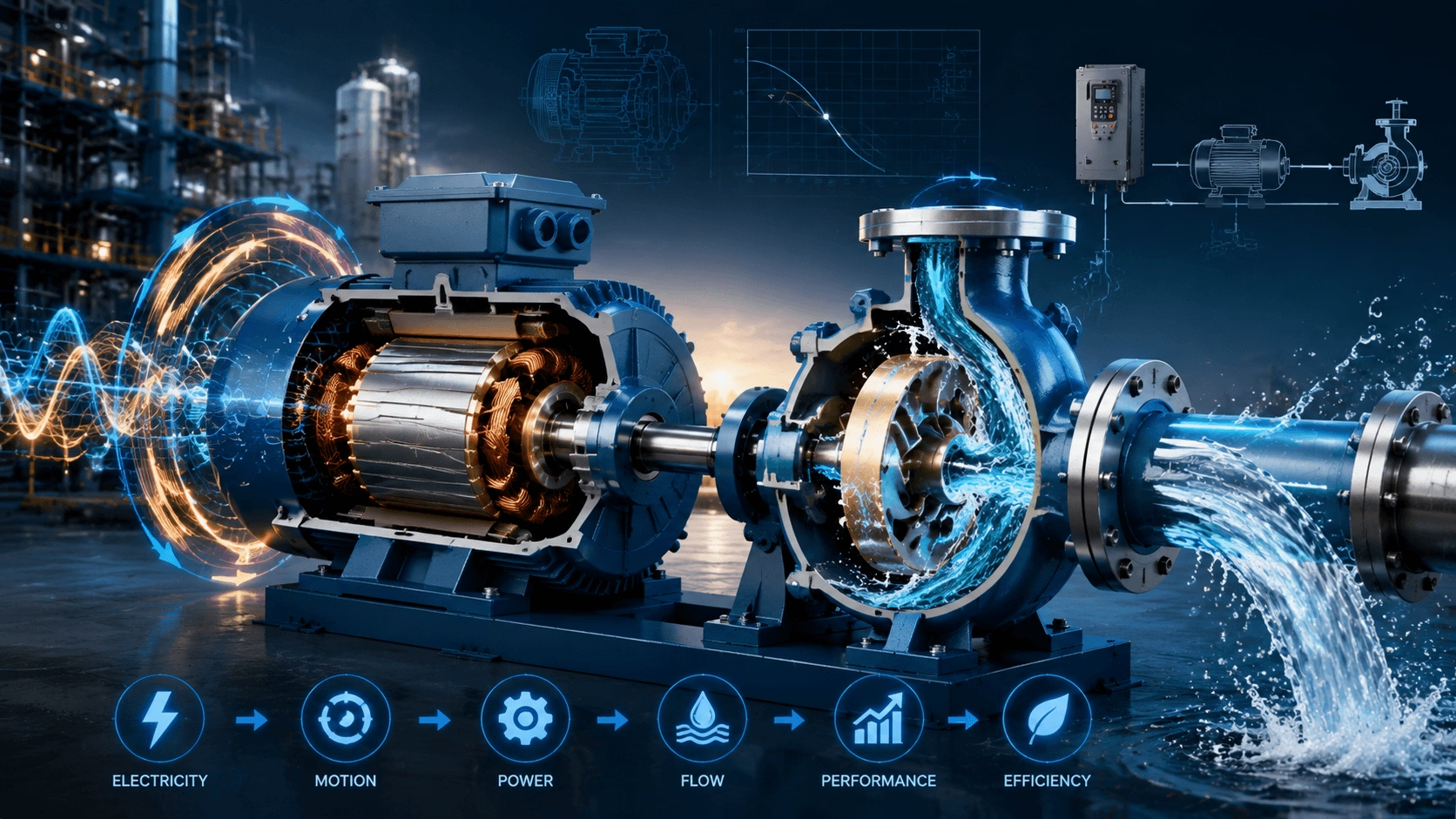
A comprehensive guide to AC motors and water pumps. Learn how electricity becomes motion and moves water. Simple explanations of complex engineering by TITECHO.
1. Introduction: The Hidden Heroes of Modern Life
Imagine waking up in the morning. You turn on the tap, and water flows. You switch on the air conditioning, and cool air circulates. Behind the scenes, in the factories that produce the goods we use, massive machines are humming quietly. What powers all of this?
The answer lies in two unsung heroes of industry: The AC Motor and The Water Pump.
While these machines may seem like simple boxes of metal to the average observer, they represent centuries of scientific discovery and engineering precision. For business owners, facility managers, or anyone curious about industrial machinery, understanding how these devices work is not just academic—it is the key to saving money, reducing energy waste, and ensuring operational reliability.
In this comprehensive guide, TITECHO will demystify the complex physics behind motors and pumps, breaking down deep engineering concepts into clear, understandable knowledge.
2. The AC Motor: Electricity into Motion
At its core, an Alternating Current (AC) motor converts electrical energy into mechanical energy. But how does invisible electricity create rotation strong enough to drive heavy machinery?
2.1 The Magic of Electromagnetism
To understand the motor, we start with magnets: opposite poles attract, like poles repel. An AC motor uses this principle but creates magnets with electricity. When current flows through a wire coil, it generates a magnetic field—this is an electromagnet.
2.2 The Rotating Magnetic Field
The genius of the AC motor lies in "Alternating Current." Unlike DC (battery) power that flows in one direction, AC changes direction 50 or 60 times per second. Inside the motor, this changing current creates a Rotating Magnetic Field—like a circle of magnets where the North pole chases the South pole nonstop.
2.3 The Rotor: The Follower
Inside the motor, the rotating part (Rotor) acts like a follower. It tries to catch up with the rotating magnetic field from the stationary outer part (Stator). Because the magnetic field spins faster than the rotor can catch it, the rotor is constantly pushed forward, creating continuous rotation.
Analogy: Imagine a dog chasing a mechanical rabbit on a track. The rabbit (magnetic field) keeps moving, so the dog (rotor) keeps running. This running motion is what powers your machinery.
2.4 Understanding Efficiency
Not all electricity put into a motor becomes motion. Some is lost as:
- Heat: From bearing friction and wire electrical resistance.
- Noise: From vibration and mechanical movement.
- Magnetic Losses: From imperfections in the steel core.
High-efficiency motors (like TITECHO's IE3/IE4 premium models) minimize these losses. We use high-grade steel, 100% pure copper windings, and precision balancing to ensure nearly every watt of electricity is converted into useful work, not wasted as heat.
3. The Water Pump: Heart of Fluid Systems
If the motor is the muscle, the water pump is the heart. Its job is to move fluid from one place to another, often against gravity or pressure.
3.1 The Centrifugal Principle
The most common industrial pump is the Centrifugal Pump. Imagine tying a string to a bucket of water and swinging it around your head—the water stays in the bucket even upside down, thanks to Centrifugal Force. The spinning motion pushes water outward.
A pump works exactly like this. Inside the casing, a wheel with curved blades (Impeller) spins with the motor:
- Water enters the center of the impeller.
- Spinning blades catch the water and fling it outward at high speed.
- The pump casing (Volute) slows the fast-moving water.
- Speed energy converts into Pressure Energy, pushing water out the discharge pipe.
3.2 Head vs. Flow: The Two Critical Metrics
When selecting a pump, two terms define its performance:
- Flow (Q): How much water moves (e.g., liters per minute) — think of the width of a river.
- Head (H): How high/far the pump can push water (e.g., meters) — think of the height of a waterfall.
Crucial Insight: You cannot maximize both at the same time. High head reduces flow; high flow reduces head. Understanding this balance is vital for efficient system design.
3.3 The Danger of Cavitation
One of the most destructive forces in pumping is Cavitation—simply put, the formation and collapse of vapor bubbles.
If pressure at the pump inlet drops too low, water boils at room temperature, creating vapor bubbles. When these bubbles move to high-pressure areas inside the pump, they collapse violently.
- Sound: It sounds like pumping marbles instead of water.
- Damage: Collapsing bubbles act like tiny jackhammers, eroding the metal impeller over time.
- Prevention: Keep the water source high enough above the pump, and use short, wide inlet pipes to maintain pressure.
4. The Perfect Marriage: Matching Motor & Pump
Motors and pumps rarely work alone—they operate as a system. The whole system's efficiency depends on how well they are matched.
4.1 The Risk of Over-sizing
Many businesses buy a motor that is too powerful for the pump.
- Consequence: The motor runs at low load, where efficiency drops sharply. It wastes electricity and may overheat due to poor cooling airflow.
- Solution: Select a motor power rating that closely matches the pump's power requirement at the operating point.
4.2 The Risk of Under-sizing
A motor that is too weak will struggle to meet demand.
- Consequence: The motor draws excessive current, tripping breakers or burning out windings.
- Solution: Always include a reasonable safety margin (Service Factor), but avoid excessive oversizing.
4.3 VFDs: The Smart Controller
In modern systems, you don't always need the pump to run at 100% speed. A Variable Frequency Drive (VFD) controls motor speed by adjusting the frequency of the electricity.
Why use a VFD? Recall the Pump Affinity Laws: Power is proportional to the cube of speed. Running at 80% speed doesn't save 20% energy—it saves nearly 50%.
By slowing the motor when full power isn't needed, VFDs deliver massive energy savings. TITECHO motors are VFD-ready, with enhanced insulation systems that protect against the electrical stress of variable speed operation.
5. Maintenance Checklist for Longevity
Even the best engineering requires care. Use this simple checklist to keep your motor and pump running reliably for years:
| Component | What to Check | Why It Matters |
|---|---|---|
| Motor Bearings | Listen for humming/grinding noises | Worn bearings cause vibration and shaft damage |
| Pump Seals | Check for water leaks around the shaft | Leaks waste water and can damage the motor |
| Temperature | Touch the casing or use a thermometer | Excessive heat indicates overload or poor ventilation |
| Vibration | Feel for unusual shaking | Misalignment causes rapid wear on parts |
| Cleanliness | Keep cooling fins free of dust | Dust traps heat, shortening motor life |
6. The Future of Industrial Motion
The industry is evolving fast. Here's what to expect from TITECHO and the global market in the coming years:
- Smart Monitoring: Motors with embedded sensors that send real-time data, warning of failures before they happen.
- Higher Efficiency Standards: Global push for IE5 ultra-premium efficiency, with even less energy waste.
- Sustainable Materials: Recyclable, low-carbon materials to reduce environmental impact.
7. Conclusion: Empower Your Operations
Understanding the principles behind AC motors and water pumps empowers you to make better decisions. It allows you to:
- Reduce Costs: By selecting high-efficiency equipment.
- Prevent Downtime: By understanding maintenance needs.
- Optimize Performance: By matching the right motor to the right pump.
At TITECHO, we are not just manufacturers; we are your partners in engineering excellence. We combine deep technical knowledge with practical manufacturing capabilities to deliver products that power your success.
Whether you need a standard replacement or a customized solution for a complex application, our team is ready to assist.
Harness the Invisible Force with TITECHO
Ready to optimize your system? Our engineering team is here to help you find the perfect motor and pump solution for your needs.
- 🌐 Visit our website: www.cntecho.com
- ✉️ Contact our engineers: [email protected]
TITECHO – TECHO ELECTRICAL & MECHANICAL (TAIZHOU) CO., LTD
Taizhou City, Zhejiang, China | www.cntecho.com