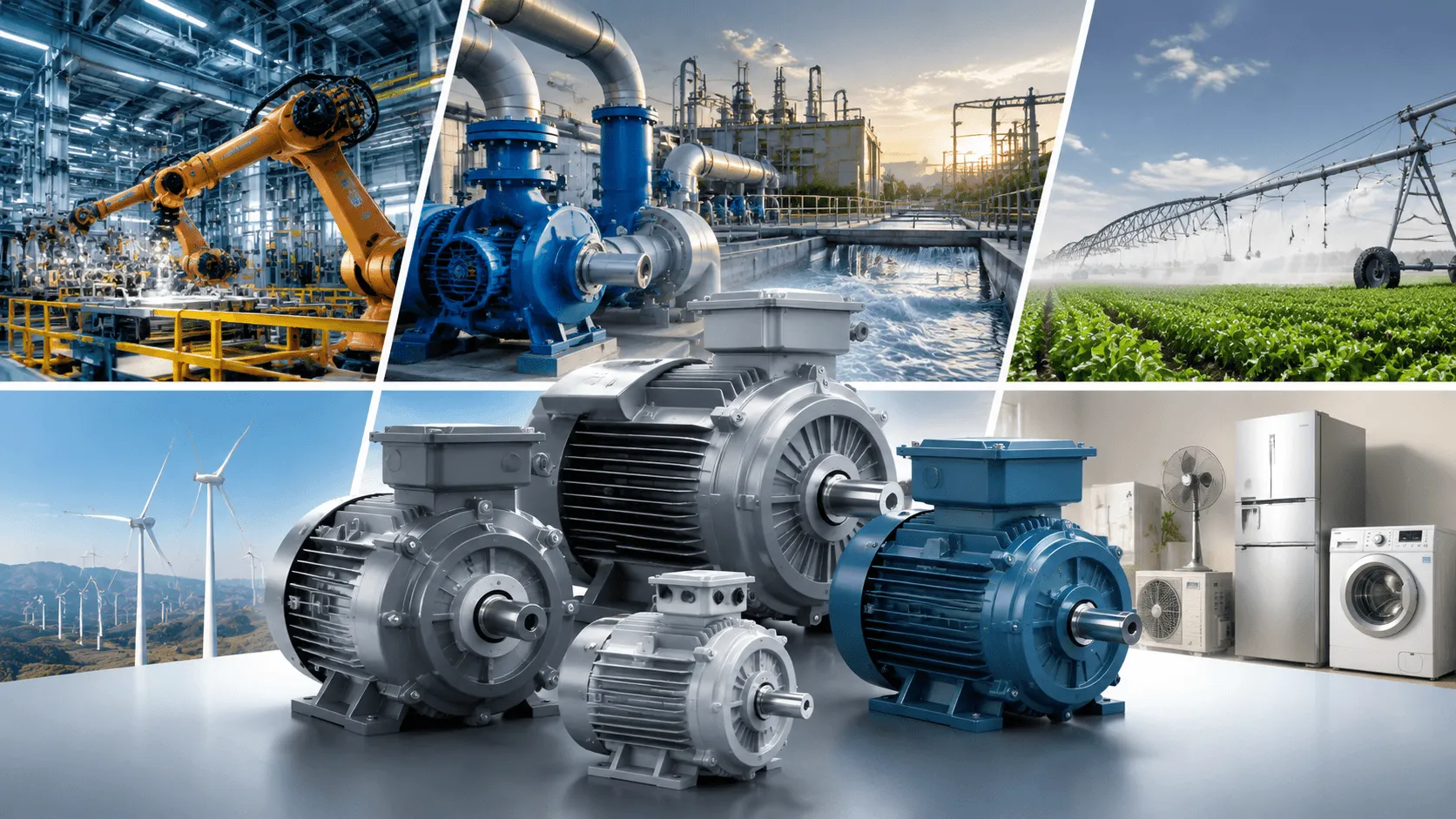
This comprehensive guide (Jan 05, 2026) explores AC motors—cornerstone equipment in industrial and daily applications—covering their fundamental definition, core working principle (rotating magnetic fields), key classifications (induction/synchronous motors with distinct characteristics), critical performance parameters (power, speed, efficiency, torque, power factor) for proper selection, diverse industry applications (industrial manufacturing, water management, agriculture, renewable energy, daily life), and industry-recognized maintenance tips to extend service life. It also outlines future trends toward higher efficiency (IE5+) and intelligence (sensor-integrated, IoT-enabled models), providing technical professionals and enthusiasts with a holistic understanding of AC motors for optimal use and cost savings.
AC Motors Overview
In the realm of industrial power transmission and automation, AC (Alternating Current) motors stand as the cornerstone of modern engineering. From powering small household appliances to driving large-scale industrial machinery, AC motors are ubiquitous due to their efficiency, reliability, and cost-effectiveness. This guide unravels the core knowledge of AC motors, helping engineers, industry enthusiasts, and technical professionals gain a deeper understanding of this critical equipment.
1. What is an AC Motor? Basic Definition and Core Functions
An AC motor is an electromagnetic device that converts alternating current electrical energy into mechanical energy. Unlike DC motors that rely on direct current, AC motors operate by utilizing the alternating nature of the input current to generate a rotating magnetic field, which in turn drives the rotor to rotate and output mechanical power. This fundamental working principle eliminates the need for commutators and brushes—components that are essential in DC motors—greatly simplifying the motor structure and enhancing operational stability.
The core functions of AC motors revolve around providing continuous, stable mechanical power for various applications. Key performance indicators include power rating, speed, efficiency, torque, and power factor. These indicators determine the motor's suitability for different scenarios, from low-power, low-speed household fans to high-power, high-speed industrial compressors.
2. Core Working Principle: The Magic of Rotating Magnetic Fields
The operation of AC motors is based on two fundamental electromagnetic principles: electromagnetic induction and the interaction between magnetic fields and currents. The most critical part of this process is the generation of a rotating magnetic field (RMF), which is the driving force behind the rotor's rotation.
2.1 How is a Rotating Magnetic Field Generated?
For three-phase AC motors, the stator is equipped with three sets of windings separated by 120 electrical degrees. When three-phase alternating currents with equal amplitude, the same frequency, and a phase difference of 120 degrees are passed through these windings, they form a magnetic field that rotates continuously at a fixed speed.
Synchronous Speed Formula: n₁ = 60f / p
Where f = frequency (Hz), p = pole pairs
Example: 50 Hz, 2-pole motor = 3000 rpm | 60 Hz, 2-pole motor = 3600 rpm
2.2 How Does the Rotor Rotate?
The rotor conductor cuts the magnetic field lines, inducing an electromotive force (EMF) and current. The energized rotor interacts with the rotating magnetic field, generating electromagnetic torque. Note that rotor speed (n) is always lower than synchronous speed (n₁)—this is called "slip".
Slip Rate Formula: s = (n₁ - n) / n₁ × 100%
Typical slip: 1% - 5% at rated load for induction motors
3. Classification of AC Motors: Key Types and Their Characteristics
AC motors can be divided into two main categories: induction motors (asynchronous) and synchronous motors. Each category has unique characteristics and application scenarios.
3.1 Induction Motors: 90%+ of All Applications
Squirrel-Cage Induction Motors
- Advantages: Simple structure, low cost, high efficiency, reliable operation, minimal maintenance.
- Applications: Water pumps, fans, compressors, conveyor belts, machine tools, household appliances.
Wound-Rotor Induction Motors
- Advantages: High starting torque, adjustable speed, suitable for heavy-load starting.
- Applications: Crushers, hoists, extruders, and other heavy-load equipment.
3.2 Synchronous Motors: Precision and High-Efficiency Options
- Advantages: High efficiency (especially high-power), constant speed, high power factor (adjustable to leading).
- Applications: Large air compressors, water pumps, generators, precision equipment, renewable energy systems.
4. Key Performance Parameters: How to Choose the Right Motor?
- Power Rating (P): Output mechanical power in kW or HP. Range: 0.18 kW to 1000 kW.
- Speed (n): Rotor speed in rpm. Induction: slightly below synchronous. Synchronous: equals n₁.
- Efficiency (η): IE1 (Standard) → IE2 (High) → IE3 (Premium) → IE4 (Super Premium).
- Torque (T): Starting, rated, and maximum torque. Critical for heavy-load applications.
- Power Factor (cosφ): Induction: lagging. Synchronous: adjustable to leading (improves grid power factor).
5. Common Applications Across Industries
- ▸ Industrial Manufacturing: Machine tools, conveyors, compressors, extruders, robots
- ▸ Water & Wastewater: Municipal supply, sewage treatment, desalination plants
- ▸ Agriculture: Irrigation pumps, grain dryers, agricultural machinery
- ▸ Renewable Energy: Wind turbines, solar thermal systems
- ▸ Daily Life: Air conditioners, refrigerators, washing machines, fans
6. Maintenance Tips: Extending Service Life
- ✓ Regular Inspection: Check electrical connections to prevent overheating
- ✓ Lubrication: Every 2000 operating hours for general industrial motors
- ✓ Temperature Monitoring: Shut down immediately if exceeding rated limits
- ✓ Cleaning: Keep surface and ventilation ducts clean for proper heat dissipation
- ✓ Vibration Detection: Monitor for bearing wear or rotor imbalance
7. Future Trends: Efficiency and Intelligence
The global AC motor industry is moving toward higher efficiency and intelligence. IE5 and above motors are gradually entering the market, offering further reductions in energy consumption compared to IE4 models.
Intelligent AC motors integrated with sensors and IoT technology can monitor operating status in real time, predict potential failures, and achieve remote control—ideal for smart factories and Industrial Internet of Things (IIoT) applications.
Customized solutions for extreme environments (high-altitude, low-temperature, corrosive) are in increasing demand, with advanced materials such as high-grade stainless steel and heat-resistant insulation further improving durability.
Conclusion
AC motors are the core power equipment that drives modern industry and daily life, with their working principles, types, and performance parameters closely related to application effects and operating costs. By understanding the basic knowledge of AC motors, technical professionals can better select, use, and maintain motors, improving operational efficiency and reducing costs.
As global demand for energy efficiency and intelligence grows, AC motors will continue to evolve, playing an even more critical role in supporting sustainable industrial development and smart manufacturing.
Key Takeaways for AC Motor Selection & Maintenance
Prioritize efficiency ratings (IE3/IE4) for long-term cost savings, match motor type to your application's load and speed needs, and follow regular maintenance protocols to extend service life. Stay updated on intelligent motor trends to keep pace with industrial automation.
✓ Browse Full Product Catalog | ✓ Request Free Efficiency Analysis | ✓ Get Custom Quote in 24 Hours