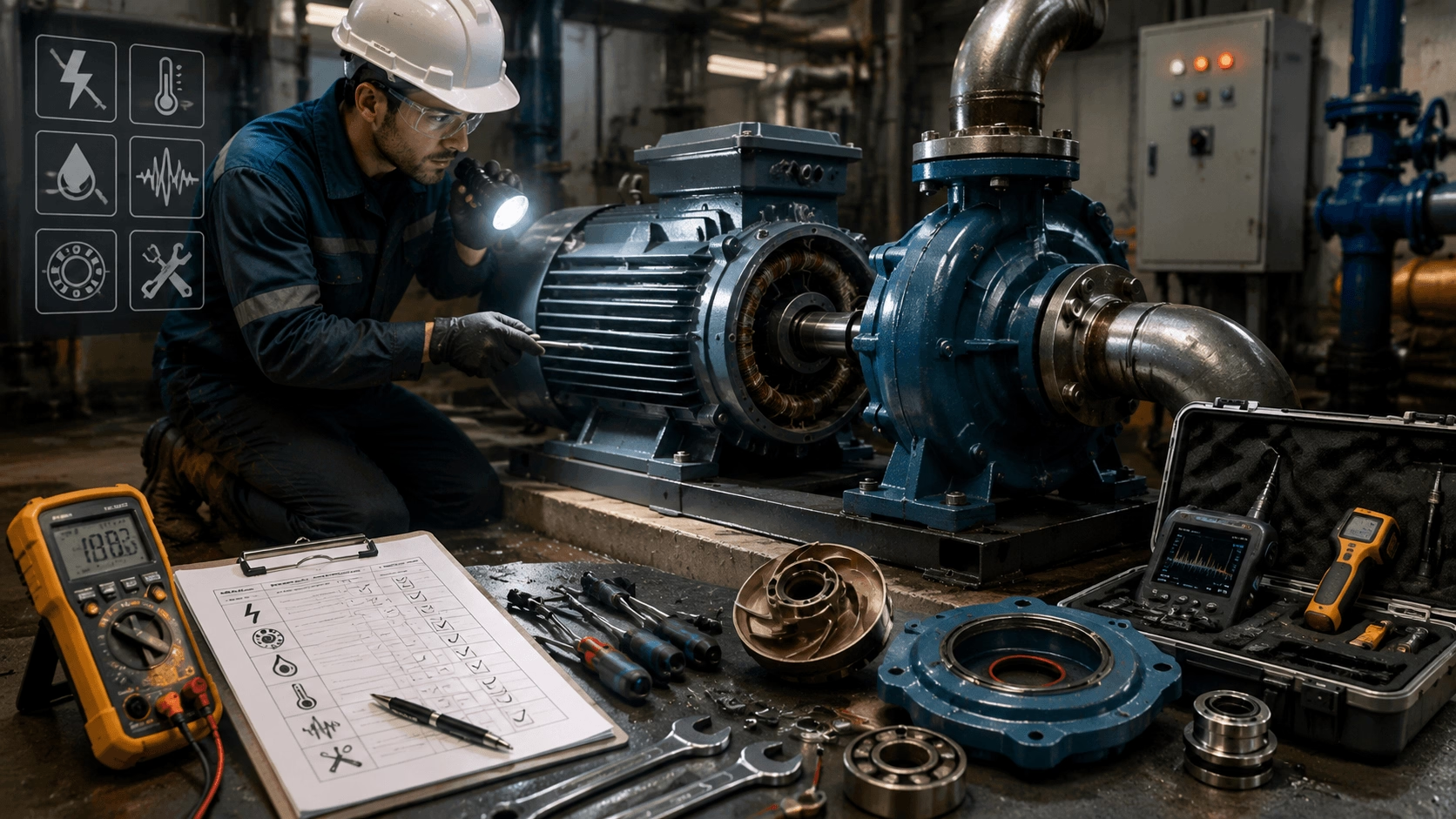
Common AC Motor and Water Pump Problems: Comprehensive Troubleshooting Guide | TITECHO
Abstract: A systematic troubleshooting guide for diagnosing and resolving common AC motor and water pump failures. This document covers overheating, vibration, leakage, starting issues, and preventive maintenance protocols. TITECHO provides expert technical support for complex industrial equipment diagnostics.
1. Introduction: The Critical Value of Systematic Troubleshooting
Even premium-quality motors and pumps experience operational degradation over time. The ability to accurately identify and resolve common issues minimizes unplanned downtime, reduces repair costs, and extends asset lifecycle.
This TITECHO troubleshooting guide addresses the most frequent failure modes in industrial motor and pump systems, providing structured diagnostic procedures and verified corrective actions.
2. AC Motor Fault Diagnosis
2.1 Motor Failure to Start
| Possible Cause | Diagnostic Check | Corrective Action |
|---|
| No Power Supply | Measure voltage at motor terminals | Restore power; inspect circuit breaker and upstream distribution |
| Blown Fuse | Visual inspection and continuity test | Replace with correct rating; investigate root cause of fuse failure |
| Faulty Starter | Test contactor contacts and coil operation | Repair or replace starter assembly |
| Open Winding | Measure winding resistance (phase-to-phase and phase-to-ground) | Contact manufacturer or certified rewind facility |
| Locked Rotor | Attempt manual shaft rotation (power disconnected) | Remove mechanical obstruction; inspect driven equipment |
2.2 Motor Overheating
| Possible Cause | Diagnostic Check | Corrective Action |
|---|
| Overload | Compare running current to nameplate FLA | Reduce load or upgrade motor rating |
| Poor Ventilation | Inspect cooling fins and fan condition | Clean accumulated debris; verify fan rotation |
| High Ambient Temperature | Measure ambient temperature at motor location | Improve ventilation, add forced cooling, or relocate equipment |
| Voltage Deviation | Measure supply voltage under load | Correct voltage to within ±10% of nameplate rating |
| Worn Bearings | Monitor bearing temperature and acoustic signature | Replace bearings; verify lubrication specification |
Temperature Rise Guidelines (Above Ambient):
- Normal Operating Range: 60–80 °C
- Warning Threshold: 90 °C — Investigate immediately
- Critical Threshold: ≥100 °C — Immediate shutdown required to prevent insulation failure
2.3 Excessive Vibration
| Possible Cause | Diagnostic Check | Corrective Action |
|---|
| Unbalanced Rotor | Vibration spectrum analysis | Perform dynamic balancing |
| Misalignment | Laser or dial indicator alignment check | Realign motor and driven equipment |
| Loose Mounting | Torque verification of foundation bolts | Tighten to specification; inspect base integrity |
| Worn Bearings | Bearing clearance measurement and vibration analysis | Replace bearings; verify fit and lubrication |
| Bent Shaft | Shaft runout measurement | Replace or machine-straighten shaft |
2.4 Abnormal Noise Identification
| Noise Characteristic | Likely Cause | Recommended Action |
|---|
| Humming | Electrical imbalance, single-phasing | Verify three-phase voltage balance; check connections |
| Grinding | Bearing surface damage | Replace bearings immediately |
| Clicking | Loose internal components or foreign object ingress | Inspect and tighten; clear debris |
| High-Frequency Whining | VFD carrier frequency resonance | Adjust VFD switching frequency; verify cable shielding |
3. Water Pump Fault Diagnosis
3.1 Pump Failure to Prime
| Possible Cause | Diagnostic Check | Corrective Action |
|---|
| Suction Line Air Leak | Pressure test or soap solution on all joints | Seal leaks; tighten fittings; replace gaskets |
| Insufficient Water Source | Verify source level relative to pump centerline | Raise source level or lower pump elevation |
| Clogged Strainer | Inspect inlet filter/screen | Clean or replace strainer element |
| Worn Impeller | Measure impeller-to-casing clearance | Replace impeller if beyond tolerance |
| Incorrect Rotation | Verify motor rotation direction against arrow | Reverse any two power leads (three-phase only) |
3.2 Low Flow or Discharge Pressure
| Possible Cause | Diagnostic Check | Corrective Action |
|---|
| Clogged Impeller | Visual inspection of impeller passages | Clean debris from impeller and volute |
| Worn Wear Rings | Measure radial clearance | Replace wear rings when clearance exceeds 2× original |
| Air Entrainment | Check for air pockets in suction line | Bleed air; verify suction line integrity |
| Incorrect Speed | Verify motor RPM and supply frequency | Confirm voltage/frequency match nameplate |
| Excessive System Resistance | Inspect valves, filters, and piping | Open throttled valves; clean blocked pipes |
3.3 Pump Leakage
| Leak Location | Probable Cause | Corrective Action |
|---|
| Mechanical Seal | Worn seal faces or elastomer degradation | Replace mechanical seal assembly |
| Gasket Joint | Compressed, aged, or damaged gasket | Replace gasket with correct material specification |
| Casing | Crack, corrosion, or erosion damage | Repair via welding/epoxy or replace casing |
| Shaft Area | Shaft sleeve wear or scoring | Replace shaft/sleeve and seal simultaneously |
3.4 Excessive Pump Vibration
| Possible Cause | Diagnostic Check | Corrective Action |
|---|
| Cavitation | Audible "marble-like" noise; erratic pressure | Increase NPSHa; reduce speed; trim impeller |
| Misalignment | Coupling alignment verification | Realign pump and motor to OEM tolerances |
| Unbalanced Impeller | Vibration analysis at 1× RPM | Balance or replace impeller |
| Loose Foundation | Bolt torque and grout condition check | Retighten; re-grout if necessary |
| Bearing Degradation | Temperature and vibration trending | Replace bearings; investigate contamination source |
4. Preventive Maintenance Schedule
| Frequency | Task | Objective |
|---|
| Daily | Visual inspection; leak check; abnormal sound monitoring | Early anomaly detection |
| Weekly | Vibration and noise assessment | Trend equipment health indicators |
| Monthly | Current draw and temperature measurement | Detect developing overload conditions |
| Quarterly | Bearing lubrication per OEM specification | Extend bearing service life |
| Annually | Full mechanical inspection; alignment verification; insulation testing | Comprehensive preventive overhaul |
5. When to Engage Professional Support
Certain failure modes require specialized expertise:
- Electrical winding faults requiring rewind or replacement.
- Major mechanical damage (shaft fracture, casing breach).
- Recurring failures after attempted repair.
- Warranty-covered equipment requiring authorized service.
TITECHO Technical Support: Our engineering team is available to assist with complex diagnostics and root cause analysis. Contact us at [email protected].
6. Safety Protocols
⚠️ Lockout/Tagout (LOTO): Always isolate and verify zero energy state before performing any work.
⚠️ Thermal Hazard: Motors and pumps retain heat after shutdown; allow adequate cooldown before contact.
⚠️ Electrical Safety: Use properly rated insulated tools and PPE for all electrical diagnostics.
⚠️ Manufacturer Documentation: Adhere strictly to OEM manuals for disassembly, torque values, and reassembly procedures.
7. Conclusion
Systematic troubleshooting combined with disciplined preventive maintenance significantly extends the operational life of motors and pumps while minimizing unplanned downtime. Retain this guide as a field reference for rapid fault diagnosis and resolution.
Technical Support Resources